




.jpg)
Back
Alpinia zerumbet 'Variegata'
| Family Name: | Zingiberaceae |
| Common Name: | Variegated Shell Ginger, Variegated Pink Porcelain Lily |
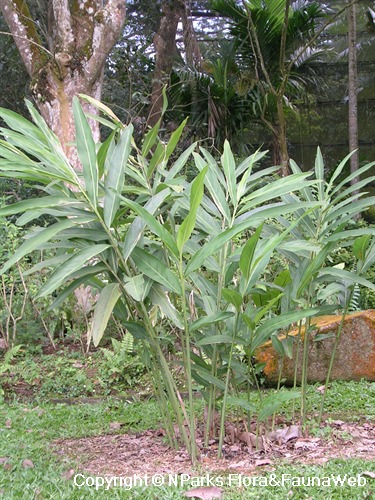
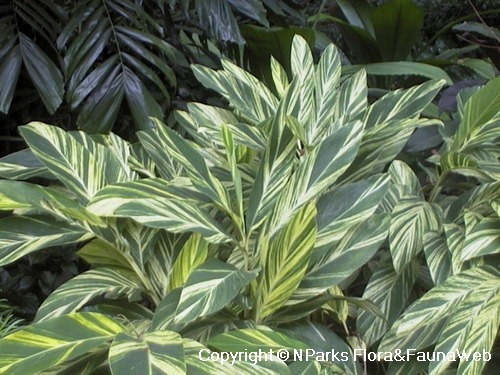
The Variegated Shell Ginger (Alpinia zerumbet 'Variegata') is a herbaceous perennial with erect pseudostems growing up to 1.5 - 2 metres tall. It is grown in landscaping as an ornamental for its strikingly variegated leaves and is suitable in sunny parks and gardens.
.jpg)
-(1).jpg)
Name
Classifications and Characteristics
| Plant Division | Angiosperms (Flowering Seed Plants) (Monocotyledon) |
|---|---|
| Plant Growth Form | Herbaceous Plant |
| Lifespan (in Singapore) | Perennial |
| Mode of Nutrition | Autotrophic |
Biogeography
| Preferred Climate Zone | Tropical |
|---|---|
| Local Conservation Status | Non-native (Horticultural / Cultivated Only) |
Description and Ethnobotany
| Growth Form | It is a rhizomatous, herbaceous perennial that grows in upright clumps up to 1.5 - 2 m tall. |
|---|---|
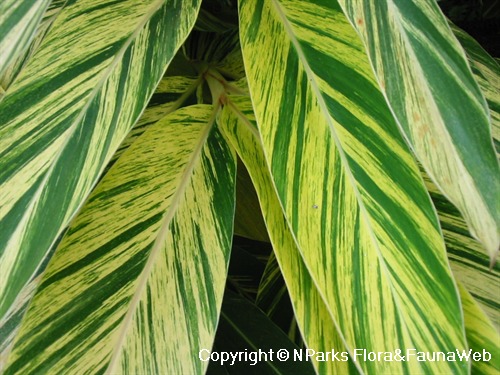
| Foliage | The leaves are leathery and oblong to oblong-lanceolate, growing up to 30 - 70 cm long and 5 - 14 cm wide. The leaves are variegated with irregular strips and speckles of whitish-yellow or cream. The margin is usually entire and brownish. The leaves are arranged alternately in two ranks, i.e. distichously. |
| Stems | The erect aboveground 'stems' are pseudostems, a shoot formed from a series of leaf sheaths tightly wrapped around one another, and can reach 2 - 3 m tall. The true stems are underground ginger-like rhizomes (thick, horizontal modified stems). |
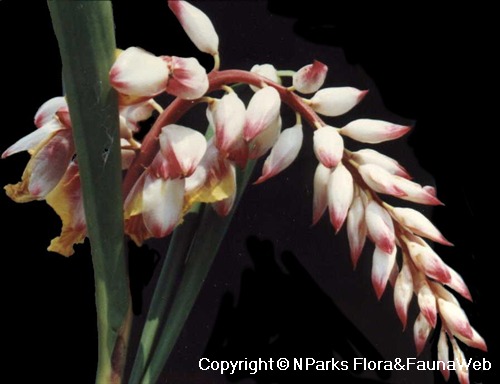
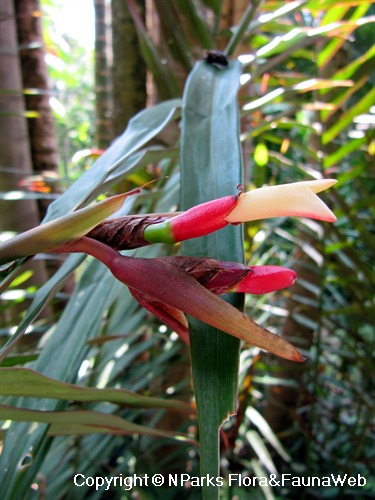
| Flowers | The inflorescence is a pendulous raceme growing at the terminal end of the leafy shoots. Individual flowers are fragrant, bilaterally symmetrical, and tubular, composed of a white calyx, a shorter corolla tube with milky white, pink-tipped lobes, and a distinct yellow lip with an orange-red center. |
| Fruit | The fruit is a round capsule (a type of dry, dehiscent fruit), usually light orange to orange-yellow. |
| Cultivation | It grows well in moist, well-drained, fertile soil, and bright, direct or indirect sunlight or under dappled shade. It can be propagated by division via rhizomes. |
| Etymology | The genus Alpinia is named in honour of Prosper Alpino (1553 - 1617), an Italian botanist who introduced coffee and bananas to Europe. The specific epithet zerumbet refers to an Indian vernacular name of Arabic origins for likely Zingiber zerumbet. |
Landscaping Features
| Desirable Plant Features | Ornamental Foliage, Ornamental Flowers, Ornamental Form |
|---|---|
| Landscape Uses | General, Parks & Gardens |
Plant Care and Propagation
| Light Preference | Semi-Shade |
|---|---|
| Water Preference | Lots of Water |
| Plant Growth Rate | Moderate |
| Rootzone Tolerance | Moist Soils, Well-Drained Soils, Fertile Loamy Soils |
| Pest(s) | Chewing Insects |
| Propagation Method | Division, Storage Organ (Rhizome) |
Foliar
| Foliage Retention | Evergreen |
|---|---|
| Mature Foliage Colour(s) | Green, Yellow / Golden |
| Mature Foliage Texture(s) | Leathery, Smooth |
| Foliar Type | Simple / Unifoliate |
| Foliar Arrangement Along Stem | Alternate |
| Foliar Attachment to Stem | Petiolate |
| Foliar Shape(s) | Non-Palm Foliage (Oblong, Elliptical) |
| Foliar Venation | Pinnate / Net |
| Foliar Margin | Entire |
| Foliar Apex - Tip | Acuminate |
| Foliar Base | Attenuate |
| Leaf Area Index (LAI) for Green Plot Ratio | 3.5 (Shrub & Groundcover - Monocot) |
Non - Foliar and Storage
| Stem Type & Modification | Pseudostem, Herbaceous |
|---|---|
| Root Type | Underground (Fibrous Root) |
| Specialised Storage Organ(s) | Underground (Rhizome) |
Floral (Angiosperm)
| Flower Colour(s) | White, Yellow / Golden |
|---|---|
| Flower Grouping | Cluster / Inflorescence |
Fruit, Seed and Spore
| Mature Fruit Colour(s) | Orange |
|---|---|
| Fruit Classification | Simple Fruit |
| Fruit Type | Dehiscent Dry Fruit , Capsule |
Image Repository
Others
| Master ID | 355 |
|---|---|
| Species ID | 1651 |
| Flora Disclaimer | The information in this website has been compiled from reliable sources, such as reference works on medicinal plants. It is not a substitute for medical advice or treatment and NParks does not purport to provide any medical advice. Readers should always consult his/her physician before using or consuming a plant for medicinal purposes. |
.jpg)