






Back
Cananga odorata var. fruticosa
| Family Name: | Annonaceae |
| Common Name: | Dwarf Ylang-Ylang Tree |
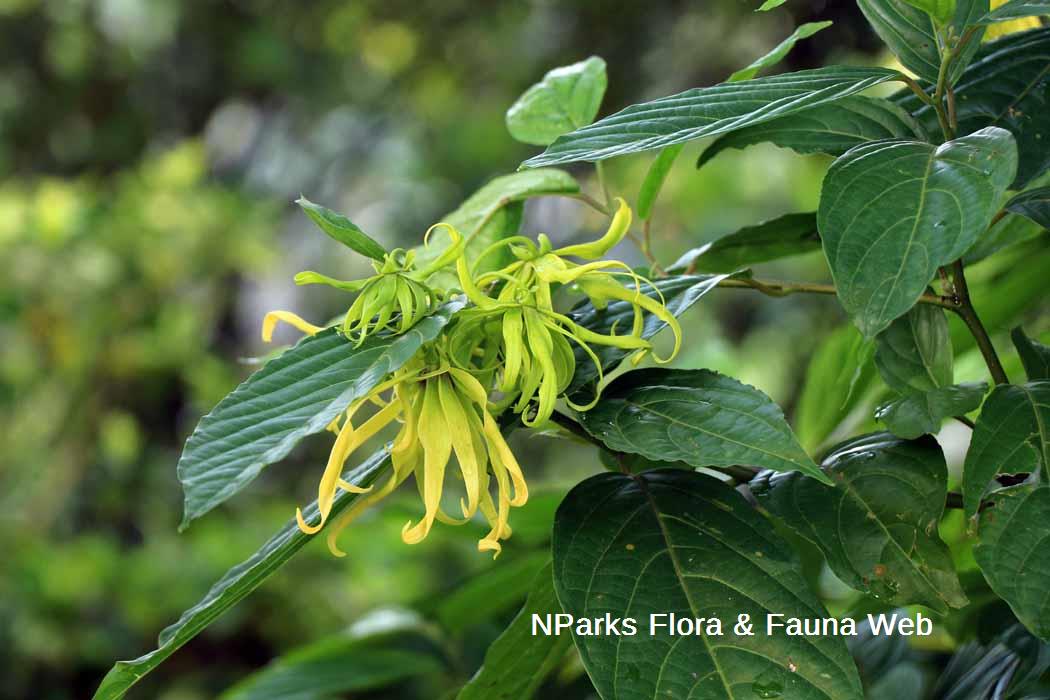
Dwarf Ylang-Ylang Tree (Cananga odorata var. fruticosa) is a compact, ornamental shrub prized for its highly fragrant flowers. Unlike its tree-sized counterpart, this variety maintains a shrub form of up to 2 m tall, making it suitable for smaller gardens or container growing. It produces distinctive, yellow, star-shaped flowers that release a rich, sweet, and exotic scent that are stronger in the evenings. For optimal growth, Dwarf Ylang-Ylang requires full sun to partial shade, and well-drained, fertile soil with regular watering.



Name
Classifications and Characteristics
| Plant Division | Angiosperms (Flowering Seed Plants) (Dicotyledon) |
|---|---|
| Plant Growth Form | Shrub |
| Lifespan (in Singapore) | Perennial |
| Mode of Nutrition | Autotrophic |
| Plant Shape | Shrubby |
| Maximum Height | 1 m to 2 m |
Biogeography
| Native Distribution | Vietnam and Thailand |
|---|---|
| Native Habitat | Terrestrial |
| Preferred Climate Zone | Tropical |
| Local Conservation Status | Non-native (Horticultural / Cultivated Only) |
Description and Ethnobotany
| Growth Form | Small-sized shrub, compact, able to grow to about 1 - 2 m tall. |
|---|---|
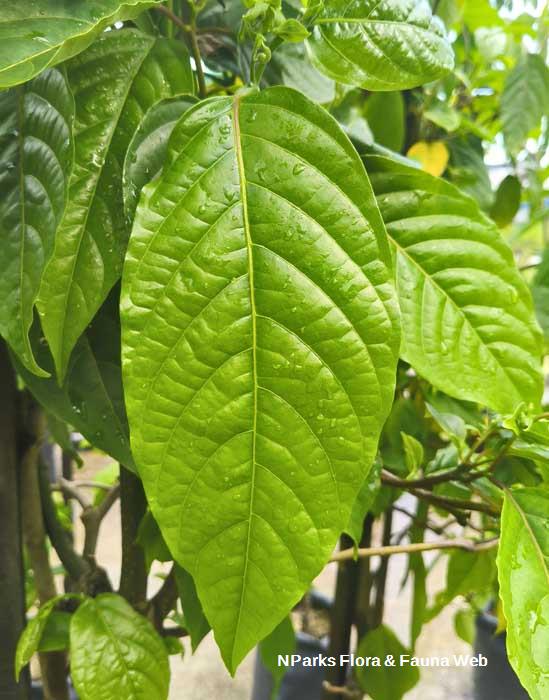
| Foliage | Leaves are distichous (leaves are arranged in two opposite rows, with one on each side of the stem), papery. The leaves have cuneate, rounded or cordate base (sometimes asymmetrical), acuminate tip and wavy leaf edges. |
| Flowers | Highly fragrant yellow or greenish-yellow flowers with curly petals. The sweet scent is more intense during the night and early morning, becoming stronger when flowers turn from greenish-yellow to yellow. The flowers can be found at the branch tips or along the branches. |
| Fruit | Fruiting is not observed in Singapore. |
| Associated Flora | It is a dwarf form of Cananga odorata. |
| Cultivation | It grows well in humid lowland areas, under bright light on fertile loamy soil. |
| Etymology | Genus Cananga is derived from a Tagalog name "alang ilang" which refers to the tree of Cananga odorata and also refers to the perfume produced from its fragrant flowers. Species odorata means fragrant or sweet-scented, bearing perfume, which refers to the flowers. |
Landscaping Features
| Landscaping | The shrub variety of Cananga odorata is widely grown as an ornamental plant, for its highly fragrant flowers with curly petals. |
|---|---|
| Desirable Plant Features | Ornamental Flowers, Fragrant |
| Landscape Uses | Parks & Gardens, Small Gardens |
| Thematic Landscaping | Fragrant / Aromatherapy Garden |
Plant Care and Propagation
| Light Preference | Full Sun |
|---|---|
| Water Preference | Moderate Water |
| Plant Growth Rate | Moderate |
| Rootzone Tolerance | Moist Soils, Well-Drained Soils |
| Propagation Method | Stem Cutting |
Foliar
| Foliage Retention | Evergreen |
|---|---|
| Mature Foliage Colour(s) | Green |
| Mature Foliage Texture(s) | Papery |
| Prominent Young Flush Colour(s) | Green |
| Young Flush Texture(s) | Papery |
| Foliar Type | Simple / Unifoliate |
| Foliar Arrangement Along Stem | Alternate |
| Foliar Attachment to Stem | Petiolate |
| Foliar Shape(s) | Non-Palm Foliage (Ovate, Oblong, Lanceolate) |
| Foliar Venation | Pinnate / Net |
| Foliar Margin | Entire - Wavy / Undulate |
| Foliar Apex - Tip | Acuminate |
| Foliar Base | Cuneate, Rounded / Obtuse, Cordate, Oblique / Asymmetrical |
| Leaf Area Index (LAI) for Green Plot Ratio | 4.5 (Shrub & Groundcover - Dicot) |
Floral (Angiosperm)
| Flower & Plant Sexuality | Bisexual Flowers |
| Flower Colour(s) | Yellow / Golden, Green - Light Green |
|---|---|
| Flower Texture(s) | Smooth |
| Flower Grouping | Cluster / Inflorescence |
| Flower Location | Terminal, Axillary |
| Flower Symmetry | Asymmetrical |
| Flowering Opening Time | Night (dusk to dawn) |
| Flowering Habit | Polycarpic |
Image Repository
Others
| Master ID | 479 |
|---|---|
| Species ID | 1775 |
| Flora Disclaimer | The information in this website has been compiled from reliable sources, such as reference works on medicinal plants. It is not a substitute for medical advice or treatment and NParks does not purport to provide any medical advice. Readers should always consult his/her physician before using or consuming a plant for medicinal purposes. |
