






Back
Flemingia strobilifera (L.) W.T.Aiton
| Family Name: | Fabaceae (Leguminosae) |
| Synonyms: | Moghania strobilifera |
| Common Name: | Bracteate Flemingia, Serengan |

Name
Classifications and Characteristics
| Plant Division | Angiosperms (Flowering Seed Plants) (Dicotyledon) |
|---|---|
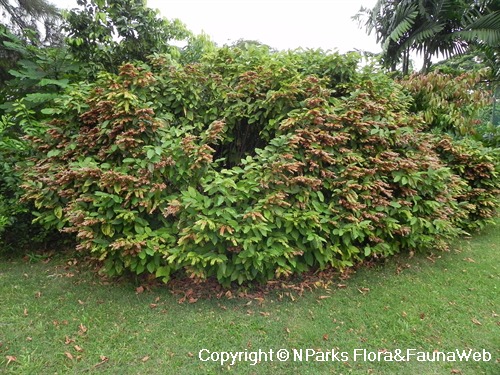
| Plant Growth Form | Shrub |
| Lifespan (in Singapore) | Perennial |
| Mode of Nutrition | Autotrophic |
| Maximum Height | 2 m |
Biogeography
| Native Distribution | Pakistan, West Himalaya, Nepal, East Himalaya, India (including Assam), Sri Lanka, Bangladesh, Andaman Islands, Nicobar Islands, South-Central China, Southeast China, Hainan, Taiwan, Nansei-shoto, Myanmar, Laos, Vietnam, Cambodia, Thailand, Peninsular Malaysia, Singapore, Borneo, Philippines, Sumatra, Java, Lesser Sunda Islands, Sulawesi, Maluku, New Guinea, Bismarck Archipelago, Mariana Islands and Caroline Islands |
|---|---|
| Native Habitat | Terrestrial |
| Preferred Climate Zone | Tropical, Sub-Tropical / Monsoonal |
| Local Conservation Status | Native to Singapore (Critically Endangered (CR)) |
Description and Ethnobotany
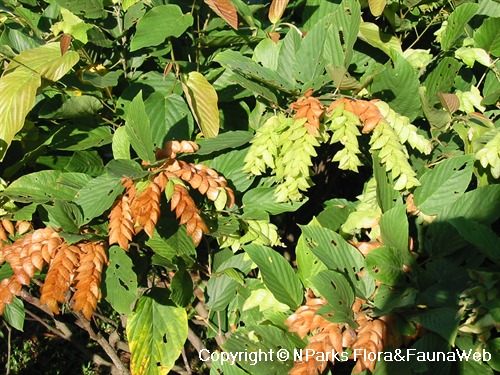
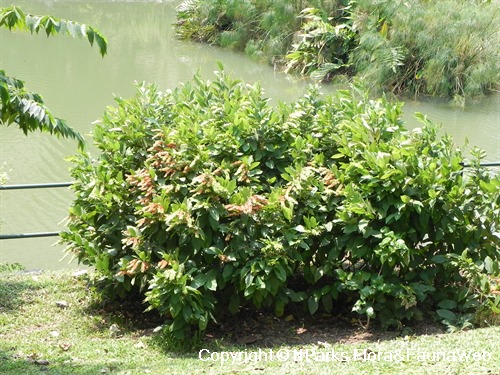
| Growth Form | It is an erect shrub growing up to 2 m tall with branching stems. |
|---|---|
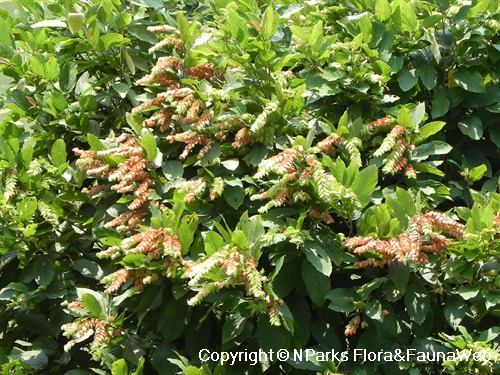
| Foliage | The green leaves are ovate to oblong with a wavy leaf margin and hairy texture. Leaf blade has acute apex (leaf tips), subcordate (nearly heart-shaped) base, with 5 to 7 pairs of lateral veins. |
| Stems | Stems are 0.2 - 4 cm in diameter, triangular when young, and cylindrical with gland dots and hairy when mature. |
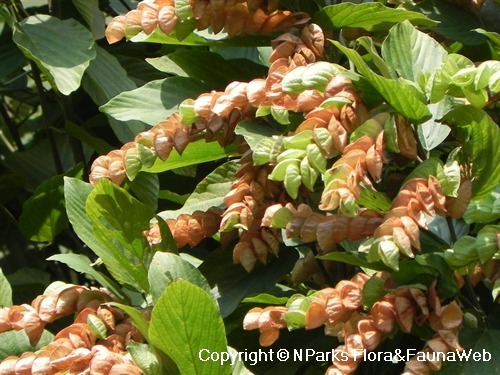
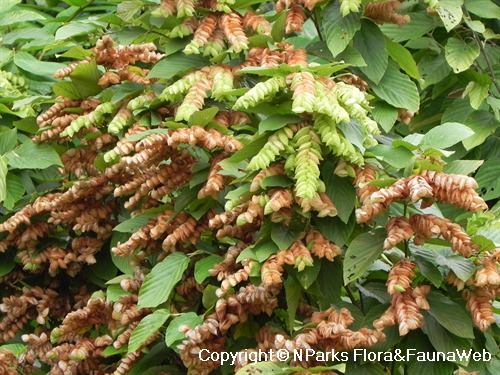
| Flowers | The creamy - white flowers are small, pea-shaped and enclosed in a pair of bean-shaped, leaf-like flower bracts. The bracts are arranged in 2 files along the raceme inflorescence stalk in a zigzag pattern. They are initially green, and eventually turn light brown and papery. Inflorescences are located at the tip and along the stems. |
| Fruit | Small, elliptical to oblong pods, releasing tiny globose (rounded, ball-like shaped) seeds by explosive dehiscence. Seeds are brown-black with red spots. |
| Habitat | It is found in open jungle or bamboo forest, from mixed evergreen to dry deciduous and dipterocarp forests, sometimes by the roadsides and wet places, and between 0 - 1,600 m altitude. |
| Etymology | The genus Flemingia is named after Dr. John Fleming, a friend and colleague of Roxburgh (Roxburgh 1820), who compiled the Catalogue of Indian medicinal plants and drugs (1810). The species strobilifera means cone-bearing |
| Ethnobotanical Uses | Medicinal: Traditional Medicinal Uses In Java, decoction made from the leaves are used as vermifuge both internally and externally for children. In Bangladesh, the leaf juice is taken for worm infection, In Malaysia, the leaves are used to cure rheumatism. In Nepal, the paste from root is used for treating scabies by the Darai tribe of Chitwan district. <2>
It is important to note that some therapeutic effects from traditional medicinal uses of plants are currently not supported or verified by scientific research. |
Landscaping Features
| Desirable Plant Features | Ornamental Foliage |
|---|---|
| Landscape Uses | General |
Plant Care and Propagation
| Light Preference | Full Sun |
|---|---|
| Water Preference | Moderate Water |
| Plant Growth Rate | Moderate |
Foliar
| Foliage Retention | Evergreen |
|---|---|
| Mature Foliage Colour(s) | Green |
| Mature Foliage Texture(s) | Hairy / Hirsute |
| Prominent Young Flush Colour(s) | Green |
| Foliar Attachment to Stem | Petiolate |
| Leaf Area Index (LAI) for Green Plot Ratio | 4.5 (Shrub & Groundcover - Dicot) |
Floral (Angiosperm)
| Flower & Plant Sexuality | Bisexual Flowers |
| Flower Colour(s) | White |
|---|---|
| Flower Texture(s) | Smooth |
| Flower Grouping | Cluster / Inflorescence |
| Flower Location | Axillary, Terminal |
| Flower Symmetry | Bilateral |
| Individual Flower Shape | Papilionaceous / Pea-shaped |
| Inflorescence Type | Raceme |
Fruit, Seed and Spore
| Mature Fruit Colour(s) | Brown, Black |
|---|---|
| Fruit Classification | Simple Fruit |
| Fruit Type | Dehiscent Dry Fruit , Legume / Pod |
| Mature Seed Colour(s) | Black, Brown |
References
| References | <1> Gavade, S.K., van der Maesen, L.J.G. & Lekhak, M.M. (2020). Taxonomic revision of the genus Flemingia (Leguminosae: Papilionoideae) in India. Webbia. Journal of Plant Taxonomy and Geography 75(2):141-218. <2> Sajeev, S., Jeganathan, A., Byju, A., George, A.R., Thangasamu, K. & Geetha, N. (2024). Flemingia strobilifera (L.) W.T. Aiton: A holistic review on phytochemistry and pharmacological aspects. Pharmacognosy Reviews, Vol. 18, Issue 36. |
|---|
Image Repository
Others
| Master ID | 724 |
|---|---|
| Species ID | 2019 |
| Flora Disclaimer | The information in this website has been compiled from reliable sources, such as reference works on medicinal plants. It is not a substitute for medical advice or treatment and NParks does not purport to provide any medical advice. Readers should always consult his/her physician before using or consuming a plant for medicinal purposes. |