








Back
Hornstedtia leonurus (J.Koenig) Retz.
| Family Name: | Zingiberaceae |
| Synonyms: | Amomum leonurus J.Koenig, Amomum ridleyi Baker, Stenochasma convoluta Griff. |
| Common Name: | Lesser Spindle Ginger |
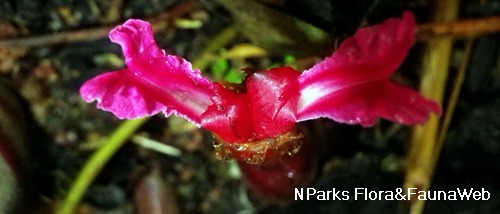
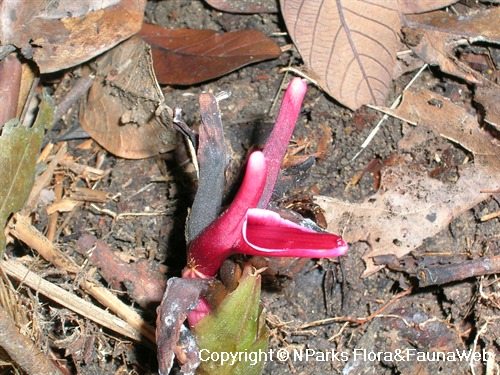
Hornstedtia leonurus, commonly known as the Lesser Spindle Ginger, is a robust, rhizomatous, herbaceous perennial reaching 3–4 metres in height. It can be distinguished from the other native Hornstedtia species by its half-buried green inflorescences and conspicuous red tubular flowers with white-tipped corolla lobes and white-edged lip.


Name
Classifications and Characteristics
| Plant Division | Angiosperms (Flowering Seed Plants) (Monocotyledon) |
|---|---|
| Plant Growth Form | Herbaceous Plant |
| Lifespan (in Singapore) | Perennial |
| Mode of Nutrition | Autotrophic |
| Maximum Height | 3 m to 4 m |
Biogeography
| Native Distribution | Thailand, Peninsular Malaysia, Singapore & Borneo |
|---|---|
| Native Habitat | Terrestrial (Secondary Rainforest, Riverine) |
| Preferred Climate Zone | Tropical |
| Local Conservation Status | Native to Singapore (Vulnerable (VU)) |
Description and Ethnobotany
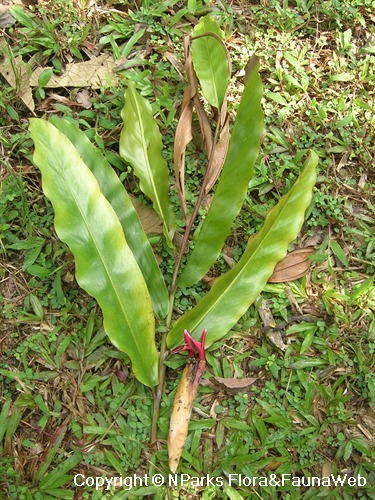
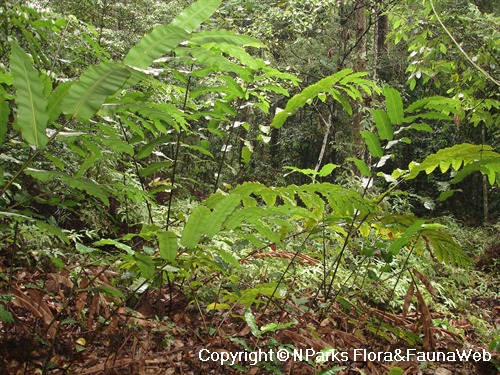
| Growth Form | It is a rhizomatous, herbaceous perennial with upright shoots reaching up to 3–4 m tall. |
|---|---|
| Foliage | The leaves are smooth and oblong, up to 62 cm long × 15.5 cm wide, with a yellow patch along the midvein, dark glossy green on the upper surface and a broadly crisped margin. The leaf sheaths are smooth, shallowly ribbed and dark brown, and the ligule (projection at the top of the leaf sheath) is minute (up to 7 mm long) with hairs longer than the ligule. The petioles are short (about 1.5 cm long). The leaves are arranged alternately in two ranks along the shoot, i.e. distichously. |
| Stems | The erect aboveground 'stems' are pseudostems (shoots formed from a series of leaf sheaths tightly wrapped around one another) and can reach 3–4 m in height. The true stems are ginger-like rhizomes (thick, horizontal modified stems) found deep underground. |
| Flowers | The inflorescence is a short spike, consisting of small, overlapping bracts subtending conspicuously red flowers. The bracts are narrow, brownish-green with golden, tightly appressed hairs. The peduncle (the central stalk of the inflorescence) is often hidden underground, reaching about 2 cm in height. The red tubular flowers are conspicuous and much larger than the bracts with a whitish tip to the corolla lobes and a labellum, which is made of fused staminodes (sterile stamens), with a white margin. |
| Habitat | It can be found in partial shade near streams in evergreen forests at 0–200 m above sea level. |
| Associated Fauna | This species is similar in appearance to the two other native species, Hornstedtia scyphifera var. scyphifera & H. conica, but can be differentiated by their inflorescence and flower shape. |
| Taxonomy | There are three species of Hornstedtia native to Singapore. |
| Etymology | The genus Hornstedtia is named in honour of Claës Fredric Hornstedt (1758-1809), a Swedish surgeon and naturalist. The specific epithet leonurus means "lion's tail", possibly referring to the shape of the inflorescence. |
| Ethnobotanical Uses | Medicinal: It is reported that the extracts from the rhizome have antifungal and antioxidant activities. |
Landscaping Features
| Desirable Plant Features | Ornamental Flowers, Ornamental Form |
|---|---|
| Landscape Uses | Parks & Gardens |
| Thematic Landscaping | Naturalistic Garden |
Fauna, Pollination and Dispersal
| Pollination Method(s) | Biotic (Fauna) (Vertebrates (Bird)) |
|---|
Plant Care and Propagation
| Light Preference | Semi-Shade |
|---|---|
| Water Preference | Lots of Water, Moderate Water, Occasional Misting |
| Plant Growth Rate | Moderate |
| Rootzone Tolerance | Moist Soils, Well-Drained Soils |
| Propagation Method | Division, Storage Organ (Rhizome) |
Foliar
| Foliage Retention | Evergreen |
|---|---|
| Mature Foliage Colour(s) | Green |
| Mature Foliage Texture(s) | Glossy / Shiny, Smooth |
| Foliar Modification | Flower/Fruit Bract |
| Foliar Type | Simple / Unifoliate |
| Foliar Arrangement Along Stem | Alternate |
| Foliar Attachment to Stem | Petiolate |
| Foliar Shape(s) | Non-Palm Foliage (Oblong) |
| Foliar Venation | Parallel |
| Foliar Margin | Entire - Wavy / Undulate |
| Foliar Base | Oblique / Asymmetrical, Cordate, Truncate / Square |
| Leaf Area Index (LAI) for Green Plot Ratio | 3.5 (Shrub & Groundcover - Monocot) |
Non - Foliar and Storage
| Stem Type & Modification | Pseudostem |
|---|---|
| Root Type | Underground (Fibrous Root) |
| Specialised Storage Organ(s) | Underground (Rhizome) |
Floral (Angiosperm)
| Flower & Plant Sexuality | Bisexual Flowers |
| Flower Colour(s) | Red |
|---|---|
| Flower Grouping | Cluster / Inflorescence |
| Flower Location | Axillary |
| Flower Symmetry | Bilateral |
| Individual Flower Shape | Tubular |
| Inflorescence Type | Spike |
| Ovary Position | Inferior / Epipgynous |
| Flowering Habit | Polycarpic |
References
| References | 2. Hornstedtia leonurus (J.Koenig) Retz. https://botany.dnp.go.th/eflora/floraspecies.html?tdcode=08871 (Accessed on 24 February 2026) Leong-Škornicková, J. (2010). Spindle gingers – jewels of Singapores forests. Gardenwise. Vol 34. 24-25. |
|---|
Image Repository
Others
| Master ID | 815 |
|---|---|
| Species ID | 2110 |
| Flora Disclaimer | The information in this website has been compiled from reliable sources, such as reference works on medicinal plants. It is not a substitute for medical advice or treatment and NParks does not purport to provide any medical advice. Readers should always consult his/her physician before using or consuming a plant for medicinal purposes. |