








Back
Hornstedtia scyphifera var. scyphifera
| Family Name: | Zingiberaceae |
| Synonyms: | Hornstedtia scyphus Retz., Stenochasma urceolare Griff. |
| Common Name: | Great Spindle Ginger, Walking Ginger, 杯状大豆蔻 |
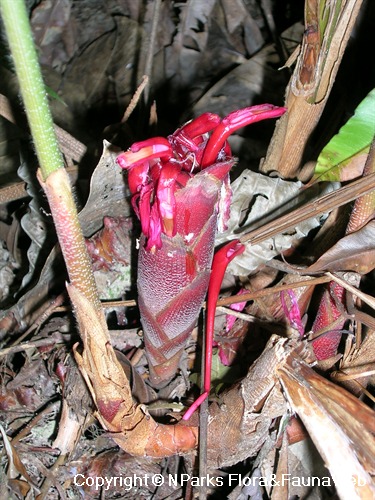
Hornstedtia scyphifera var. scyphifera, commonly known as the Greater Spindle Ginger, is a robust, rhizomatous, herbaceous perennial reaching 2–5 metres in height. The most common among the native Hornstedtia species, it can be distinguished by its cup-shaped inflorescences, which comprise tightly overlapping dark-maroon bracts with intricate white markings, and slender, red tubular flowers.



Name
Classifications and Characteristics
| Plant Division | Angiosperms (Flowering Seed Plants) (Monocotyledon) |
|---|---|
| Plant Growth Form | Herbaceous Plant |
| Lifespan (in Singapore) | Perennial |
| Mode of Nutrition | Autotrophic |
| Plant Shape | Irregular, Leggy |
| Maximum Height | 2 m to 5 m |
Biogeography
| Native Distribution | Thailand, Peninsular Malaysia, Singapore, Borneo, Sumatra |
|---|---|
| Native Habitat | Terrestrial (Primary Rainforest, Secondary Rainforest) |
| Preferred Climate Zone | Tropical |
| Local Conservation Status | Native to Singapore (Vulnerable (VU)) |
Description and Ethnobotany
| Growth Form | It is a rhizomatous, herbaceous perennial with upright shoots reaching up to 2–5 m tall. |
|---|---|
| Roots | Stilt roots are often present at the base of leafy shoots. |
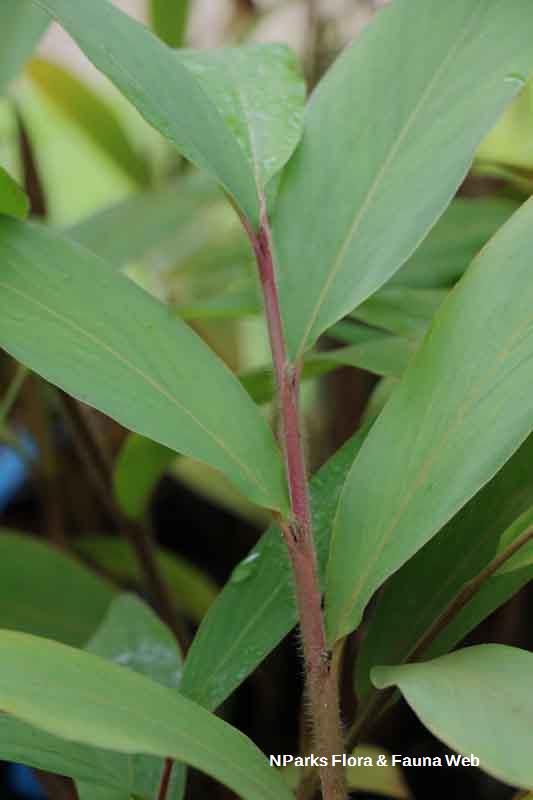
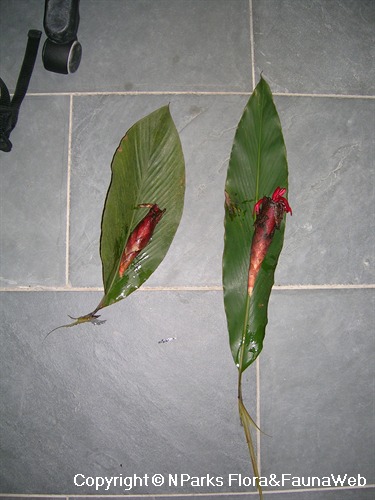
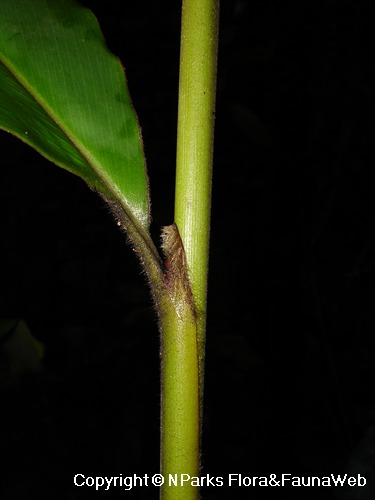
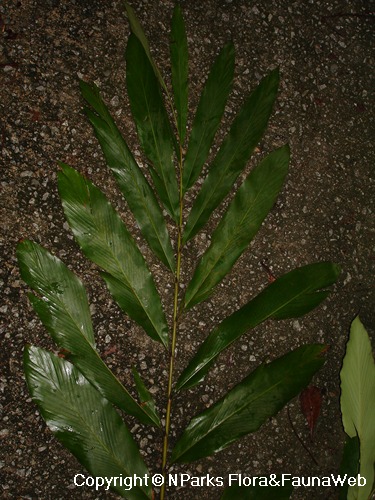
| Foliage | The leaves are green, smooth to densely hairy, and narrowly lance-shaped, up to 85 cm long × 18 cm wide. The leaf sheaths are smooth or densely hairy, especially in the upper portions, and the ligule (projection at the top of the leaf sheath) is hairy, up to 1–2 cm long. The petioles are short (1–2 cm long). The leaves are arranged alternately in two ranks along the shoot, i.e. distichously. |
| Stems | The erect aboveground 'stems' are pseudostems (shoots formed from a series of leaf sheaths tightly wrapped around one another) and can reach 2–5 m tall. The true stems are underground ginger-like rhizomes (thick, horizontal modified stems). |
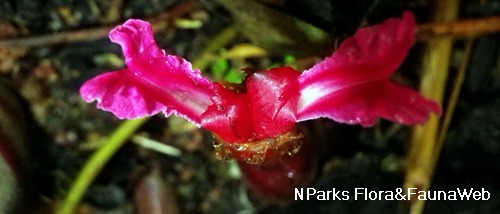
| Flowers | The inflorescence is a short spike, consisting of tightly overlapping bracts subtending small red flowers. The bracts are dark maroon-red with white horizontal net-like markings and white hairs. The peduncle (the central stalk of the inflorescence) is short, reaching 15 cm in height. Young inflorescences are spindle-shaped and mature into a cup shape with the upper bracts opening up and filling with mucilaginous liquid. The slender, red tubular flower has anthers pressed closely against the small labellum, which is made of fused staminodes (sterile stamens), resembling a duck's beak. |
| Habitat | It can be found in lowland evergreen forests. In Singapore, it can be found in the secondary rainforests of Bukit Timah and near MacRitchie reservoir. |
| Similar | This species is similar in appearance to the two other native species, Hornstedtia leonurus & H. conica, but can be differentiated by their inflorescence and flower shape. |
| Taxonomy | There are three species of Hornstedtia native to Singapore, with H. scyphifera var. scyphifera being more common and most conspicuous. |
| Cultivation | It does well in fertile, well-drained soil rich in organic matter and grows under partial shade. It can be propagated by seed, division and rhizomes. |
| Etymology | The genus Hornstedtia is named in honour of Claës Fredric Hornstedt (1758-1809), a Swedish surgeon and naturalist. The specific epithet scyphifera is derived from Greek meaning "cup-bearing", referring to the shape of the mature inflorescence. |
Landscaping Features
| Desirable Plant Features | Ornamental Flowers, Ornamental Form |
|---|---|
| Landscape Uses | Parks & Gardens, Small Gardens |
| Thematic Landscaping | Naturalistic Garden |
Fauna, Pollination and Dispersal
| Pollination Method(s) | Biotic (Fauna) |
|---|
Plant Care and Propagation
| Light Preference | Semi-Shade |
|---|---|
| Water Preference | Lots of Water, Moderate Water, Occasional Misting |
| Plant Growth Rate | Moderate |
| Rootzone Tolerance | Moist Soils, Fertile Loamy Soils |
| Propagation Method | Seed, Division, Storage Organ (Rhizome) |
Foliar
| Foliage Retention | Evergreen |
|---|---|
| Mature Foliage Colour(s) | Green |
| Mature Foliage Texture(s) | Smooth, Hairy / Hirsute |
| Foliar Modification | Flower/Fruit Bract |
| Foliar Type | Simple / Unifoliate |
| Foliar Arrangement Along Stem | Alternate |
| Foliar Attachment to Stem | Petiolate |
| Foliar Shape(s) | Non-Palm Foliage (Lanceolate) |
| Foliar Venation | Parallel |
| Foliar Margin | Entire |
| Foliar Apex - Tip | Acute, Acuminate |
| Foliar Base | Oblique / Asymmetrical, Rounded / Obtuse |
| Leaf Area Index (LAI) for Green Plot Ratio | 3.5 (Shrub & Groundcover - Monocot) |
Non - Foliar and Storage
| Root Type | Underground (Fibrous Root), Aboveground (Prop / Stilt Root) |
|---|---|
| Specialised Storage Organ(s) | Underground (Rhizome) |
Floral (Angiosperm)
| Flower & Plant Sexuality | Bisexual Flowers , Bisexual Flowers |
| Flower Colour(s) | Red |
|---|
| Flower Grouping | Cluster / Inflorescence |
| Flower Location | Axillary |
| Flower Symmetry | Bilateral |
| Individual Flower Shape | Tubular |
| Inflorescence Type | Spike |
| Ovary Position | Inferior / Epipgynous |
| Flowering Habit | Polycarpic |
References
| References | Leong-Škornicková, J. (2010). Spindle gingers – jewels of Singapores forests. Gardenwise. Vol 34. 24-25. |
|---|
Image Repository
Others
| Master ID | 816 |
|---|---|
| Species ID | 2111 |
| Flora Disclaimer | The information in this website has been compiled from reliable sources, such as reference works on medicinal plants. It is not a substitute for medical advice or treatment and NParks does not purport to provide any medical advice. Readers should always consult his/her physician before using or consuming a plant for medicinal purposes. |