




Back
Opuntia cochenillifera
| Family Name: | Cactaceae |
| Synonyms: | Cactus cochenillifer |
| Common Name: | Cochineal Nopal Cactus, Prickly Pear |

Name
Classifications and Characteristics
| Plant Division | Angiosperms (Flowering Seed Plants) |
|---|---|
| Plant Growth Form | Herbaceous Plant |
| Lifespan (in Singapore) | Perennial |
| Mode of Nutrition | Autotrophic |
Biogeography
| Native Distribution | Mexico or Central America |
|---|---|
| Native Habitat | Terrestrial (Desert / Semi-Desert) |
| Preferred Climate Zone | Desert / Arid |
| Local Conservation Status | Non-native (Horticultural / Cultivated Only) |
Description and Ethnobotany
| Growth Form | Cactus with an erect, tree-like growth form. |
|---|---|
| Foliage | Tiny leaves occur on the stem where you would expect to find thorns. |
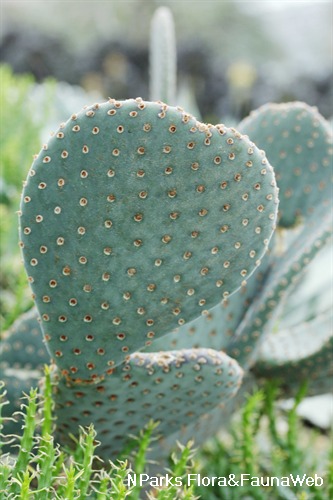
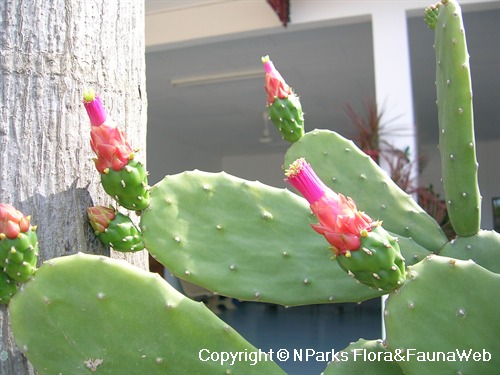
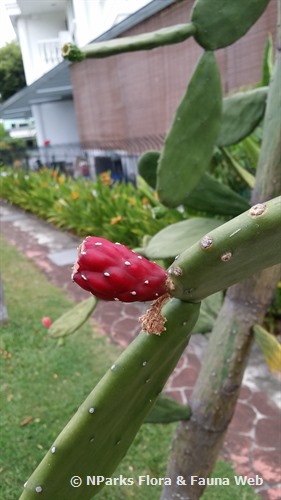
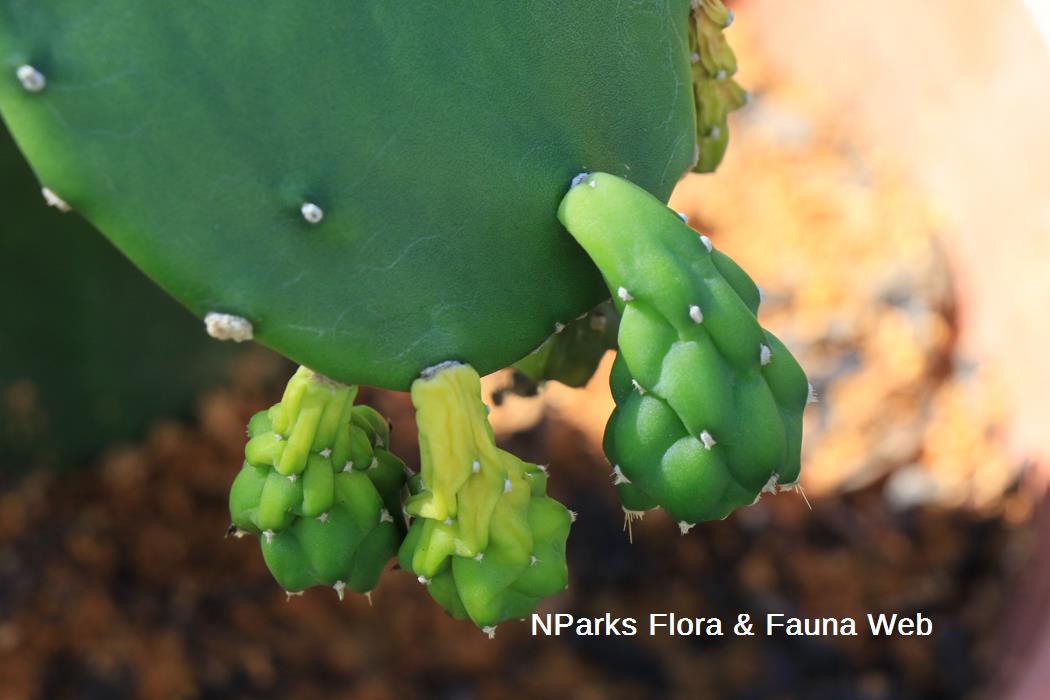
| Stems | Thornless, light green stems are composed of paddle-shaped subunits (10 cm long) which are linked together in a branched pattern. They are mostly smooth with white raised spots which are known as areoles. |
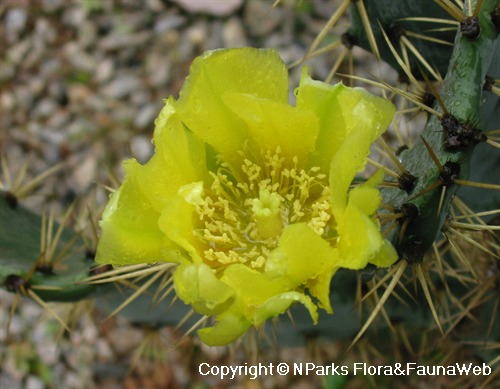
| Flowers | Pinkish red flowers are composed of thick, triangular petals and a thick bundle of stamens. Stamens have a pinkish red stalk (filament) and whitish, rounded tip (anther). The stigma protrudes about 1 cm past the anthers and has a star-shaped tip that folds upward to form a cup-like structure. |
| Cultivation | The stem pads root easily. To propagate, place 1 stem pad in well-drained soil with the cut end halfway submerged and roots will gradually form. |
| Ethnobotanical Uses | Edible Plant Parts : Edible Stems Food (Fruit or Vegetable): The pad-like stems can be eaten raw or cooked and are rich in amino acids and vitamins. Young stems have a citrus-like flavor. They can be added to salads, omelettes, soups and stir fry. |
Landscaping Features
| Desirable Plant Features | Ornamental Form |
|---|---|
| Thematic Landscaping | Rockery / Desert Garden |
Plant Care and Propagation
| Light Preference | Full Sun |
|---|---|
| Water Preference | Little Water |
| Plant Growth Rate | Fast |
| Rootzone Tolerance | Drought Tolerant |
| Maintenance Requirements | Low |
| Propagation Method | Stem Cutting (Herbaceous) |
Foliar
| Mature Foliage Colour(s) | Green |
|---|---|
| Leaf Area Index (LAI) for Green Plot Ratio | 4.5 (Shrub & Groundcover - Dicot) |
Floral (Angiosperm)
| Flower & Plant Sexuality | Bisexual Flowers |
| Flower Texture(s) | Gloss / Shiny, Waxy, Scaly, Thick / Fleshy |
|---|---|
| Flower Symmetry | Radial |
Image Repository
Others
| Master ID | 987 |
|---|---|
| Species ID | 2281 |
| Flora Disclaimer | The information in this website has been compiled from reliable sources, such as reference works on medicinal plants. It is not a substitute for medical advice or treatment and NParks does not purport to provide any medical advice. Readers should always consult his/her physician before using or consuming a plant for medicinal purposes. |