






Back
Utania racemosa (Jack ex Wall.) Sugumaran
| Family Name: | Gentianaceae |
| Synonyms: | Fagraea racemosa Jack ex Wall. |
| Common Name: | False Coffee Tree, Kopi Utan, Kahwa Utan, Mengkudu Utan, Sepuleh, Sepulis, Tembusu Ayer |
Name
Classifications and Characteristics
| Plant Division | Angiosperms (Flowering Seed Plants) |
|---|---|
| Plant Growth Form | Tree |
| Lifespan (in Singapore) | Perennial |
| Mode of Nutrition | Autotrophic |
| Maximum Height | 15 m |
Biogeography
| Native Distribution | Cambodia, southern Vietnam, Thailand, Peninsular Malaysia, Singapore and Sumatra. |
|---|---|
| Native Habitat | Terrestrial (Monsoon Forest, Secondary Rainforest) |
| Preferred Climate Zone | Tropical |
| Local Conservation Status | Native to Singapore (Critically Endangered (CR)) |
Description and Ethnobotany
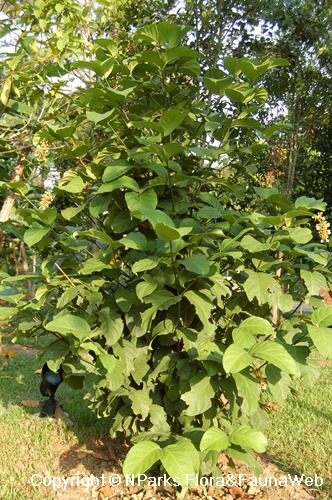
| Growth Form | It is a tree, which usually grow to 3 - 4 m tall. It can reach 15 m tall in the wild. |
|---|---|
| Trunk | Girth size can reach up to 18 cm wide, bark is pale to dark grey, surface is deeply fissured. |
| Foliage | Large dark green broadly ovate to obovate-oblong leaves, opposite arrangement, size varies and measuring about 5 - 50 cm long and 1 - 23 cm wide, petiole about 0.2 - 5 cm long, stipules joined into a sheath around the stem. |
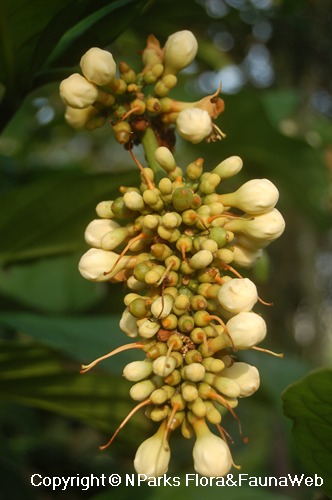
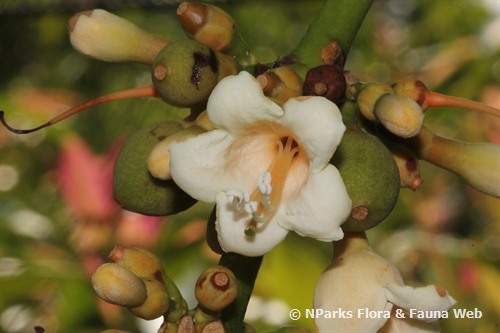
| Flowers | White flowers borne on a drooping terminal inflorescence about 8 - 9 cm long. |
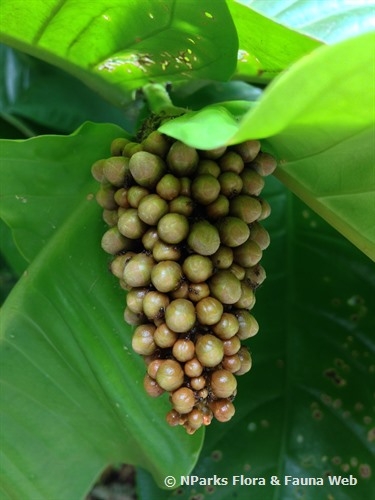
| Fruit | Fruit is round or ellipsoid-ovoid in shape and turns red when ripen. |
| Habitat | It can be found in seasonal forest and tropical evergreen lowland rain forest, including secondary forest. |
| Etymology | Genus Fagraea is named after Dr Jonas Theodorus Fagraeus (1729 - 1797), who was a Swedish physician, naturalist and botanist. Species racemosa means having racemose inflorescence. |
| Ethnobotanical Uses | Medicinal: The flowers and bark can be used as an antidote for snakebite. The leaves are heated and applied as a poultice to swellings and sprains. A decoction of leaves can be used to treat fever and rheumatism. |
Landscaping Features
| Desirable Plant Features | Ornamental Flowers |
|---|---|
| Landscape Uses | Parks & Gardens |
Plant Care and Propagation
| Light Preference | Semi-Shade, Full Sun |
|---|---|
| Water Preference | Little Water, Moderate Water |
| Plant Growth Rate | Moderate |
| Rootzone Tolerance | Moist Soils, Well-Drained Soils |
| Propagation Method | Seed |
Foliar
| Mature Foliage Colour(s) | Green |
|---|---|
| Foliar Arrangement Along Stem | Opposite |
| Foliar Attachment to Stem | Petiolate |
| Foliar Apex - Tip | Acute, Rounded |
Floral (Angiosperm)
| Flower Colour(s) | White |
|---|---|
| Flower Grouping | Cluster / Inflorescence |
| Flower Location | Terminal |
Fruit, Seed and Spore
| Mature Fruit Colour(s) | Red |
|---|
References
| References | Sugumaran. M & Wong K.M. 2014. Studies in Malesian Gentianaceae, VI. A revision of Utania in the Malay Peninsula with two new species. Plant Ecology and Evolution . 147. 2. 213-223 |
|---|
Image Repository
Others
| Master ID | 1603 |
|---|---|
| Species ID | 2896 |
| Flora Disclaimer | The information in this website has been compiled from reliable sources, such as reference works on medicinal plants. It is not a substitute for medical advice or treatment and NParks does not purport to provide any medical advice. Readers should always consult his/her physician before using or consuming a plant for medicinal purposes. |