





Back
Tamarindus indica L.
| Family Name: | Fabaceae (Leguminosae) |
| Common Name: | Tamarind, Asam Jawa, 酸豆 |
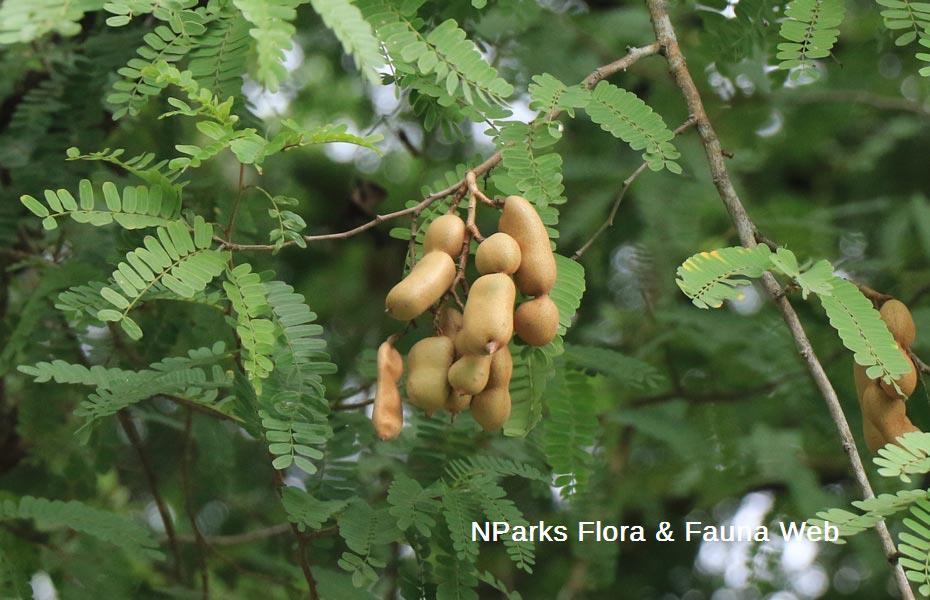
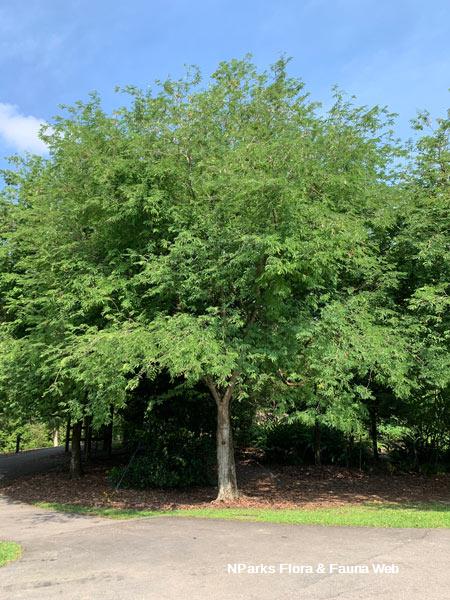
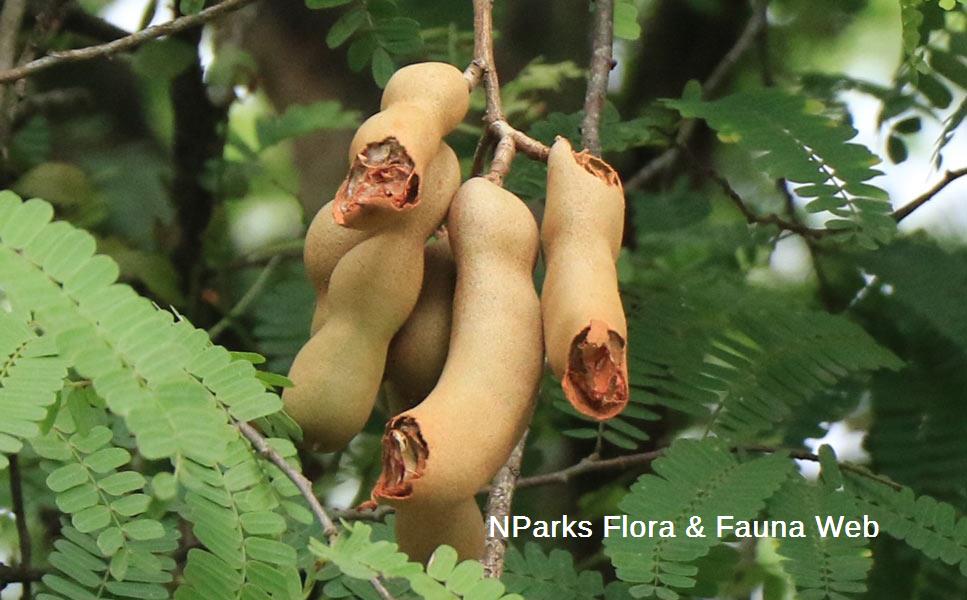
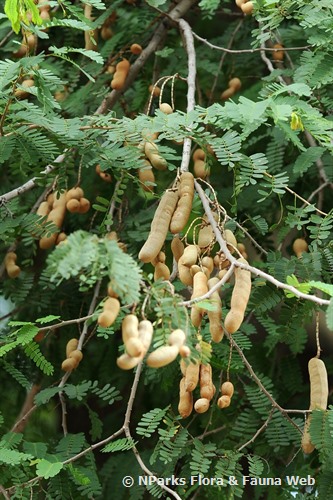
Tamarindus indica, also known as Tamarind, is a tree that can grow up to 24 m tall. It produces oblong fruit pods that are sometimes slightly curved and occasionally constricted. These pods turn brown in colour when ripe. Each pod contains about 10 seeds which are surrounded by an edible, sticky pulp that is sweet and tart. This pulp is widely used as a flavouring in various cuisines in tropical and subtropical regions, from Southeast Asia to Latin America.
Name
Classifications and Characteristics
| Plant Division | Angiosperms (Flowering Seed Plants) (Dicotyledon) |
|---|---|
| Plant Growth Form | Tree (Medium (16m-30m)) |
| Lifespan (in Singapore) | Perennial |
| Mode of Nutrition | Autotrophic |
| Plant Shape | Irregular |
| Maximum Height | 24 m |
Biogeography
| Native Distribution | The exact origin is unknown. It is thought to be native to Africa but has been widely cultivated in tropical and subtropical regions worldwide. |
|---|---|
| Native Habitat | Terrestrial |
| Preferred Climate Zone | Tropical |
| Local Conservation Status | Non-native (Spontaneous (Casual)) |
Description and Ethnobotany
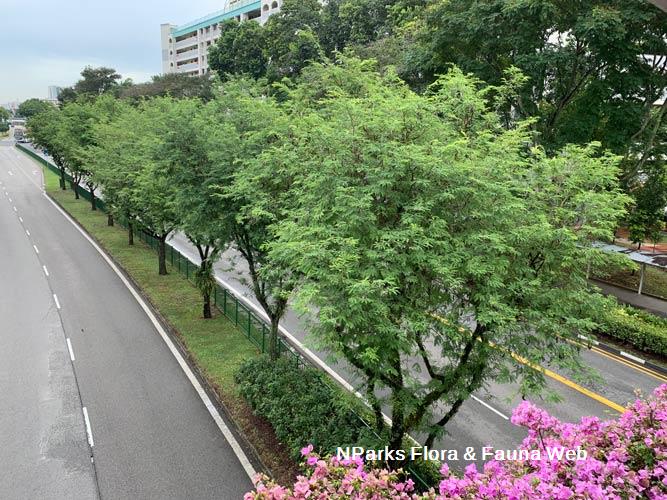
| Growth Form | It is a tree, up to 24 m tall. |
|---|---|
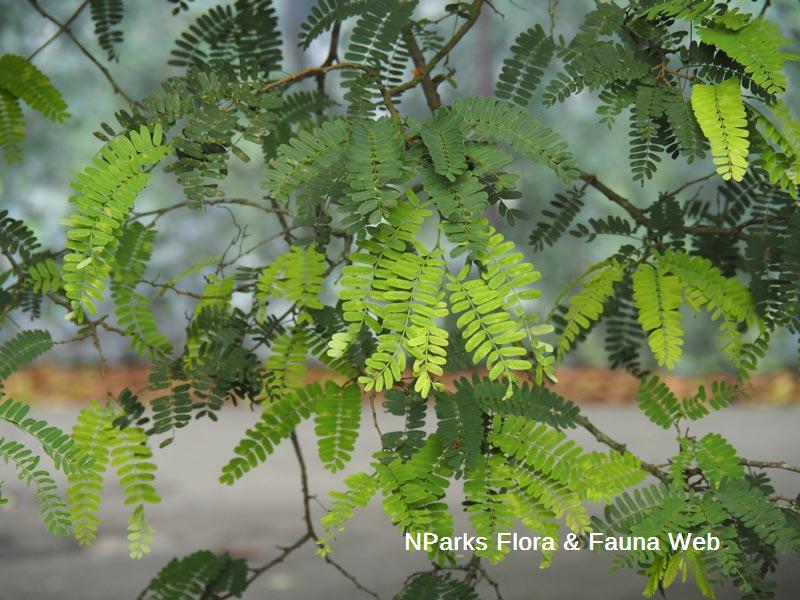
| Foliage | The leaves are compound and paripinnate, measuring 5 – 12 cm long, and consist of 10 – 18 (–21) pairs of leaflets. The leaflet is narrowly oblong about 0.8 – 3 cm long and 0.3 – 1 cm wide. The leaflet tip is rounded or slightly mucronate, while the base is rounded. The stipule is very small and falls off early. |
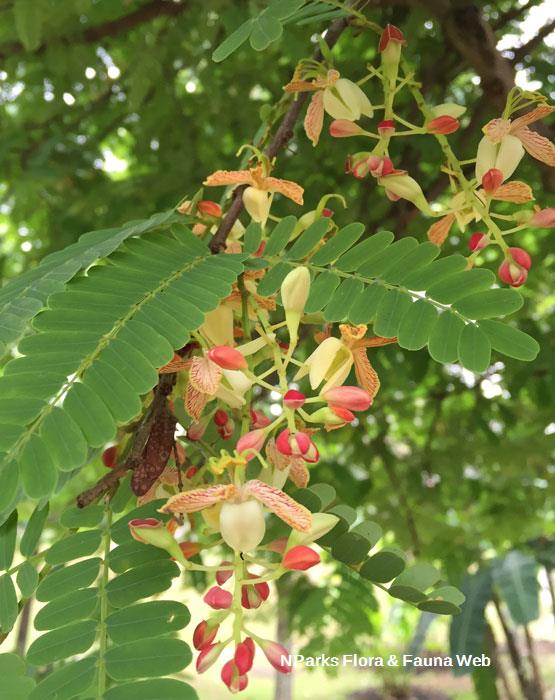
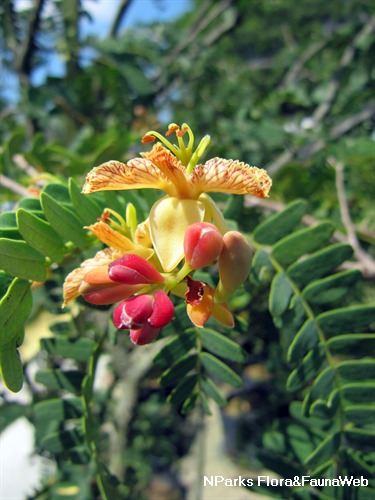
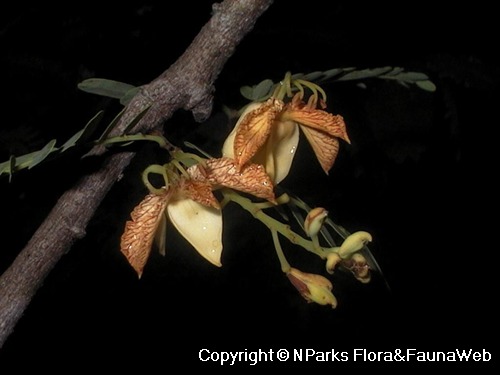
| Flowers | The flowers occur in clusters (racemes), measuring up to 15 (–22) cm long. Each flower has 4 sepals, which are reddish on the outside and yellow on the inside, and 5 yellow or cream petals with red veins. Of the five petals, the upper three petals are well-developed while the lower two petals are reduced. Each flower also contains 3 fertile stamens. The ovary is linear and hairy. The style is hairy, measuring about 7 mm long. |
| Fruit | The fruit is an oblong pod, measuring about 5 – 15 cm long and 2 – 3 cm wide and may be slightly curved or straight. The pod remains closed at maturity. Each fruit pod contains about 10 seeds which are surrounded by an edible, sourish pulp. The seeds are obovate to orbicular, glossy and dark brown, and measure about 1.1–1.7 cm long and 1–1.2 cm wide. |
| Habitat | Its natural habitat is uncertain, but it can grow in a wide range of soil types. |
| Associated Fauna | Flowers are pollinated by insects. Fruits are eaten and dispersed by ring-tailed lemurs in Madagascar. |
| Cultivation | It can be propagated by seed. |
| Etymology | The genus epithet is derived from the Arabic name tamr hindi, meaning Indian date, referring to the edible, fibrous pulp of its fruit. The specific epithet, in Latin, refers to India, where the species was introduced in ancient times and later became widely cultivated and traded across tropical regions. |
| Ethnobotanical Uses | Edible Plant Parts : Edible Fruits Food (Fruit or Vegetable): The fruit pulp is sticky and tart and is widely used as a flavouring in curries, chutneys, jams, Worcestershire sauce, confectionery, and beverages, particularly in tropical and subtropical regions <2,3,4,5>. The tender flowers and shoots are eaten in curries, soups, and salads in countries such as Thailand, India, and Zimbabwe <4,7>. Medicinal: Traditional Medicine Uses The fruit and leaves are used as traditional medicine by local villagers in Africa, Asia, and the Americas to stimulate bowel movements, aid digestion, and relieve constipation <4>. The bark is used in lotions and poultices to treat skin ailments such as sores <2,5>. Timber & Products: The wood is used for furniture, particularly in Réunion, and is sometimes traded as ‘Madeira mahogany’ in North America <4>. It is also used as firewood in Thailand and Ghana <1,7>. Cultural / Religious: Heritage Tree: There are currently 2 individuals of Tamarindus indica listed as Heritage Trees in Singapore. The trees can be found at Surin Avenue Park and beside The Fullerton Waterboat House garden. To find out more about these trees, please visit the Heritage Tree Register. Others: The leaves are used as fodder for cattle and goats <4,7> and are eaten by elephants and giraffes in African woodlands <4>. They are also used in India and West Africa to rear silkworms <4>. The seeds are used as cattle feed in India, while the seed oil is used to make varnish and paint <2,4> and for illumination in Bengal <4>. |
Landscaping Features
| Landscape Uses | Parks & Gardens |
|---|
Fauna, Pollination and Dispersal
| Pollination Method(s) | Biotic (Fauna) |
|---|---|
| Seed or Spore Dispersal | Biotic (Fauna) |
Plant Care and Propagation
| Light Preference | Full Sun |
|---|---|
| Water Preference | Moderate Water |
| Plant Growth Rate | Moderate |
| Rootzone Tolerance | Moist Soils, Well-Drained Soils |
Foliar
| Foliage Retention | Evergreen |
|---|---|
| Mature Foliage Colour(s) | Green |
| Foliar Type | Compound (Even-Pinnate) |
| Foliar Arrangement Along Stem | Spiral |
| Foliar Attachment to Stem | Petiolate |
| Foliar Apex - Tip | Mucronate, Rounded |
| Foliar Base | Rounded / Obtuse |
| Leaf Area Index (LAI) for Green Plot Ratio | 3.0 (Tree - Intermediate Canopy) |
Non - Foliar and Storage
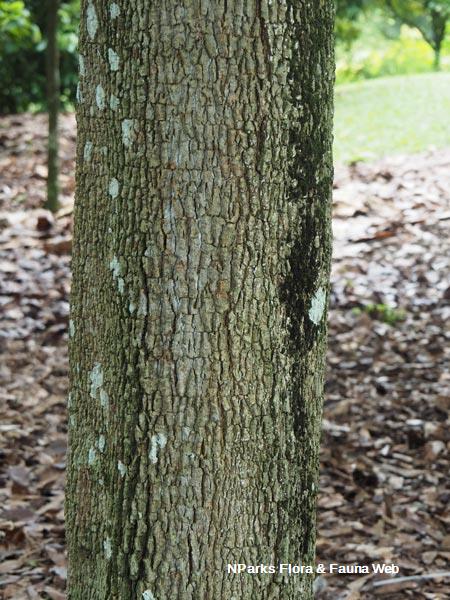
| Trunk Type (Non Palm) | Woody |
|---|---|
| Root Type | Underground |
Floral (Angiosperm)
| Flower & Plant Sexuality | Bisexual Flowers |
| Flower Colour(s) | Yellow / Golden |
|---|---|
| Flower Grouping | Cluster / Inflorescence |
Fruit, Seed and Spore
| Mature Fruit Colour(s) | Brown |
|---|---|
| Fruit Classification | Simple Fruit |
| Fruit Type | Indehiscent Dry Fruit , Pod |
References
| References | <1> Chimsah, F. A., Nyarko, G., & Abubakari, A.H. (2020). A review of explored uses and study of nutritional potential of tamarind (Tamarindus indica L.) in Northern Ghana. African Journal of Food Science, 14(9), 285–294. <2> Coronel, R.E., 1991. Tamarindus indica L. In: Verheij, E.W.M., Coronel, R.E. (eds) Plant Resources of South-East Asia Volume 2, Edible Fruits and Nuts. pp. 278-281. Indonesia: Prosea Foundation. |
|---|
Image Repository
Others
| Master ID | 1881 |
|---|---|
| Species ID | 3174 |
| Flora Disclaimer | The information in this website has been compiled from reliable sources, such as reference works on medicinal plants. It is not a substitute for medical advice or treatment and NParks does not purport to provide any medical advice. Readers should always consult his/her physician before using or consuming a plant for medicinal purposes. |