






Back
Drypetes pendula Ridl.
| Family Name: | Putranjivaceae |
| Synonyms: | Drypetes gigantifolia J.J.Sm. |
| Common Name: | Sabre Leaf, Garligo Salak, Gelugor Salak |
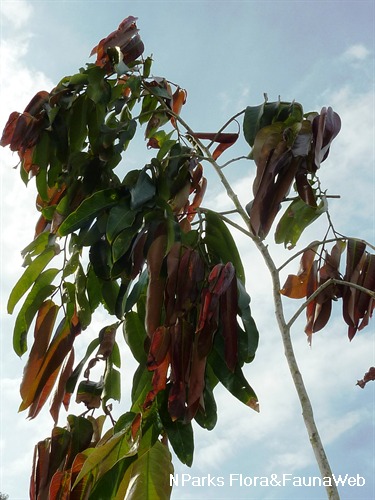
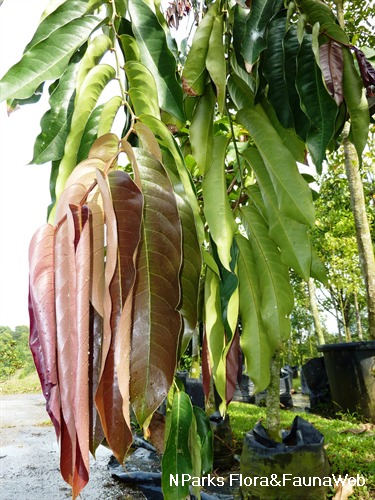
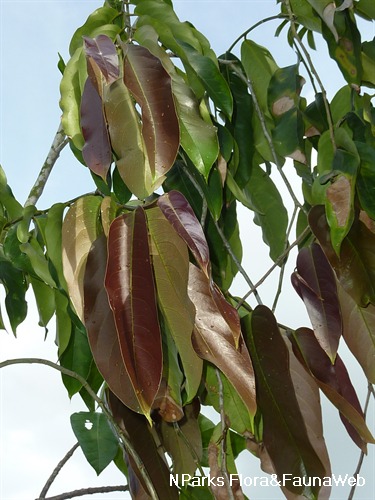
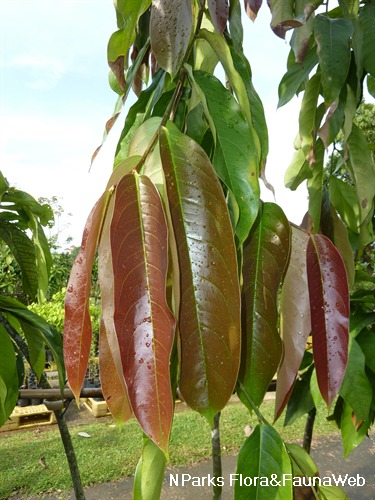
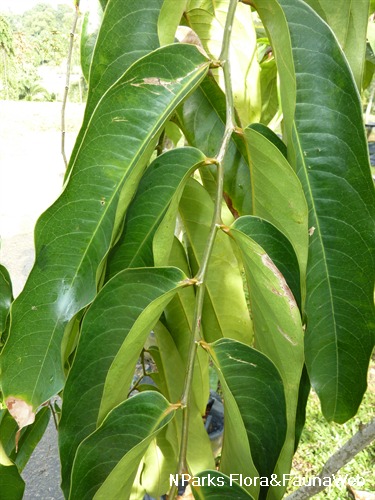
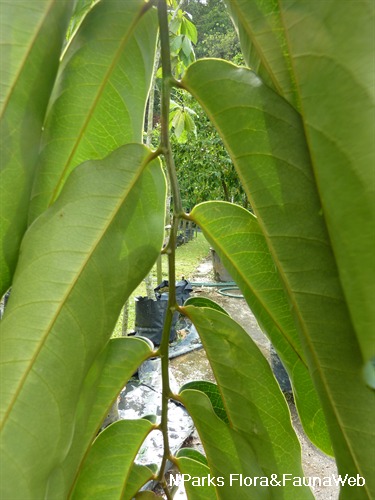
Drypetes pendula or Sabre Leaf is a medium sized tree that is native to Singapore. Growing to a height of 20 m tall, it has long, pendulous branches with thick, rigid, leathery, oblong leaves that starts off red to purple-red when young. Flowers are dioecious, produced on a clustering inflorescence along the axils behind the foliage. The fruit is a leathery, oblong, 1 to 3-seeded drupe that turns strongly wrinkled, thinly velvety, brown to dark dull red when ripe.


Name
Classifications and Characteristics
| Plant Division | Angiosperms (Flowering Seed Plants) (Dicotyledon) |
|---|---|
| Plant Growth Form | Tree (Medium (16m-30m)) |
| Lifespan (in Singapore) | Perennial |
| Mode of Nutrition | Autotrophic |
| Plant Shape | Weeping / Pendulous |
| Maximum Height | 20 m |
Biogeography
| Native Distribution | Thailand, Peninsular Malaysia, Singapore and Borneo |
|---|---|
| Native Habitat | Terrestrial (Primary Rainforest, Secondary Rainforest) |
| Preferred Climate Zone | Tropical |
| Local Conservation Status | Native to Singapore (Critically Endangered (CR)) |
Description and Ethnobotany
| Growth Form | It is a medium-sized tree that can grow to 20 m tall with a single distinct trunk and long pendulous branches. |
|---|---|
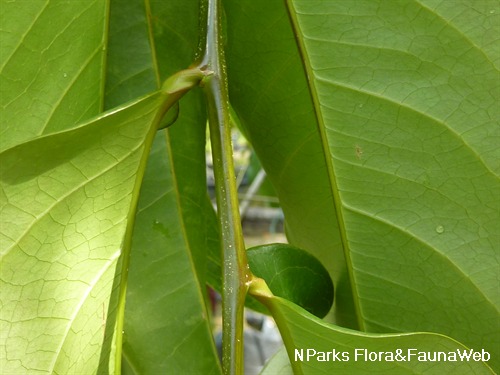
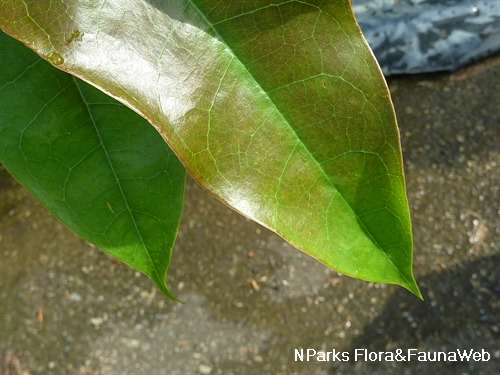
| Foliage | The pendulous foliage starts off thin, narrowly oblong and red to purple-red when young. Mature leaves are large, rigid, thick, leathery and oblong measuring 30 - 60 cm long, 10 - 25 cm wide. The base of the leaves are unequally heart-shaped, glossy above. |
| Flowers | Flowers are dioecious where the female and male flowers are produced on separate indivduals. Borne on a clustering inflorescence, the flowers are found along the axils behind the foliage. |
| Fruit | The fruit is a leathery, oblong drupe which contains 1-3 seeds within. When ripe, the fruit becomes dry, thinly velvety brown to dark dull red and strongly wrinkled. |
| Habitat | Occurs in primary, secondary lowland forest, on hillside, ridges and along river banks, in flat, hilly and moist land up to altitude of 1300 m. <1 & 2> |
Landscaping Features
| Desirable Plant Features | Ornamental Foliage |
|---|---|
| Landscape Uses | General, Reforestation |
Plant Care and Propagation
| Light Preference | Full Sun |
|---|---|
| Water Preference | Moderate Water |
| Plant Growth Rate | Moderate |
| Rootzone Tolerance | Moist Soils, Well-Drained Soils, Fertile Loamy Soils |
| Propagation Method | Seed |
Foliar
| Foliage Retention | Evergreen |
|---|---|
| Mature Foliage Texture(s) | Glossy / Shiny |
| Prominent Young Flush Colour(s) | Red |
| Young Flush Texture(s) | Glossy / Shiny |
| Foliar Type | Simple / Unifoliate |
| Foliar Arrangement Along Stem | Spiral |
| Foliar Attachment to Stem | Petiolate |
| Foliar Shape(s) | Non-Palm Foliage (Oblong) |
| Foliar Venation | Pinnate / Net |
| Foliar Margin | Entire |
| Foliar Apex - Tip | Acuminate |
| Foliar Base | Cordate |
Non - Foliar and Storage
| Stem Type & Modification | Woody |
|---|
Floral (Angiosperm)
| Flower & Plant Sexuality | Unisexual Flowers , Dioecious |
| Flower Grouping | Cluster / Inflorescence |
|---|
| Flower Location | Axillary |
| Flower Symmetry | Radial |
| Flowering Habit | Polycarpic |
Fruit, Seed and Spore
| Fruit Classification | Simple Fruit |
|---|---|
| Fruit Type | Fleshy Fruit , Drupe |
References
| References | <1> Ridley, H.N. et. al (1924). The flora of Malay Peninsula, vol. 3. London: L. Reeve & Co., Ltd. pp. 222. <2> Kochummen, K.M. (1973). Euphorbiaceae. Tree Flora of Malaya, vol. 2, pp. 89. Kuala Lumpur, Longman Group Limited. |
|---|
Image Repository
Others
| Master ID | 29072 |
|---|---|
| Species ID | 3388 |
| Flora Disclaimer | The information in this website has been compiled from reliable sources, such as reference works on medicinal plants. It is not a substitute for medical advice or treatment and NParks does not purport to provide any medical advice. Readers should always consult his/her physician before using or consuming a plant for medicinal purposes. |