






Back
Crinum 'Menehune'
| Family Name: | Amaryllidaceae |
| Common Name: | Red Bog Lily, Red Swamp Lily, Fire & Ice Bog Lily |
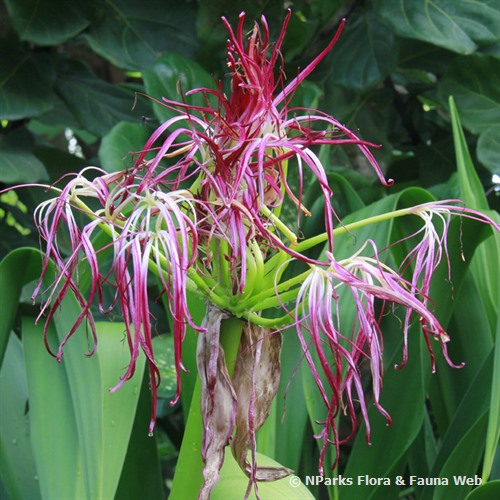
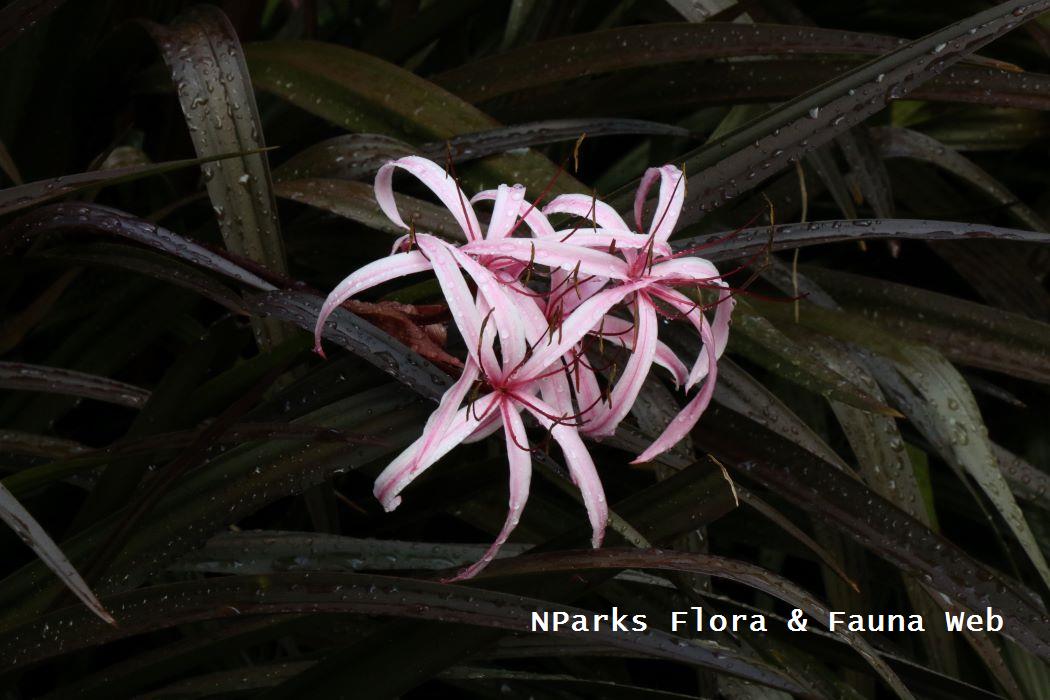
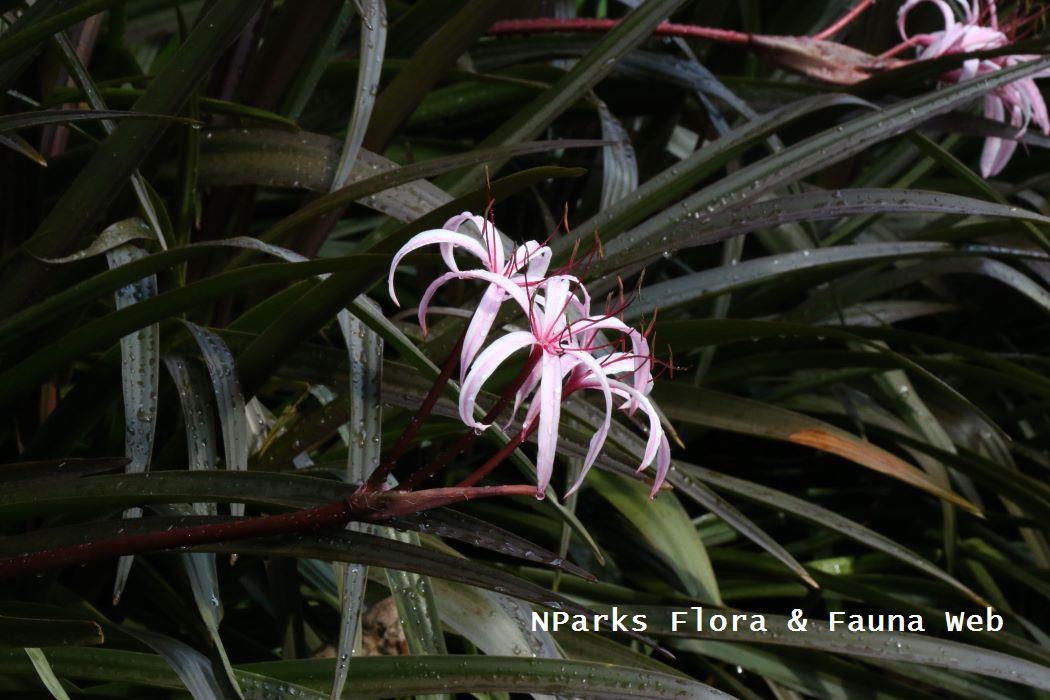
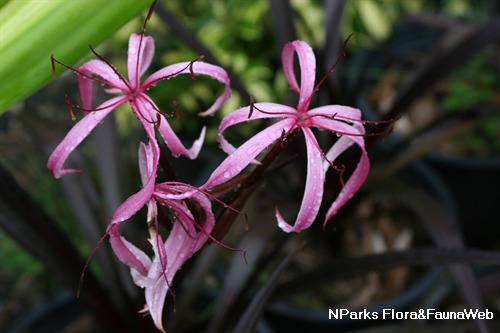
Crinum 'Menehune', or known as the Red Bog Lily, is a cultivated tropical hybrid with dark purple to near black foliage and pink flowers. This cultivar remains compact, growing no more than a metre in height and spread, and is tolerant of waterlogged soil. It is best grown in full sun for darker foliage and more flowers.




Name
Classifications and Characteristics
| Plant Division | Angiosperms (Flowering Seed Plants) (Monocotyledon) |
|---|---|
| Plant Growth Form | Herbaceous Plant, Aquatic (Emergent Aquatic, Waterside / Marginal) |
| Lifespan (in Singapore) | Perennial |
| Mode of Nutrition | Autotrophic |
| Plant Shape | Compact |
| Maximum Height | 0.6 m to 1 m |
| Maximum Plant Spread / Crown Width | 0.6 m to 1 m |
Biogeography
| Preferred Climate Zone | Tropical |
|---|---|
| Local Conservation Status | Non-native (Horticultural / Cultivated Only) |
Description and Ethnobotany
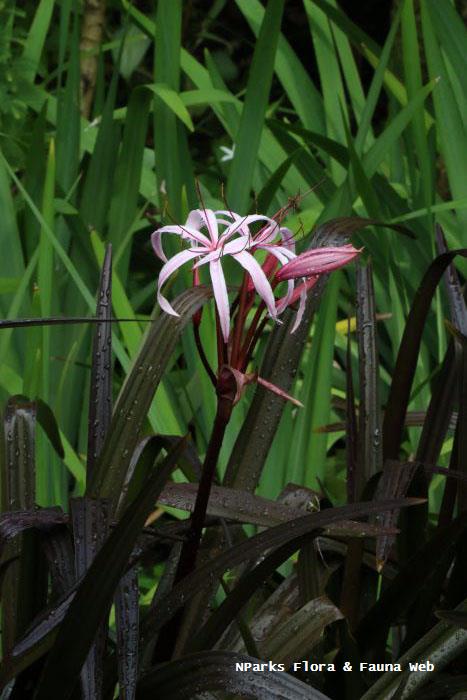
| Growth Form | It is a short, bulb-bearing herbaceous perennial that grows up to 1m tall. |
|---|---|
| Roots | The roots are fibrous, like most monocots. They are also contractile roots that help pull their bulbs deeper into the ground for better anchorage. |
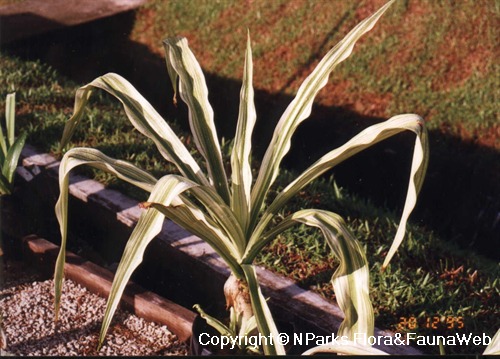
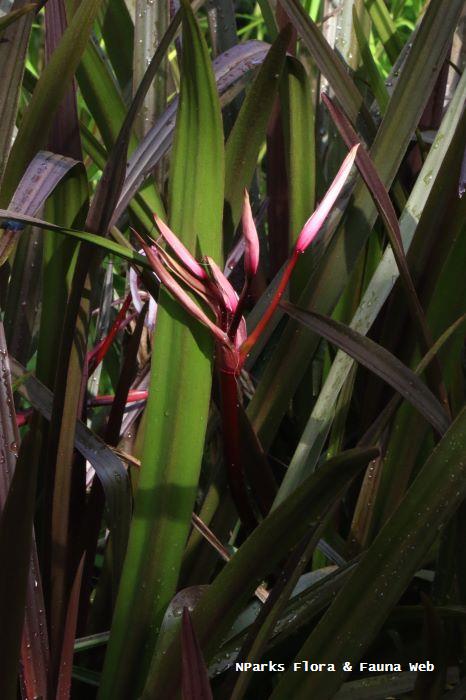
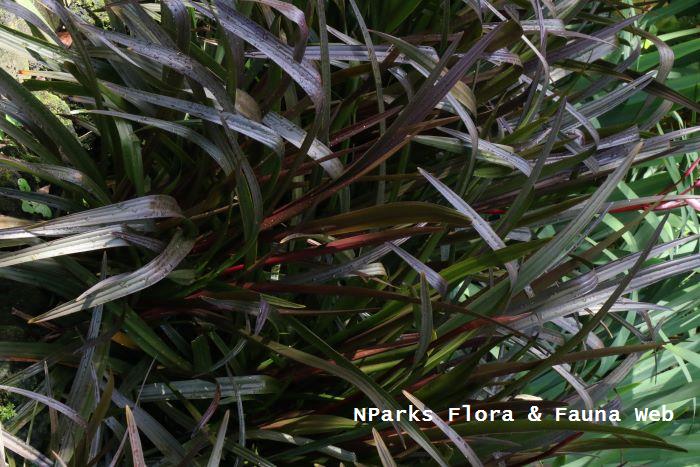
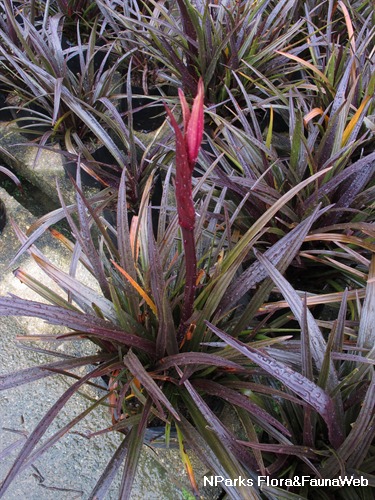
| Foliage | The leaves are strap-shaped (60 cm long & 2.5–5 cm wide), glossy, dark purple to near black, with an entire leaf margin, and a slightly pleated leaf surface. The leaves are arranged in a rosette. |
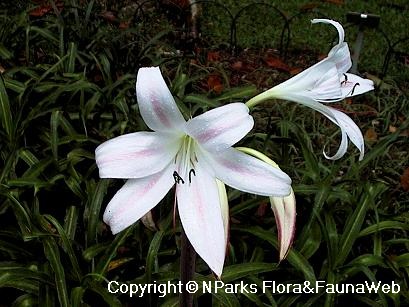
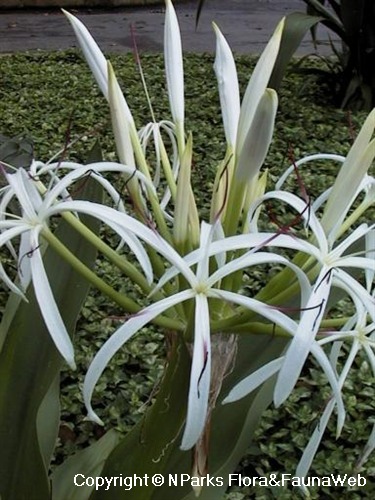
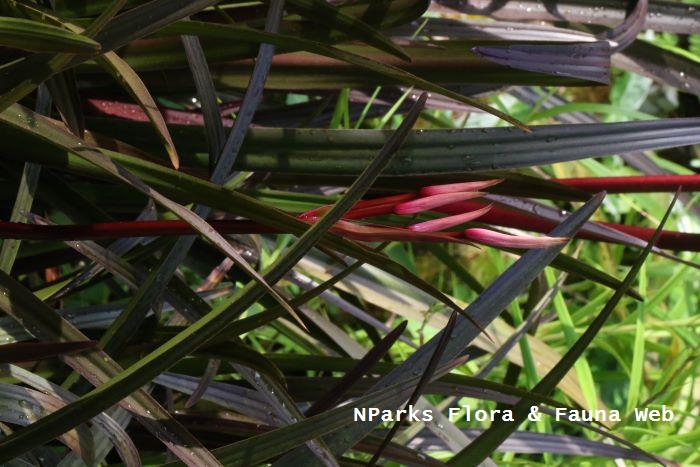
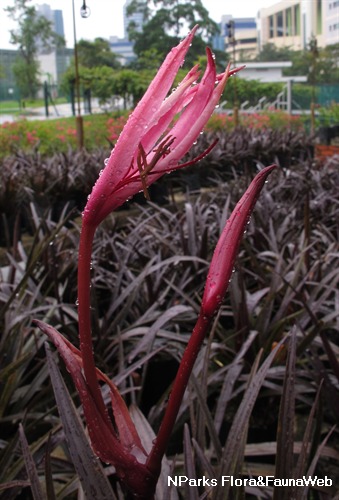
| Flowers | The inflorescence is an umbel (a type of inflorescence in which the flowers radiate from the same point of a peduncle). The peduncle or scape (inflorescence stalk) is thick and dark red. The flowers are composed of six narrow, pink, recurved tepals (indistinguishable petals and sepals that resemble one another) and six long, dark red stamens. |
| Fruit | The fruit is a capsule (a type of dry, dehiscent fruit). |
| Others - Plant Morphology | It produces underground tunicate bulbs (modified storage organs composed of a reduced stem (basal plate), multiple fleshy leaves and a tunic or dry, membranous scale leaves), which can grow to 22 cm wide or more. |
| Taxonomy | This cultivar is a hybrid, supposedly a cross between Crinum amabile and an unknown Crinum species from the Caribbean, and was first introduced into trade by the Hawaii Tropical Botanical Garden. |
| Cultivation | It grows best in bright, direct sunlight and fertile soil with plenty of organic material. It is tolerant of light, dappled shade and waterlogged soils. To cultivate as an emergent aquatic plant, the plant should be grown in a 1–3-gallon pot, with the soil surface 8–15 cm below the water. It is susceptible to the black-and-yellow striped amaryllis caterpillar (Brithys pancratii) and occasionally snails and slugs. It can be propagated by division. |
| Etymology | The genus Crinum is derived from Greek krinon "lily". The cultivar name 'Menehune' is derived from a mythological race of Hawaiian forest dwellers, who were short, dark-skinned, and kept to themselves. |
Landscaping Features
| Landscaping | This cultivar is grown for its ornamental foliage and flowers. The dark red leaves will provide contrast against a mostly green landscape. It will thrive in waterlogged areas and can be grown along pond margins or as an emergent aquatic plant. |
|---|---|
| Desirable Plant Features | Ornamental Foliage, Ornamental Flowers |
| Landscape Uses | Marsh / Bog, Pond / Lake / River, Parks & Gardens, Small Gardens |
| Thematic Landscaping | Bioswales / Sunken Garden, Water Garden, Marsh Garden |
| Usage Hazard - Cons | Toxic Upon Ingestion, Irritant - Sap |
| Usage Hazard - Cons Remarks | Irritant Sap/ Toxic Upon Ingestion: All plant parts contain alkaloids that can cause irritation to skin when handled. Consumption of any plant parts, especially the bulbs, can result in vomiting, abdominal pain, diarrhea, constipation, irregular breathing, rapid pulse, and fever. Avoid handling the plants without gloves and keep plants away from children and pets. |
Plant Care and Propagation
| Light Preference | Full Sun |
|---|---|
| Water Preference | Lots of Water |
| Plant Growth Rate | Fast to Moderate |
| Rootzone Tolerance | Fertile Loamy Soils, Waterlogged Soils |
| Diseases | It is susceptible to the black-and-yellow striped amaryllis caterpillar (Brithys pancratii) and occasionally snails and slugs. |
| Pest(s) | Associated with, Chewing Insects |
| Propagation Method | Division, Storage Organ (Bulb) |
| Propagation Method Remarks | Propagate by dividing the bulbs or replanting offsets. |
| Planting Distance | 0.9 m to 1.2 m |
Foliar
| Foliage Retention | Evergreen |
|---|---|
| Mature Foliage Colour(s) | Red, Purple, Brown |
| Mature Foliage Texture(s) | Glossy / Shiny |
| Prominent Young Flush Colour(s) | Purple, Brown, Red |
| Foliar Type | Simple / Unifoliate |
| Foliar Arrangement Along Stem | Rosulate / Rosette |
| Foliar Attachment to Stem | Sessile |
| Foliar Shape(s) | Non-Palm Foliage (Linear) |
| Foliar Venation | Parallel |
| Foliar Margin | Entire |
| Foliar Apex - Tip | Acute |
| Foliar Base | Clasping |
| Typical Foliar Area | Mesophyll ( 45cm2 - 182.25 cm2 ), Macrophyll ( 182.25cm2 - 1640.25 cm2 ) |
Non - Foliar and Storage
| Stem Type & Modification | Herbaceous |
|---|---|
| Root Type | Underground (Contractile, Fibrous Root) |
| Specialised Storage Organ(s) | Underground (Bulb) |
Floral (Angiosperm)
| Flower & Plant Sexuality | Bisexual Flowers |
| Flower Colour(s) | Pink |
|---|---|
| Flower Texture(s) | Smooth |
| Flower Grouping | Cluster / Inflorescence |
| Flower Location | Terminal |
| Flower Symmetry | Radial |
| Individual Flower Shape | Stellate / Star-shaped |
| Inflorescence Type | Umbel |
| Ovary Position | Inferior / Epipgynous |
| Flowering Habit | Polycarpic |
Fruit, Seed and Spore
| Fruit Classification | Simple Fruit |
|---|---|
| Fruit Type | Dehiscent Dry Fruit , Capsule |
| Seed Quantity Per Fruit | Few (1-5) |
Image Repository
Others
| Master ID | 30627 |
|---|---|
| Species ID | 4936 |
| Flora Disclaimer | The information in this website has been compiled from reliable sources, such as reference works on medicinal plants. It is not a substitute for medical advice or treatment and NParks does not purport to provide any medical advice. Readers should always consult his/her physician before using or consuming a plant for medicinal purposes. |