








Back
Aloysia citriodora Palau
| Family Name: | Verbenaceae |
| Synonyms: | Aloysia triphylla Britton |
| Common Name: | Lemon verbena, 柠檬马鞭草 |

Name
Classifications and Characteristics
| Plant Division | Angiosperms (Flowering Seed Plants) (Dicotyledon) |
|---|---|
| Plant Growth Form | Herbaceous Plant |
| Lifespan (in Singapore) | Perennial |
| Mode of Nutrition | Autotrophic |
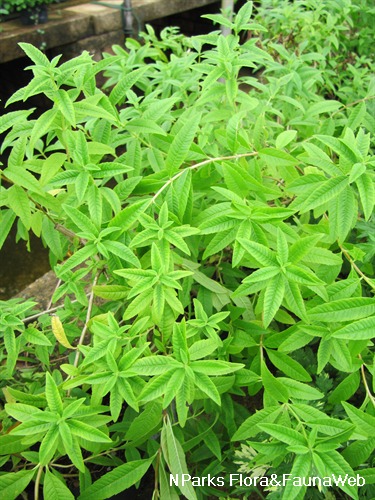
| Plant Shape | Compact |
| Maximum Height | 1 m to 3 m |
Biogeography
| Native Distribution | South America (Brazil, Argentina, Chile and Peru) |
|---|---|
| Native Habitat | Terrestrial |
| Preferred Climate Zone | Tropical, Sub-Tropical / Monsoonal |
| Local Conservation Status | Non-native |
Description and Ethnobotany
| Growth Form | Herbaceous shrub growing up to 1. 5 - 2 m long and wide. |
|---|---|
| Ethnobotanical Uses | Edible Plant Parts : Edible Leaves, Edible Flowers Food (Fruit or Vegetable): The leaves can be steamed and eaten as vegetable. The flowers are edible and can be used in teas. (Herb or Spice): The leaf has aromatic lemony, sweet and citrus flavor that are used in many food preparations, particularly in fish and chicken recipes. They are a popular ingredient in stuffing, and are added to various vegetable dishes. They can be combine with other herbs, used in desserts such as ice cream, cakes and muffins. Medicinal: In traditional, the plant has been used to treat stomach ailments and as a skin stimulate. It is also used to reduce fevers, to treat coughs and colds. |
Landscaping Features
| Desirable Plant Features | Ornamental Flowers, Fragrant (Flowers) |
|---|---|
| Landscape Uses | Parks & Gardens, Small Gardens |
Fauna, Pollination and Dispersal
| Pollination Method(s) | Biotic (Fauna) |
|---|
Plant Care and Propagation
| Light Preference | Full Sun |
|---|---|
| Water Preference | Moderate Water |
| Plant Growth Rate | Fast |
| Rootzone Tolerance | Moist Soils, Well-Drained Soils |
| Propagation Method | Stem Cutting (Tip) |
| Propagation Method Remarks | Seed - Although the plant has both male and female parts, they rarely set seed, and the seed that is produced is said to be infertile. |
Foliar
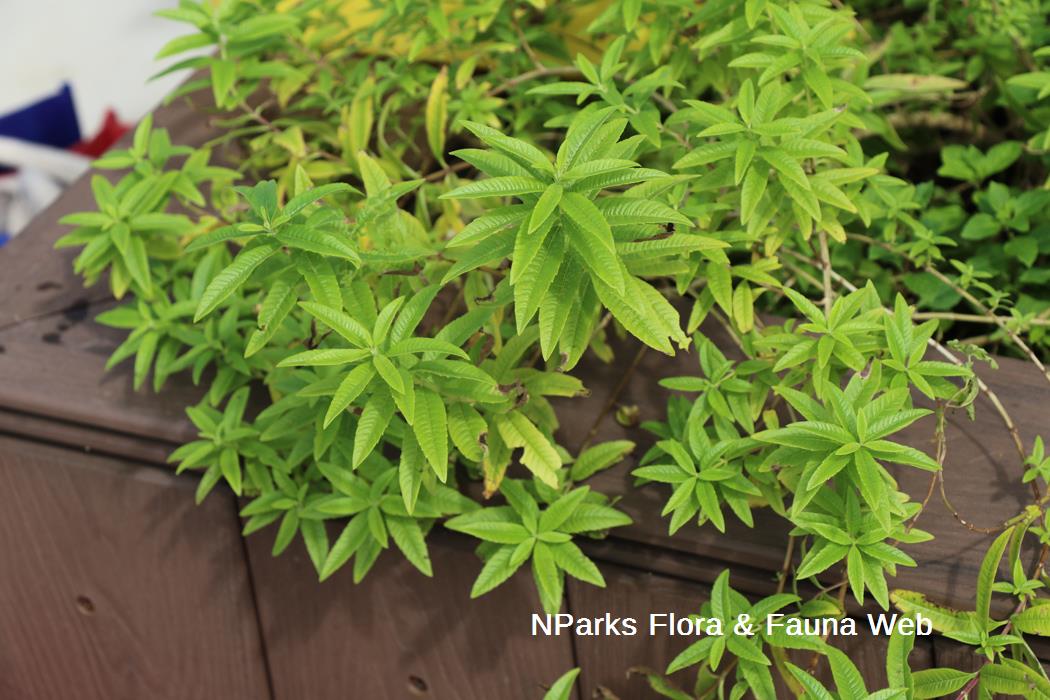
| Foliage Retention | Evergreen |
|---|---|
| Mature Foliage Colour(s) | Green |
| Mature Foliage Texture(s) | Smooth, Thin |
| Prominent Young Flush Colour(s) | Green |
| Young Flush Texture(s) | Smooth, Thin |
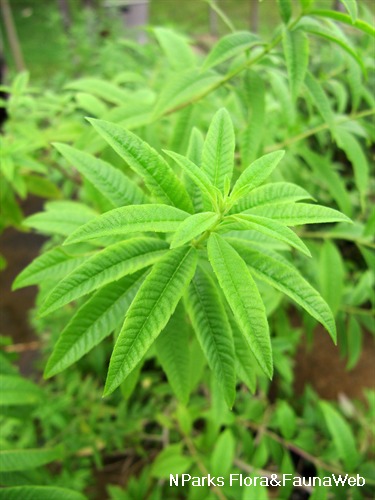
| Foliar Type | Simple / Unifoliate |
| Foliar Arrangement Along Stem | Whorled |
| Foliar Attachment to Stem | Petiolate |
| Foliar Shape(s) | Non-Palm Foliage (Lanceolate) |
| Foliar Venation | Pinnate / Net |
| Foliar Margin | Serrate / Toothed |
| Foliar Apex - Tip | Acuminate |
| Leaf Area Index (LAI) for Green Plot Ratio | 4.5 (Shrub & Groundcover - Dicot) |
Floral (Angiosperm)
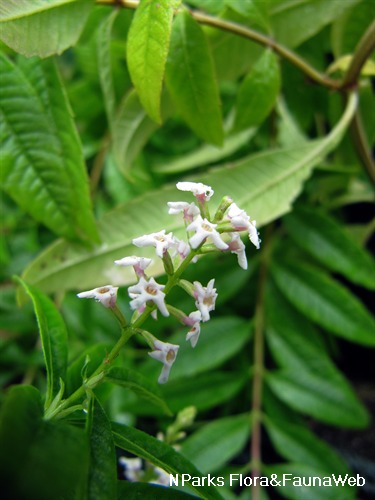
| Flower & Plant Sexuality | Bisexual Flowers |
| Flower Colour(s) | White |
|---|---|
| Flower Grouping | Cluster / Inflorescence |
| Inflorescence Type | Spike |
Image Repository
Others
| Master ID | 31118 |
|---|---|
| Species ID | 5509 |
| Flora Disclaimer | The information in this website has been compiled from reliable sources, such as reference works on medicinal plants. It is not a substitute for medical advice or treatment and NParks does not purport to provide any medical advice. Readers should always consult his/her physician before using or consuming a plant for medicinal purposes. |
.jpg)