




Back
Furcraea macdougalii Matuda
| Family Name: | Asparagaceae |
| Common Name: | MacDougal's Giant Century Plant |
Name
Classifications and Characteristics
| Plant Division | Angiosperms (Flowering Seed Plants) (Monocotyledon) |
|---|---|
| Plant Growth Form | Tree (Small (6m-15m)) |
| Lifespan (in Singapore) | Perennial |
| Mode of Nutrition | Autotrophic |
| Plant Shape | Fountain (Palm-like) |
| Maximum Height | 6 m to 7 m |
Biogeography
| Native Distribution | Mexico |
|---|---|
| Native Habitat | Terrestrial (Desert / Semi-Desert) |
| Preferred Climate Zone | Desert / Arid |
| Local Conservation Status | Non-native (Horticultural / Cultivated Only) |
Description and Ethnobotany
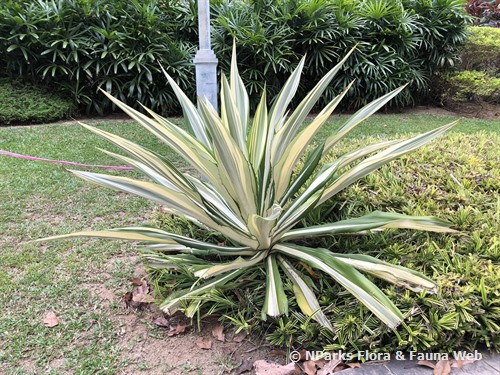
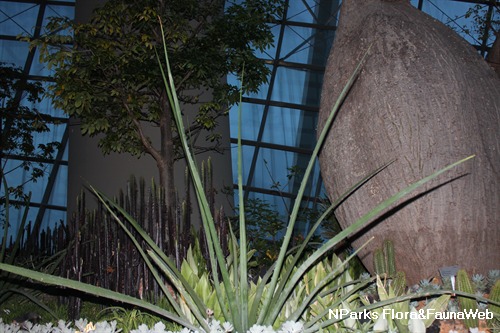
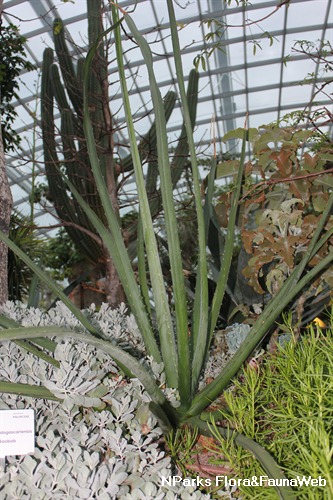
| Growth Form | Succulent with a tree-like growth form up to 7 m tall. |
|---|---|
| Trunk | The trunk is straight and thick. It appears rough, because it is covered by old leaf bases. |
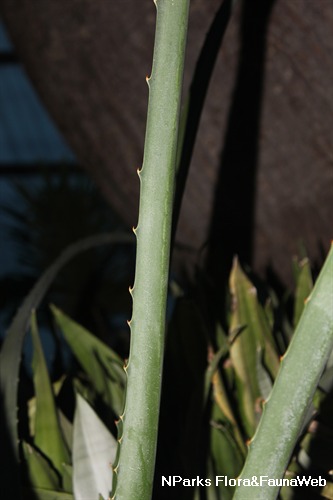
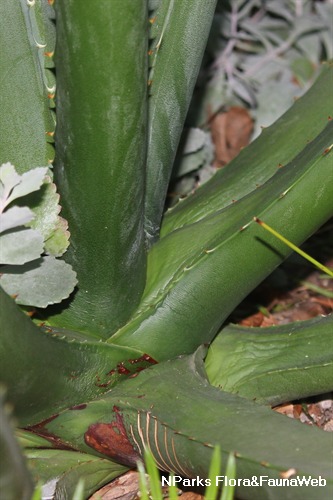
| Foliage | Narrow, linear leaves are dull olive green, smooth on top, and rough below (up to 2.1 m long, 7 cm wide). Spiny leaf margin is lined with brownish, triangular teeth which are hooked at the tip. They are held erect in a rosette with longer leaves arching backwards. |
| Flowers | Whitish flowers with dull green interior (2.5 cm long) hang downwards in a large branched cluster known as a panicle (up to 7.6 m tall). |
| Fruit | Dry, dehiscent capsule-like fruits produce many black, flat seeds. Each of the 3 locules contains 2 rows of seeds. |
| Similar | This species resembles Furcraea roezlii which also has a large trunk. F. macdougalii has green leaves with brown spines along the margin, while F. roezlii has blue-green leaves with smaller marginal spines. |
Landscaping Features
| Desirable Plant Features | Ornamental Form |
|---|---|
| Landscape Uses | Indoor Plant, Container Planting |
| Thematic Landscaping | Rockery / Desert Garden |
| Usage Hazard - Cons | Spines/Thorns - Leaf |
Fauna, Pollination and Dispersal
| Fauna Pollination Dispersal Associated Fauna | Bat Food |
|---|---|
| Pollination Method(s) | Biotic (Fauna) (Vertebrates (Bat)) |
Plant Care and Propagation
| Light Preference | Full Sun |
|---|---|
| Water Preference | Little Water |
| Plant Growth Rate | Moderate |
| Rootzone Tolerance | Drought Tolerant, Well-Drained Soils |
| Propagation Method | Sucker, Aerial Bulbil |
Foliar
| Foliage Retention | Evergreen |
|---|---|
| Mature Foliage Colour(s) | Green |
| Mature Foliage Texture(s) | Smooth |
| Foliar Modification | Spine (marginal) |
| Foliar Type | Simple / Unifoliate |
| Foliar Arrangement Along Stem | Rosulate / Rosette |
| Foliar Attachment to Stem | Sessile |
| Foliar Shape(s) | Non-Palm Foliage (Linear) |
| Foliar Venation | Parallel |
| Foliar Margin | Spiny |
| Foliar Apex - Tip | Acuminate |
| Foliar Base | Truncate / Square |
Floral (Angiosperm)
| Flower & Plant Sexuality | Bisexual Flowers |
| Flower Colour(s) | White |
|---|---|
| Flower Grouping | Cluster / Inflorescence |
| Inflorescence Type | Panicle |
| Flower Size | 2.5 cm |
Fruit, Seed and Spore
| Fruit Classification | Simple Fruit |
|---|---|
| Fruit Type | Dehiscent Dry Fruit , Capsule |
| Mature Seed Colour(s) | Black |
| Seed Description | Flat seeds. |
| Seed Quantity Per Fruit | Numerous (>20) |
References
| References | Irish, M. & Irish, G.. 2000. Agaves, Yuccas, and Related Plants. USA: Timber Press, Inc.. 312 |
|---|
Image Repository
Others
| Master ID | 31858 |
|---|---|
| Species ID | 6259 |
| Flora Disclaimer | The information in this website has been compiled from reliable sources, such as reference works on medicinal plants. It is not a substitute for medical advice or treatment and NParks does not purport to provide any medical advice. Readers should always consult his/her physician before using or consuming a plant for medicinal purposes. |