

Back
Tillandsia tectorum E.Morren
| Family Name: | Bromeliaceae |
| Synonyms: | Tillandsia argentea K.Koch & Verschaff., Tillandsia rupicola Baker, Tillandsia saxicola Mez |
Name
Classifications and Characteristics
| Plant Division | Angiosperms (Flowering Seed Plants) (Monocotyledon) |
|---|---|
| Plant Growth Form | Epiphyte |
| Mode of Nutrition | Autotrophic |
Biogeography
| Native Distribution | Ecuador and Peru. |
|---|---|
| Native Habitat | Terrestrial |
| Local Conservation Status | Non-native (Horticultural / Cultivated Only) |
Description and Ethnobotany
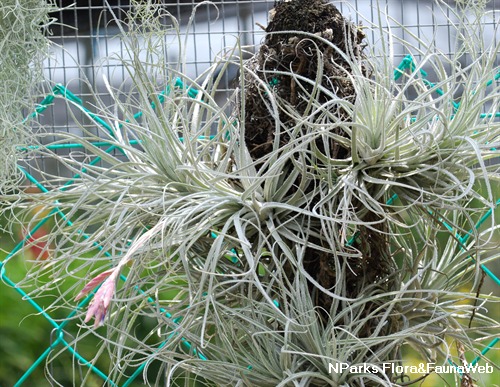
| Growth Form | The plant is epiphytic and has a caulescent growth form. |
|---|---|
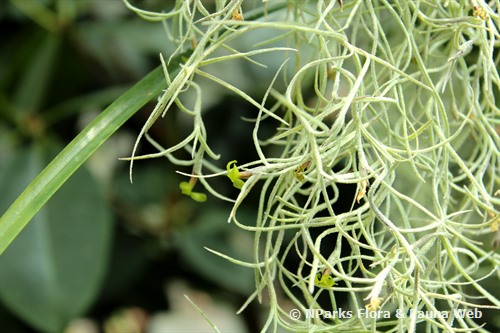
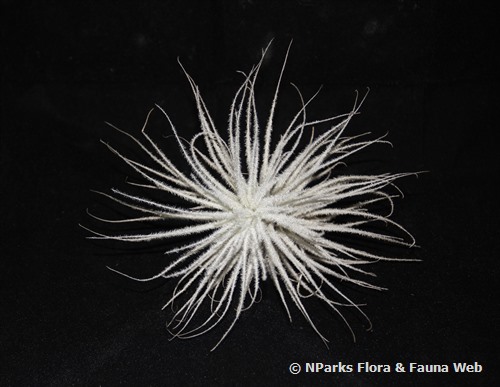
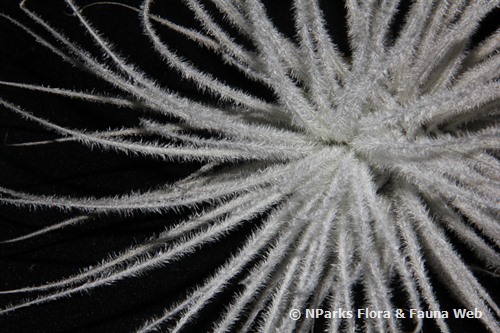
| Foliage | The leaves are green and densely covered with white hairs. The leaves have a filiform apex and are imbricate along the stem. |
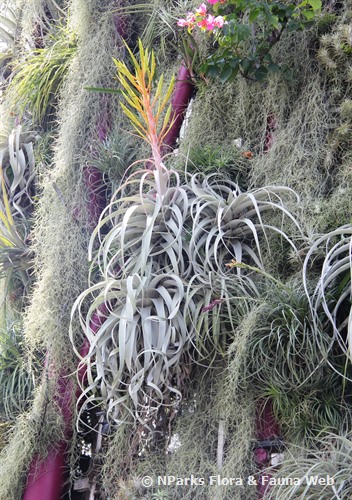
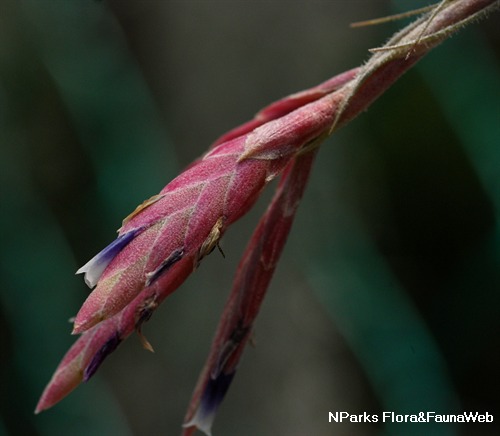
| Flowers | The flowers are borne on a branching inflorescence, on spikes. The floral bracts are red. The flowers are sessile and blue with a white margin. The flowers measure between 20 to 25 mm in length. |
| Cultivation | It is best watered via spraying and should be allowed to dry out between watering sessions or rot may occur. |
Landscaping Features
| Desirable Plant Features | Ornamental Flowers, Ornamental Foliage, Ornamental Form |
|---|---|
| Landscape Uses | Parks & Gardens, Small Gardens, Skyrise / Balcony |
Plant Care and Propagation
| Light Preference | Semi-Shade |
|---|---|
| Water Preference | Little Water |
| Propagation Method | Division |
Foliar
| Mature Foliage Colour(s) | Green |
|---|---|
| Mature Foliage Texture(s) | Velvety / Furry / Tomentose |
| Foliar Type | Simple / Unifoliate |
| Foliar Arrangement Along Stem | Imbricate |
| Foliar Attachment to Stem | Sessile |
Floral (Angiosperm)
| Flower Colour(s) | Blue, White |
|---|---|
| Flower Grouping | Cluster / Inflorescence |
| Flower Location | Terminal |
Image Repository
Others
| Master ID | 32153 |
|---|---|
| Species ID | 6559 |
| Flora Disclaimer | The information in this website has been compiled from reliable sources, such as reference works on medicinal plants. It is not a substitute for medical advice or treatment and NParks does not purport to provide any medical advice. Readers should always consult his/her physician before using or consuming a plant for medicinal purposes. |