





Name
Classifications and Characteristics
| Plant Division | Angiosperms (Flowering Seed Plants) |
|---|---|
| Plant Growth Form | Tree |
| Lifespan (in Singapore) | Perennial |
| Mode of Nutrition | Autotrophic |
| Plant Shape | Irregular |
| Maximum Height | 35 m |
Biogeography
| Native Distribution | Sumatra, Peninsular Malaysia, and Borneo |
|---|---|
| Native Habitat | Terrestrial (Freshwater Swamp Forest) |
| Preferred Climate Zone | Tropical |
| Local Conservation Status | Non-native |
Description and Ethnobotany
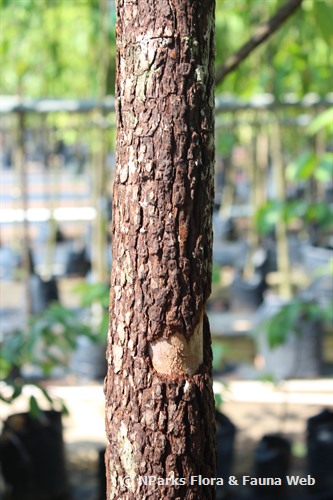
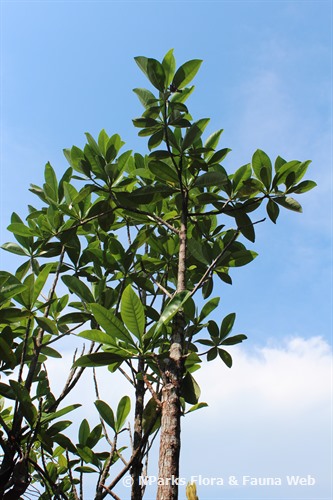
| Growth Form | It is a tree up to 35 m tall, and fluted near the base. |
|---|---|
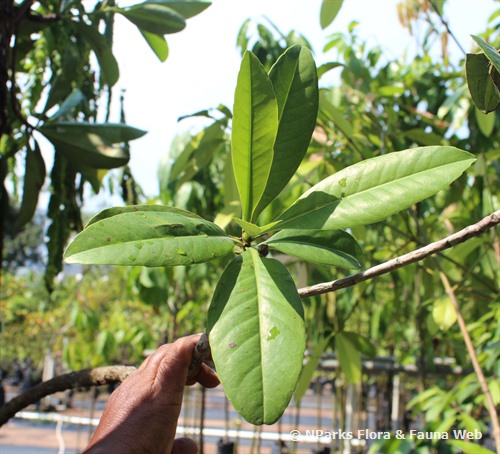
| Foliage | Tetramerista glabra leaves are spirally arranged at the distal parts of the twigs. They have leathery leaf blades that are usually inverse lance-shaped, 6.5–30 by 3–8.5 cm, and with winged leaf-stalks. The leaf margins have small, dark pit-glands. |
| Flowers | Its long-stalked flowering shoots and are found in the axils of the upper leaves. Its flowers are 2–2.5 cm wide. |
| Fruit | Its 4-seeded fruits are round, 3 by 1.5–3 cm wide, and with the surviving flower parts at the base. Its brown seeds are oblong and 10–15 by 5–8 mm. |
| Habitat | It usually grows in freshwater and peat swamp forests, from the lowlands up to 200 m altitude. |
| Etymology | Greek tetra, four; Greek meris, part, referring to the four-partite flower; Latin glaber, without hair, referring to most parts of the plant |
| Ethnobotanical Uses | Others: In Sumatra, the rather sour fruits are edible. |
Landscaping Features
| Landscape Uses | Parks & Gardens |
|---|
Plant Care and Propagation
| Light Preference | Full Sun, Semi-Shade |
|---|---|
| Water Preference | Moderate Water |
| Plant Growth Rate | Moderate |
Foliar
| Mature Foliage Colour(s) | Green |
|---|---|
| Mature Foliage Texture(s) | Leathery |
Floral (Angiosperm)
| Flower Colour(s) | Green, Yellow / Golden |
|---|
Fruit, Seed and Spore
| Mature Fruit Colour(s) | Green, Purple |
|---|
Image Repository
Others
| Master ID | 32871 |
|---|---|
| Species ID | 7285 |
| Flora Disclaimer | The information in this website has been compiled from reliable sources, such as reference works on medicinal plants. It is not a substitute for medical advice or treatment and NParks does not purport to provide any medical advice. Readers should always consult his/her physician before using or consuming a plant for medicinal purposes. |