




Back
Agelaea macrophylla (Zoll.) Leenh.
| Family Name: | Connaraceae |
| Common Name: | Akar Pinang Ketul, Akar Pinang Kutai |
Name
Classifications and Characteristics
| Plant Division | Angiosperms (Flowering Seed Plants) |
|---|---|
| Plant Growth Form | Climber |
Biogeography
| Native Distribution | Java, Sumatra, Bali, Lingga Archipelago, Peninsular Malaysia, and Borneo |
|---|---|
| Native Habitat | Terrestrial |
| Preferred Climate Zone | Tropical |
| Local Conservation Status | Native to Singapore (Least Concern (LC)) |
Description and Ethnobotany
| Growth Form | It is a climber. |
|---|---|
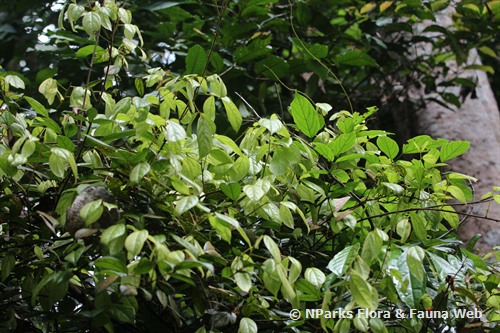
| Foliage | Its alternate, stalked leaves are trifoliate. The leathery leaf blades are longitudinally ridged, may or may not be covered with hair, have mucus cells above which are seen as pits when dry, and have veins that are rarely minutely covered with hair below. The terminal leaftlet blade is narrowly elliptic to elliptic, sometimes slightly oblique, with a pointed tip, 11–30 by 3.7–9.4 cm, and have 7–13 lateral veins. The lateral leaflet blades are elliptic, with a pointed tip, 8.5–30 by 3–9.5 cm, and have 7–8 pairs of lateral veins. |
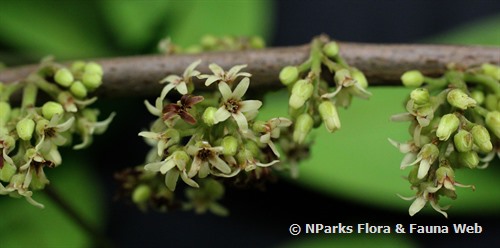
| Flowers | Its flower clusters occur at the leaf axils, are often subtended by a rudimentary leaf, have 1–4 flower branches, each 2–3 cm long, and each with 7–13 flowers that are covered with hair and have an unpleasant scent. |
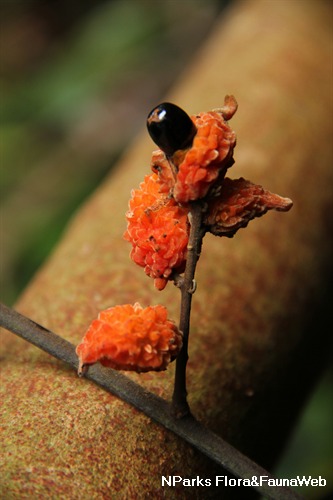
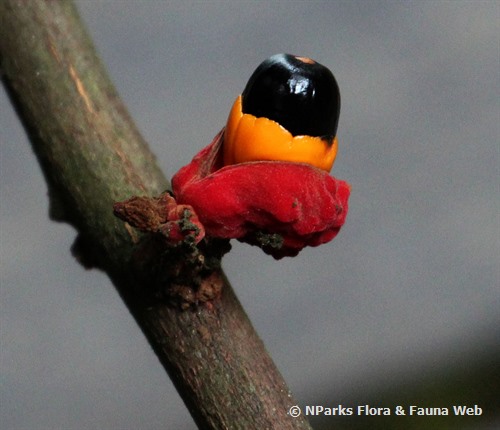
| Fruit | Its fruit is drop-shaped, 0.9–1.9 by 0.7–0.88 cm, with a smooth to wrinkled fruit wall, sometimes with warts, and covered with hair. Its seeds are drop-shaped to cylindrical and two-thirds to three-quarters covered with the sacrotesta. |
| Habitat | It grows in primary, secondary and swamp forests, often near streams, and on limestone vegetation, up to 750 m altitude. |
| Associated Fauna | Observed to be a host plant of Nacaduba sanaya elioti (Jewel Four-Line Blue); Drupadia ravindra moorei (Common Posy). |
| Etymology | Greek agelaios, forming a flock in herds, referring to the many-flowered inflorescences, Latin macrophylla, big-leaved, referring to the plant’s large leaves. |
| Ethnobotanical Uses | Others: It is used for making durable ropes to make rafts or bow-nets |
Landscaping Features
| Landscape Uses | Parks & Gardens |
|---|
Fauna, Pollination and Dispersal
| Fauna Pollination Dispersal Associated Fauna | Butterfly Host Plant |
|---|
Plant Care and Propagation
| Light Preference | Full Sun |
|---|---|
| Water Preference | Moderate Water |
| Plant Growth Rate | Moderate |
Foliar
| Mature Foliage Colour(s) | Green |
|---|
Image Repository
Others
| Master ID | 33564 |
|---|---|
| Species ID | 7978 |
| Flora Disclaimer | The information in this website has been compiled from reliable sources, such as reference works on medicinal plants. It is not a substitute for medical advice or treatment and NParks does not purport to provide any medical advice. Readers should always consult his/her physician before using or consuming a plant for medicinal purposes. |