





Back
Agelaea borneensis (Hook.f.) Merr.
| Family Name: | Connaraceae |
| Synonyms: | Agelaea vestitta Hook.f. |
| Common Name: | Akar Kachang-kachang, Akar Rusa-rusa |
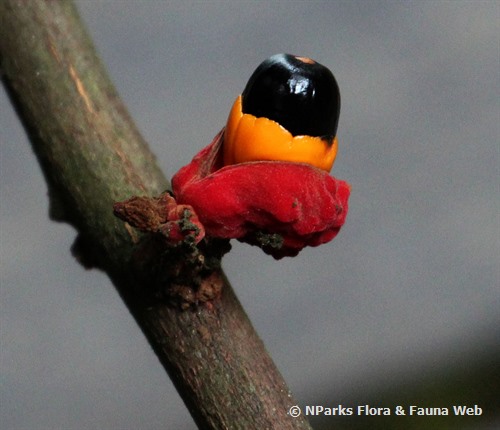
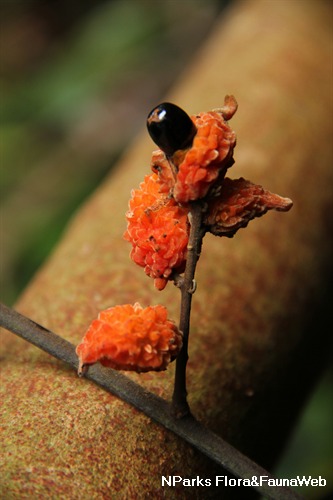
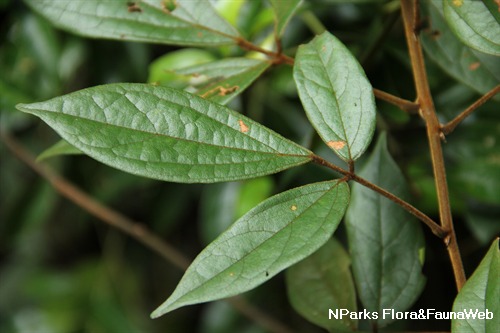
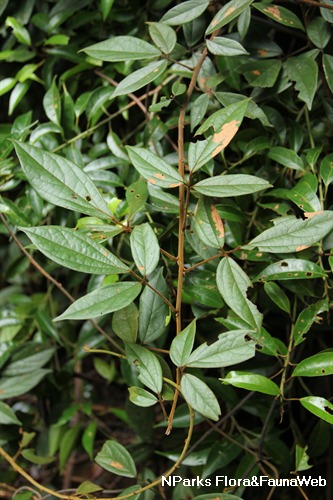
Agelaea borneensis is a large liana that has elliptic-shaped leaflets with pointed tips. The white flowers are small and fragrant. The egg-shaped fruit has rough bumpy skin and turns red when ripen.
Name
Classifications and Characteristics
| Plant Division | Angiosperms (Flowering Seed Plants) (Dicotyledon) |
|---|---|
| Plant Growth Form | Climber |
| Lifespan (in Singapore) | Perennial |
| Mode of Nutrition | Autotrophic |
| Plant Shape | Irregular |
Biogeography
| Native Distribution | Myanmar, Thailand, Peninsular Malaysia, Sumatra, Java (West & Central), Borneo and the Philippines |
|---|---|
| Native Habitat | Terrestrial |
| Preferred Climate Zone | Tropical |
| Local Conservation Status | Native to Singapore (Least Concern (LC)) |
Description and Ethnobotany
| Growth Form | It is a large liana. |
|---|---|
| Foliage | Its alternate, stalked leaves are trifoliate. The papery to thinly leathery leaflet blades have a blistered appearance, covered with hair especially at the lower surface, and seldom hairless. The terminal leaftlet blade is elliptic, egg-shaped to drop-shaped, with a pointed tip, 7–12.5 by 3.2–6 cm, and have 5–6 lateral veins. The lateral leaflet blades are oblique-oval, rarely egg-shaped or drop-shaped, with a pointed tip, 5.4–9.3 by 1.7–4 cm, and have 5–6 pairs of lateral veins. |
| Flowers | Its flower clusters occur at the leaf axils, measuring up to 5 cm long, are often subtended by a rudimentary leaf, have 1–5 flower branches, and each with 7–10 flowers that are covered with hair, have white petals, and are fragrant. |
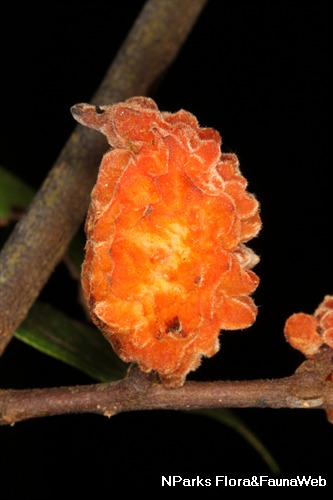
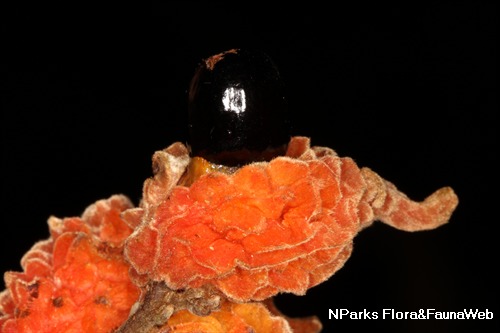
| Fruit | Its fruit is egg-shaped to ellipsoid, beaked, red when ripe, 1–2 by 0.7–1.2 cm, and densely covered with hair. Its seeds are drop-shaped, smooth, and covered by a bright yellow seed coat that is reddish-brown when dry. |
| Habitat | It grows in all kinds of forests such as primary, secondary and swamp forests, often near streams and in limestone vegetation to 700 m (-1300m) altitude. |
| Associated Fauna | Its flowers are insect-pollinated. |
| Cultivation | It can be propagated by seed. |
| Etymology | Greek agelaios, forming a flock in herds, referring to the many-flowered inflorescences, borneenis, of Borneo, referring to one locality in the natural distribution of this plant |
| Ethnobotanical Uses | Others: It can be used for making durable ropes to make rafts or bow-nets. |
Landscaping Features
| Landscaping | It is suitable for growing on trellises and pergolas for its attractive foliage, fragrant flowers, and orange fruits. |
|---|---|
| Desirable Plant Features | Ornamental Foliage, Ornamental Fruits, Fragrant (Flowers) |
| Landscape Uses | General, Parks & Gardens, Trellis / Arbour / Pergola |
Fauna, Pollination and Dispersal
| Pollination Method(s) | Biotic (Fauna) |
|---|---|
| Seed or Spore Dispersal | Biotic (Fauna) |
Plant Care and Propagation
| Light Preference | Semi-Shade |
|---|---|
| Water Preference | Moderate Water |
| Plant Growth Rate | Moderate |
| Rootzone Tolerance | Moist Soils, Well-Drained Soils, Fertile Loamy Soils |
| Maintenance Requirements | Moderate |
| Propagation Method | Seed |
Foliar
| Foliage Retention | Evergreen |
|---|---|
| Mature Foliage Colour(s) | Green |
| Mature Foliage Texture(s) | Hairy / Hirsute, Papery, Bulging in between Veins, Thin |
| Foliar Type | Compound |
| Foliar Arrangement Along Stem | Alternate |
| Foliar Attachment to Stem | Petiolate |
| Foliar Shape(s) | Non-Palm Foliage (Ovate, Obovate, Elliptical) |
| Foliar Venation | Pinnate / Net |
| Foliar Margin | Entire |
Floral (Angiosperm)
| Flower & Plant Sexuality | Bisexual Flowers |
| Flower Colour(s) | White |
|---|---|
| Flower Grouping | Cluster / Inflorescence |
| Flower Location | Axillary |
| Flower Symmetry | Radial |
Fruit, Seed and Spore
| Mature Fruit Colour(s) | Orange, Green - Light Green |
|---|---|
| Mature Fruit Texture(s) | Velvety / Furry / Tomentose |
| Fruit Classification | Simple Fruit |
| Fruit Type |
Image Repository
Others
| Master ID | 32007 |
|---|---|
| Species ID | 6409 |
| Flora Disclaimer | The information in this website has been compiled from reliable sources, such as reference works on medicinal plants. It is not a substitute for medical advice or treatment and NParks does not purport to provide any medical advice. Readers should always consult his/her physician before using or consuming a plant for medicinal purposes. |