






.jpg)
Back
Raphanus raphanistrum subsp. sativus cultivar [European Radish]
| Family Name: | Brassicaceae (Cruciferae) |
| Synonyms: | Raphanus sativus [European radish] |
.jpg)
Name
Classifications and Characteristics
| Plant Division | Angiosperms (Flowering Seed Plants) (Dicotyledon) |
|---|---|
| Plant Growth Form | Herbaceous Plant |
| Lifespan (in Singapore) | Annual |
| Mode of Nutrition | Autotrophic |
| Maximum Height | 0.6 m to 0.9 m |
| Maximum Plant Spread / Crown Width | 0.3 m to 0.6 m |
Description and Ethnobotany
| Growth Form | Annual or biennial herb. |
|---|---|
| Roots | The edible taproot may be round, cylindrical or tapered. |
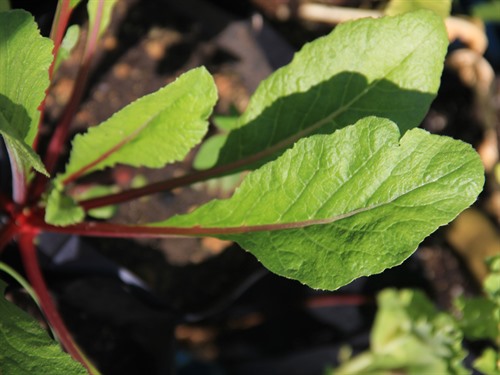
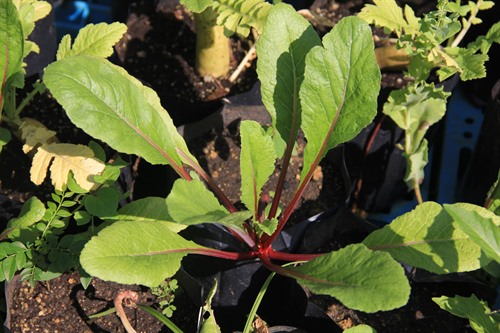
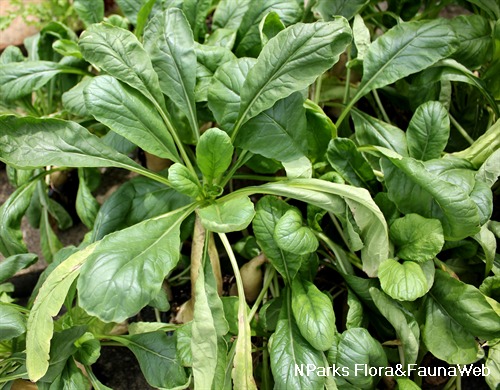
| Foliage | Oblong leaves about 5-30 cm long are sparsely covered in short, white hairs and arranged in a rosette. |
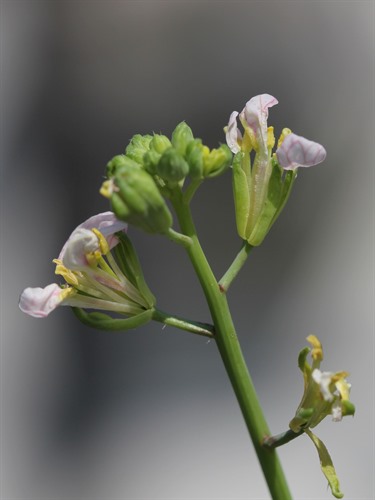
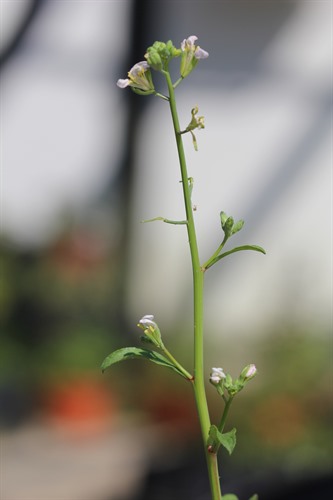
| Flowers | The 4-petaled flowers are arranged along a spike inflorescence. |
| Fruit | The dry, dehiscent fruit is narrowly cylindrical with tapering ends and known as a silique. |
| Cultivation | The edible taproot is usually harvested before flowering to ensure that it will be succulent. |
| Etymology | The genus Raphanus is derived from the Greek word for radish and the specific epithet sativus means cultivated. |
| Ethnobotanical Uses | Edible Plant Parts : Edible Fruits, Edible Leaves, Edible Storage Organs Food (Fruit or Vegetable): The taproot is typically eaten raw and added to salads. The taproot becomes more spicy as the plant matures and it eventually becomes woody. Young leaves can be cooked as a leafy vegetable. The immature, pod-like fruits are also edible. |
Landscaping Features
| Thematic Landscaping | Economic Garden |
|---|
Plant Care and Propagation
| Light Preference | Semi-Shade |
|---|---|
| Water Preference | Moderate Water |
| Plant Growth Rate | Fast |
| Rootzone Tolerance | Well-Drained Soils, Fertile Loamy Soils |
| Fertilizing | Before sowing seed, the soil should be mixed with organic fertilizer or aged manure. |
| Potential Problems | Pests that commonly attack radishes are flea beetles, slugs, and snails. |
| Diseases | Radishes are commonly attacked by Brassica downy mildew. |
| Pest(s) | Chewing Insects |
| Propagation Method | Seed |
| Planting Distance | 15 cm |
Foliar
| Foliage Retention | Evergreen |
|---|---|
| Mature Foliage Colour(s) | Green |
| Mature Foliage Texture(s) | Hairy / Hirsute |
| Prominent Young Flush Colour(s) | Green |
| Young Flush Texture(s) | Hairy / Hirsute |
| Foliar Type | Simple / Unifoliate |
| Foliar Arrangement Along Stem | Rosulate / Rosette |
| Foliar Attachment to Stem | Petiolate |
| Foliar Shape(s) | Non-Palm Foliage (Elliptical) |
| Foliar Venation | Pinnate / Net |
| Foliar Margin | Entire |
| Foliar Apex - Tip | Rounded |
| Foliar Base | Attenuate, Oblique / Asymmetrical |
Floral (Angiosperm)
| Flower Colour(s) | Pink |
|---|---|
| Flower Grouping | Cluster / Inflorescence |
| Flower Location | Terminal |
| Flower Symmetry | Bilateral |
| Individual Flower Shape | Labiate / Lipped |
Fruit, Seed and Spore
| Mature Fruit Colour(s) | Green |
|---|---|
| Mature Fruit Texture(s) | Smooth |
| Fruit Classification | Simple Fruit |
| Fruit Type |
Image Repository
Others
| Master ID | 33659 |
|---|---|
| Species ID | 8073 |
| Flora Disclaimer | The information in this website has been compiled from reliable sources, such as reference works on medicinal plants. It is not a substitute for medical advice or treatment and NParks does not purport to provide any medical advice. Readers should always consult his/her physician before using or consuming a plant for medicinal purposes. |
.jpg)