






Back
Cotyledon tomentosa Harv.
| Family Name: | Crassulaceae |
| Common Name: | Bear's Paw, Kitten Paws, Woolly Cotyledon |
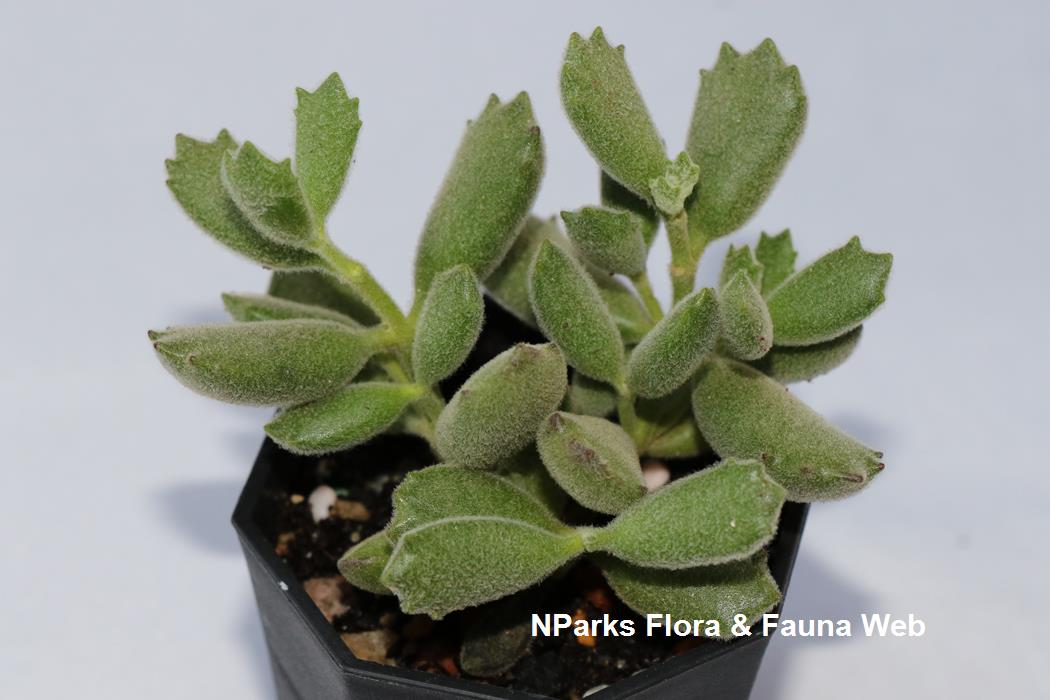
This succulent herb produces thick, softly hairy, multi-tipped leaves that resemble bear paws.
Name
Classifications and Characteristics
| Plant Division | Angiosperms (Flowering Seed Plants) (Dicotyledon) |
|---|---|
| Plant Growth Form | |
| Lifespan (in Singapore) | Perennial |
| Mode of Nutrition | Autotrophic |
| Plant Shape | Shrubby |
| Maximum Height | 0.3 m to 0.7 m |
Biogeography
| Native Distribution | Cape Province |
|---|---|
| Native Habitat | Terrestrial (Desert / Semi-Desert) |
| Preferred Climate Zone | Desert / Arid |
| Local Conservation Status | Non-native (Horticultural / Cultivated Only) |
| CITES Protection | False |
Description and Ethnobotany
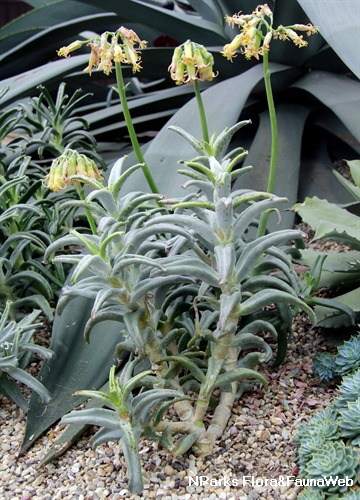
| Growth Form | Shrubby succulent up to 0.3 - 0.7 m tall and 0.3 - 0.5 m wide. |
|---|---|
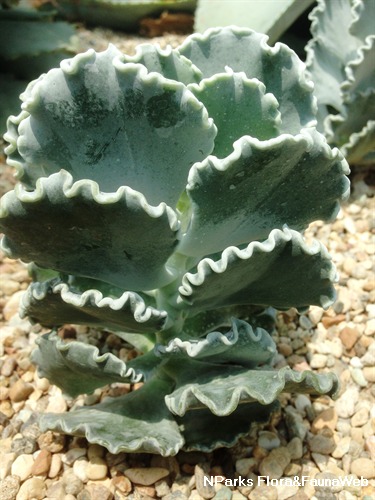
| Foliage | Obovate, fleshy leaves are multi-tipped at the apex, resembling a bear's paw. The claw-like leaf tips are sometimes dark red. |
| Flowers | Orange-red, urn-shaped flowers have reflexed petal tips. They are arranged in a thyrse inflorescence along a main axis. |
| Cultivation | It should be planted in well-drained media where it can receive at least 6 hours indirect light daily. Thoroughly water the plant but allow the soil to become quite dry before re-watering. |
Landscaping Features
| Desirable Plant Features | Ornamental Foliage |
|---|---|
| Landscape Uses | Container Planting, Indoor Plant |
Plant Care and Propagation
| Light Preference | Full Sun, Semi-Shade |
|---|---|
| Water Preference | Little Water |
| Rootzone Tolerance | Drought Tolerant, Easy to Grow |
Foliar
| Foliage Retention | Evergreen |
|---|---|
| Mature Foliage Colour(s) | Green - Light Green |
| Mature Foliage Texture(s) | Thick, Velvety / Furry / Tomentose |
| Prominent Young Flush Colour(s) | Green - Light Green |
| Young Flush Texture(s) | Velvety / Furry / Tomentose |
| Foliar Modification | Storage Organ |
| Foliar Type | Simple / Unifoliate |
| Foliar Arrangement Along Stem | Opposite |
| Foliar Attachment to Stem | Sessile |
| Foliar Shape(s) | Non-Palm Foliage (Obovate, Oblong) |
| Foliar Venation | Parallel |
| Foliar Margin | Entire |
| Foliar Apex - Tip | Emarginate |
| Foliar Base | Cuneate |
| Typical Foliar Area | Microphyll ( 2.25cm2 - 20.25 cm2 ) |
| Typical Foliar Size | 1.5 cm to 5.5 cm |
Floral (Angiosperm)
| Flower Colour(s) | Orange, Red, Yellow / Golden |
|---|---|
| Flower Texture(s) | Velvety / Furry / Tomentose |
| Flower Grouping | Cluster / Inflorescence |
| Flower Location | Terminal |
| Flower Symmetry | Bilateral |
| Individual Flower Shape | Urceolate / Urn-shaped |
| Inflorescence Type | Thyrse |
| Flower Size | 14 mm |
Image Repository
Others
| Master ID | 34076 |
|---|---|
| Species ID | 8489 |
| Flora Disclaimer | The information in this website has been compiled from reliable sources, such as reference works on medicinal plants. It is not a substitute for medical advice or treatment and NParks does not purport to provide any medical advice. Readers should always consult his/her physician before using or consuming a plant for medicinal purposes. |