




Back
Calyptrocalyx pachystachys Becc.
| Family Name: | Arecaceae (Palmae) |
| Synonyms: | Calyptrocalyx schlechterianus Becc. |
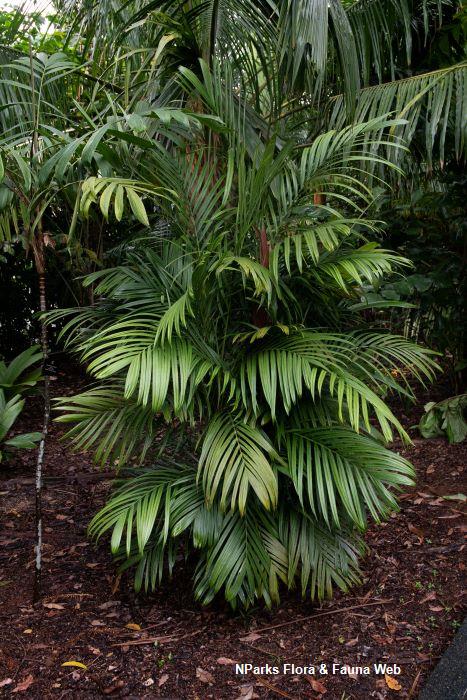
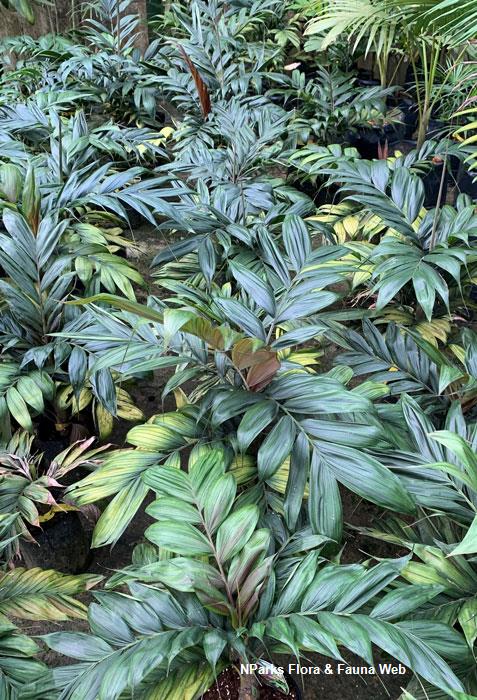
Calyptrocalyx pachystachys is a small, solitary understorey palm endemic to New Guinea, reaching up to 2 m in height. It produces pinnately compound fronds with widely spaced, sometimes irregularly arranged leaflets, each tapering to a pronounced drip tip. Juvenile plants require full to partial shade, while mature specimens grow better in filtered light conditions.

Name
Classifications and Characteristics
| Plant Division | Angiosperms (Flowering Seed Plants) (Monocotyledon) |
|---|---|
| Plant Growth Form | Palm (Solitary Habit) |
| Lifespan (in Singapore) | Perennial |
| Mode of Nutrition | Autotrophic |
| Maximum Height | 2 m |
Biogeography
| Native Distribution | New Guinea |
|---|---|
| Native Habitat | Terrestrial (Primary Rainforest) |
| Preferred Climate Zone | Tropical |
| Local Conservation Status | Non-native (Horticultural / Cultivated Only) |
Description and Ethnobotany
| Growth Form | It is a small, solitary palm that grows up to 2 m tall with 8–10 leaves on its crown. |
|---|---|
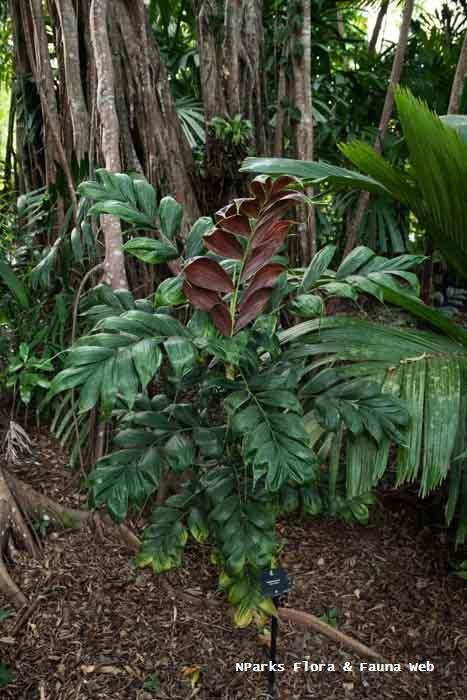
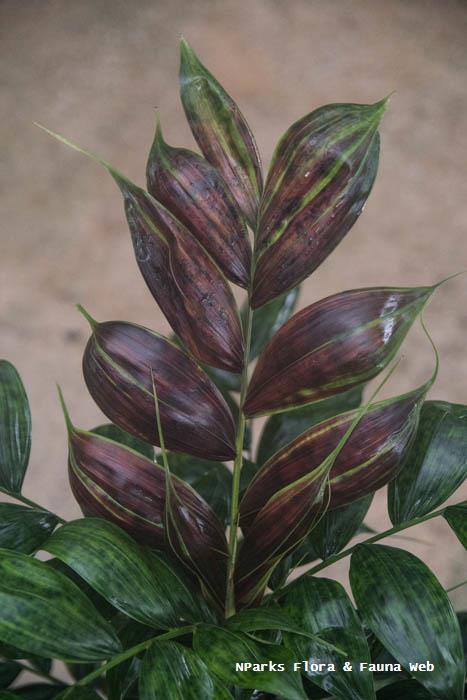
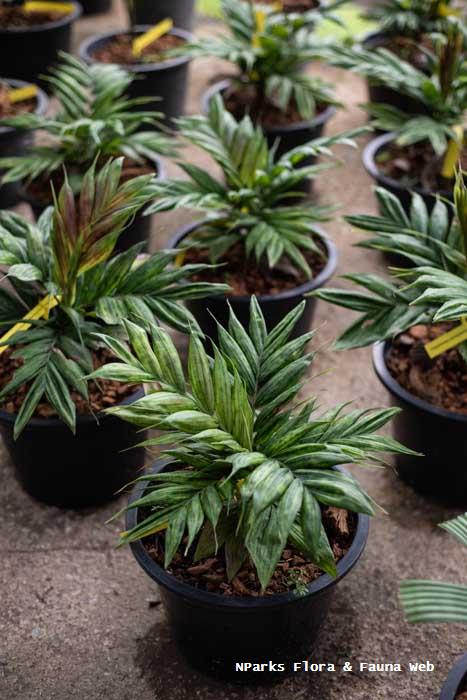
| Foliage | The fronds are medium-sized (0.8–1.4 m long), even-pinnately compound and semi-erect. There are about 9–17 alternately, widely or irregularly arranged leaflets, each about 13–44 cm long x 1.2–12 cm wide, with a 4–11 cm long drip tip. The leaflets are glossy, dark green (lighter underneath)—or lightly mottled in some forms—and cupped. The petiole (leaf stalk) is 8–25 cm long and shallowly channelled on the upper side. New fronds are brown-red, sometimes with the drip tips joined to the adjacent leaflet. The fronds of young plants are bifid. |
| Crown Shaft | The crown shaft is slender. |
| Flowers | The inflorescence is infrafoliar (emerging below the fronds and crown shaft) and subtended by a spathe or peduncular bract. It can be one- or two-spiked; the rachilla (small, secondary axes on inflorescences) is 16–39 cm long and covered in sparse reddish minute scales. Triads of one female flower flanked by two male flowers occur throughout the length of the rachillae. Male flowers have 7–19 stamens. Female flowers have a three-lobed stigma and three fused carpels. |
| Fruit | The fruit is swollen or oval-shaped (16–18 mm long × 7–8 mm in diameter) drupe. It ripens from yellow to pinkish orange to red and contains a single seed. The seed is egg-shaped or sickle-shaped (9–11 mm long × 4–6 mm in diameter) with a homogeneous endosperm. |
| Habitat | It can be found in rainforests at 0–1500 m above sea level. |
| Similar | It is similar in appearance to Calyptrocalyx polyphyllus but differs in being solitary, with fronds having alternate or irregularly arranged leaflets, and a homogeneous (uniform in appearance) endospermum. The patterns on mottled-form C. pachystachys is more faint in comparison to those of C. polyphyllus. |
| Taxonomy | The type specimen of this species was destroyed during World War II when the Berlin Herbarium was burnt. |
| Cultivation | It is best grown under filtered sun and moist, well-draining soil. Seedlings and young plants require full to semi-shade. It can be propagated by seed. |
| Etymology | The genus Calyptrocalyx is a combination of the Greek word calyptra "veil", and "calyx", in reference to the hooded appearance of the bracts that subtend the flowers of the type species, C. spicatus. The specific epithet pachystachys is derived from the Greek pachys "thick", and stachys "spiked". |
| Ethnobotanical Uses | Cultural / Religious: In Papua New Guinea, the local villages used the stems to make spears. |
Landscaping Features
| Desirable Plant Features | Ornamental Foliage |
|---|---|
| Landscape Uses | Parks & Gardens, Small Gardens, Indoor Plant |
| Thematic Landscaping | Naturalistic Garden |
Plant Care and Propagation
| Light Preference | Semi-Shade |
|---|---|
| Water Preference | Moderate Water |
| Plant Growth Rate | Moderate |
| Rootzone Tolerance | Well-Drained Soils, Moist Soils, Easy to Grow |
| Maintenance Requirements | Moderate |
| Propagation Method | Seed |
Foliar
| Foliage Retention | Evergreen |
|---|---|
| Mature Foliage Colour(s) | Green |
| Mature Foliage Texture(s) | Glossy / Shiny |
| Prominent Young Flush Colour(s) | Red |
| Foliar Modification | Flower/Fruit Bract |
| Foliar Type | Compound (Even-Pinnate) |
| Foliar Arrangement Along Stem | Spiral |
| Foliar Attachment to Stem | Petiolate |
| Foliar Shape(s) | Palm Fronds (Pinnate / Feather) |
| Foliar Venation | Parallel |
| Foliar Margin | Entire |
| Foliar Apex - Tip | Caudate |
| Foliar Base | Clasping |
| Leaf Area Index (LAI) for Green Plot Ratio | 2.5 (Palm - Solitary) |
Non - Foliar and Storage
| Trunk Type (Palm) | Aboveground |
|---|---|
| Root Type | Underground (Fibrous Root) |
Floral (Angiosperm)
| Flower & Plant Sexuality | Bisexual Flowers , Monoecious |
| Flower Colour(s) | Cream / Off-White, Yellow / Golden |
|---|
| Flower Texture(s) | Velvety / Furry / Tomentose |
| Flower Grouping | Cluster / Inflorescence |
| Flower Location | Axillary |
| Inflorescence Type | Spike, Spikelet / Pseudospikelet / Compound Spike |
| Ovary Position | Superior / Hypogynous |
| Flowering Habit | Polycarpic |
Fruit, Seed and Spore
| Mature Fruit Colour(s) | Red, Orange, Yellow / Golden |
|---|---|
| Mature Fruit Texture(s) | Smooth |
| Fruit Classification | Simple Fruit |
| Fruit Type | |
| Mature Seed Texture(s) | Fibrous |
| Seed Quantity Per Fruit | Few (1-5) |
References
| References | Dowe, J.L. & Ferrero, M.D. (2001). Revision of Calyptrocalyx and the New Guinea species of Linospadix (Linospadicinae: Arecoideae: Arecaceae). Blumea 46(2): 207–251. |
|---|
Image Repository
Others
| Master ID | 34201 |
|---|---|
| Species ID | 8614 |
| Flora Disclaimer | The information in this website has been compiled from reliable sources, such as reference works on medicinal plants. It is not a substitute for medical advice or treatment and NParks does not purport to provide any medical advice. Readers should always consult his/her physician before using or consuming a plant for medicinal purposes. |
_lowres.jpg)