






Back
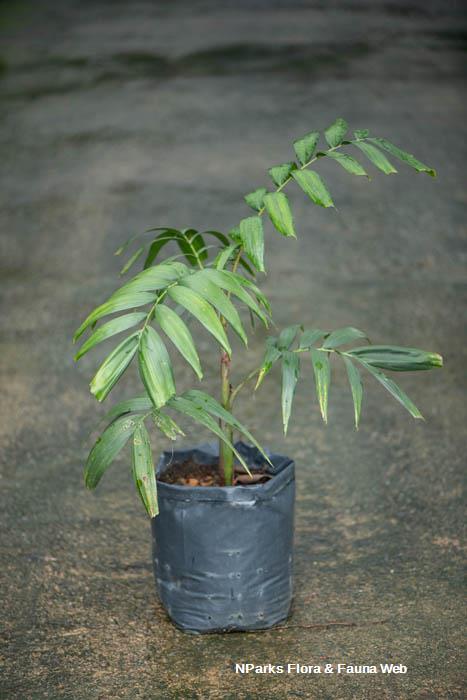
Adonidia zibabaoa Adorador & Fernando
| Family Name: | Arecaceae (Palmae) |
| Common Name: | Amuring, Samar Palm |
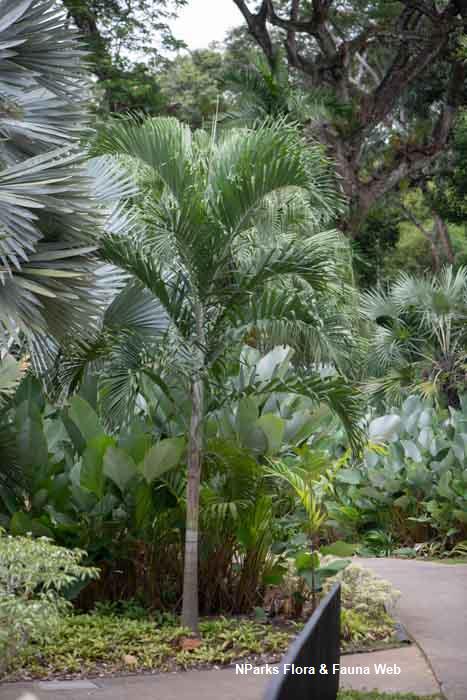
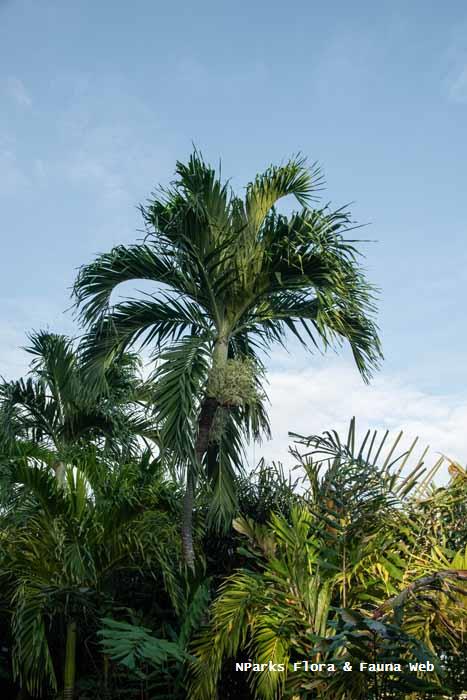
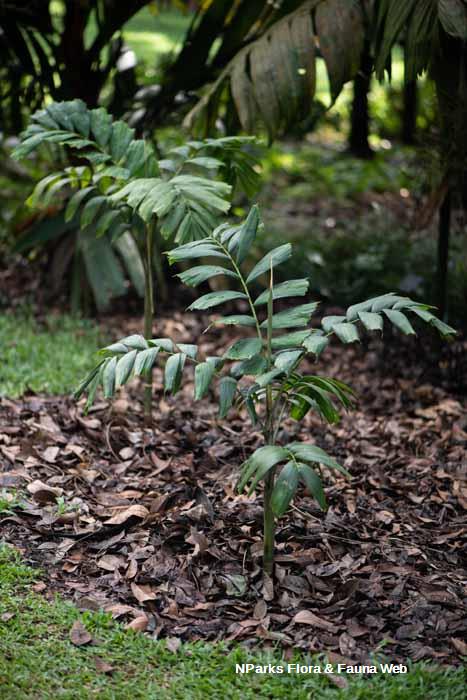
Adonidia zibabaoa, or known as Amuring or Samar Palm, is a slow-growing, understorey solitary palm endemic to the Philippines. Growing up 15 m tall, the palm produces odd-pinnately compound fronds with fish-tail leaflets. The palm was first discovered in 2013, but was only described in 2017 and formally identified as a new species in 2025.
Name
Classifications and Characteristics
| Plant Division | Angiosperms (Flowering Seed Plants) (Monocotyledon) |
|---|---|
| Plant Growth Form | Palm (Solitary Habit) |
| Lifespan (in Singapore) | Perennial |
| Mode of Nutrition | Autotrophic |
| Plant Shape | Fountain (Palm-like) |
| Maximum Height | 5 m to 15 m |
Biogeography
| Native Distribution | The Philippines (Samar Island) |
|---|---|
| Native Habitat | Terrestrial (Primary Rainforest) |
| Preferred Climate Zone | Tropical |
| Local Conservation Status | Non-native (Horticultural / Cultivated Only) |
Description and Ethnobotany
| Growth Form | It is a moderately slender, solitary palm, up to 5–15 m tall. |
|---|---|
| Trunk | The trunk is erect and tapering towards the top, reaching 5–15 m tall × 5–15 cm in diameter, and is visibly ringed. |
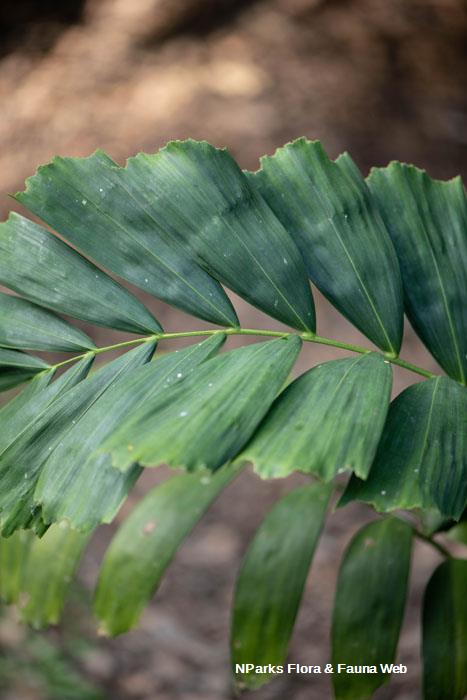
| Foliage | The fronds are semi-erect and odd-pinnately compound with 8–20 leaflets on either side of the rachis (midrib of compound leaves). The leaflets resemble fish-tails with jagged, truncated tips, ranging from 7–36 cm long × 1–14.5 cm wide. Leaflets are wider, longer and wedge-shaped along the middle, while thinner and lance-shaped towards the base, and equally thin but wedge-shaped towards the tip. The rachis is long, slender, bifacial above and rounded below, reaching 62–120 cm long × up to 1.2 cm wide. The petiole (leaf stalk) is (1–)6.7–9 cm long × up to 1.7 cm wide, shallowly channelled above and rounded below. Both the rachis and the petiole are covered in a thin, whitish-grey, powdery coating interspersed with minute, scruffy, light-brown scales and larger, dark-brown, shield-shaped scales. |
| Crown Shaft | The crown shaft is up to 40–50 cm long × 8–10 cm wide. It is covered in the same coating and scales as the rachis and petiole. |
| Flowers | The inflorescence is an infrafoliar panicle, emerging below the fronds and crown shaft, and subtended by spathes or peduncular bracts. It is up to 37 cm long, including a 5–8.5 cm long peduncle (central stalk on inflorescence) and branches up to 2–3 orders with white rachillae (minor, secondary axes on inflorescences). Triads of one female flower flanked by two male flowers are arranged spirally throughout each rachillae, with clusters of paired or solitary male flowers towards the tip. The pale green to greenish white male flowers turn purplish white when the numerous stamens mature. Female flowers are more ovoid in shape. |
| Fruit | The fruit is an ellipsoid drupe, reaching 2.4–3 cm long × 1.3–1.9 cm in diameter. They ripen from orange to red. The single seed is ovoid-ellipsoid, reaching 1.3–2.4 cm long. |
| Habitat | It can be found in the understory of forests over limestone at 270–420 m above sea level. |
| Taxonomy | The species was first discovered on Samar Island, in a limestone forest in 2013, but was only described in 2017 and formally identified in 2025. |
| Cultivation | It grows best in fertile, well-draining soil under full sun (semi-shade when young). It can be propagated by seeds. |
| Etymology | The genus Adonidia was named in honour of the Roman sun god, Adonis, combined with a diminutive suffix, referring to the attractive appearance of the compact palm. The specific epithet zibabaoa is from Zibabao, a Hispanized version of Ibabao, an old name for Samar Island. |
Landscaping Features
| Desirable Plant Features | Ornamental Form, Ornamental Foliage |
|---|---|
| Landscape Uses | General, Parks & Gardens |
| Thematic Landscaping | Naturalistic Garden |
Fauna, Pollination and Dispersal
| Pollination Method(s) | Biotic (Fauna) (Insects (Bee)) |
|---|---|
| Seed or Spore Dispersal | Biotic (Fauna) (Vertebrates (Birds)) |
Plant Care and Propagation
| Light Preference | Full Sun, Semi-Shade |
|---|---|
| Water Preference | Moderate Water |
| Plant Growth Rate | Slow |
| Rootzone Tolerance | Fertile Loamy Soils, Alkaline high pH Soils, Well-Drained Soils |
| Propagation Method | Seed |
Foliar
| Foliage Retention | Evergreen |
|---|---|
| Mature Foliage Colour(s) | Green |
| Mature Foliage Texture(s) | Smooth, Velvety / Furry / Tomentose |
| Foliar Modification | Flower/Fruit Bract |
| Foliar Type | Compound (Odd-Pinnate) |
| Foliar Arrangement Along Stem | Spiral |
| Foliar Attachment to Stem | Petiolate |
| Foliar Shape(s) | Palm Fronds (Pinnate / Feather) |
| Foliar Venation | Parallel |
| Foliar Apex - Tip | Truncate |
| Foliar Base | Cuneate |
| Leaf Area Index (LAI) for Green Plot Ratio | 2.5 (Palm - Solitary) |
Non - Foliar and Storage
| Trunk Type (Palm) | Aboveground, Solitary Habit |
|---|---|
| Root Type | Underground (Fibrous Root) |
Floral (Angiosperm)
| Flower & Plant Sexuality | Unisexual Flowers , Monoecious |
| Flower Colour(s) | Green - Light Green, White, Purple |
|---|
| Flower Texture(s) | Smooth |
| Flower Grouping | Cluster / Inflorescence |
| Flower Symmetry | Radial |
| Inflorescence Type | Panicle |
| Ovary Position | Superior / Hypogynous |
| Flowering Habit | Polycarpic |
Fruit, Seed and Spore
| Mature Fruit Colour(s) | Orange, Red |
|---|---|
| Mature Fruit Texture(s) | Smooth |
| Fruit Classification | Simple Fruit |
| Fruit Type | |
| Mature Seed Colour(s) | Brown |
| Seed Quantity Per Fruit | Few (1-5) |
References
| References | Aborabor, J.T., Perez-Calle, V., Meneses-Adorador, Z.D., Bellot, S., Baker, W.J., & Fernando, E.S. (2025). Adonidia zibabaoa, a Remarkbale New Palm Species from Samar Island, Philippines. Palms 69(1). 5-20. |
|---|
Image Repository
Others
| Master ID | 34205 |
|---|---|
| Species ID | 8618 |
| Flora Disclaimer | The information in this website has been compiled from reliable sources, such as reference works on medicinal plants. It is not a substitute for medical advice or treatment and NParks does not purport to provide any medical advice. Readers should always consult his/her physician before using or consuming a plant for medicinal purposes. |