





Back
Canarium decumanum Gaertn.
| Family Name: | Burseraceae |
| Common Name: | Kenari Sabrang, Kenari Besar |
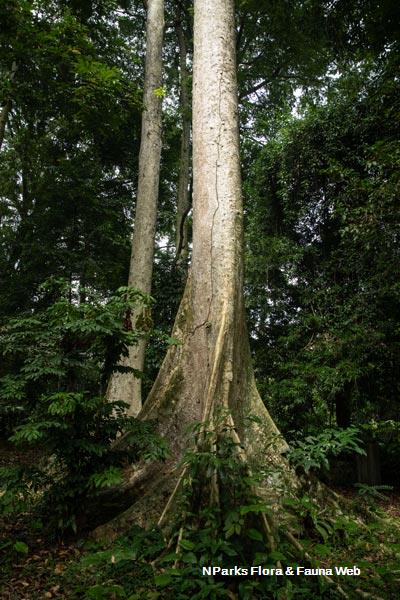
Canarium decumanum, also known as Kenari Sabrang, is a large tree growing up to 60 m tall, with buttresses up to 8 m high. It produces cream-coloured flowers and elliptical fleshy fruit with one seed within. The seeds are eaten in New Guinea and the resin is used for making torches, caulking boats and fixing knives.
Name
Classifications and Characteristics
| Plant Division | Angiosperms (Flowering Seed Plants) |
|---|---|
| Plant Growth Form | Tree |
| Lifespan (in Singapore) | Perennial |
| Mode of Nutrition | Autotrophic |
| Maximum Height | 60 m |
Biogeography
| Native Distribution | Borneo, Moluccas, New Guinea |
|---|---|
| Native Habitat | Terrestrial (Secondary Rainforest) |
| Preferred Climate Zone | Tropical |
| Local Conservation Status | Non-native |
Description and Ethnobotany
| Growth Form | It is a tree, up to 60 m tall, with buttresses, up to 8 m tall. The trunk can reach up to 2 m diameter. It produces clear sticky exudate which becomes dark brown on exposure. |
|---|---|
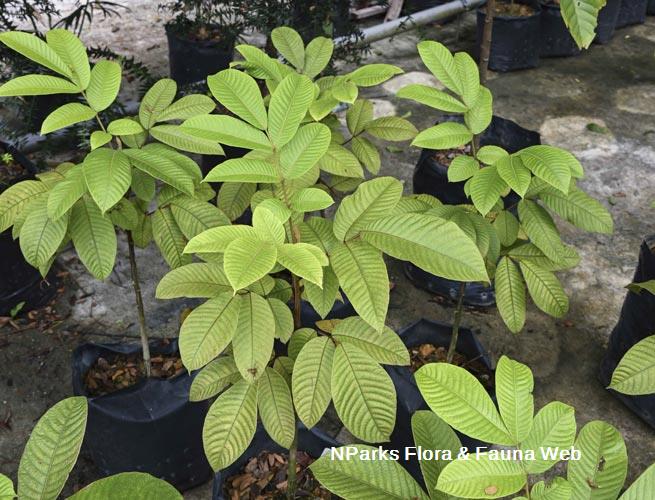
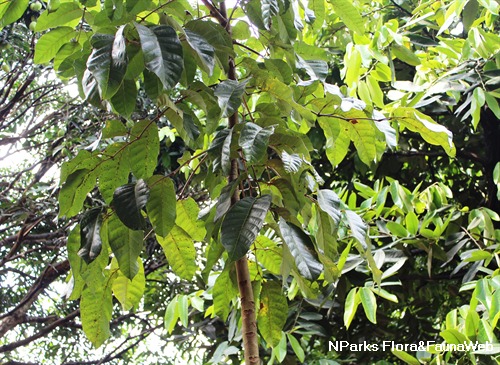
| Foliage | The leaves are compound, measuring 35 – 45 cm long, and consist of (3–) 4–5 (–6) pairs of leaflets. The leaflet is ovate to oblong about 5 –30 cm long and 2.5 – 10 cm wide. The leaflet tip is usually tapering (acuminate), while the base is rounded to slight heart-shaped (subcordate) and the margin is entire. They have a stiff and papery (stiff-chartaceous) to leathery (coriaceous) texture. Each leaflet has 17 – 26 pairs of lateral veins which are prominent on the underside of the leaf. The stipule is very small and falls off early, leaving a small circular scar. There are pellucid oil-glands present in the leaflets. |
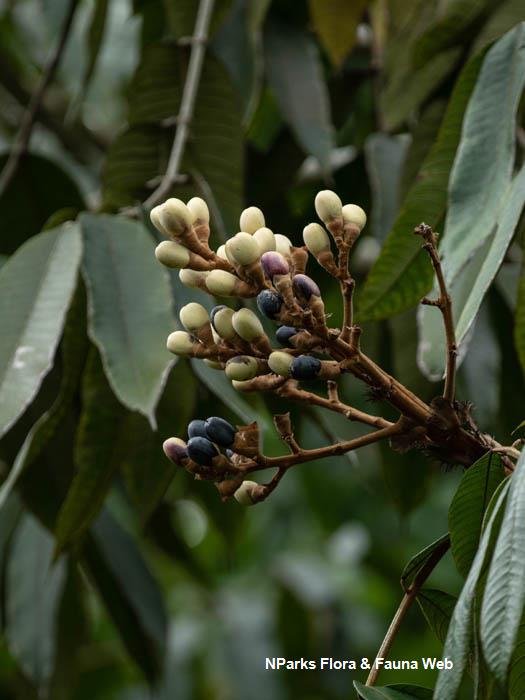
| Flowers | The flowers occur in a branched cluster (narrowly paniculate) in the leaf axils. Flowers are unisexual, with male and female flowers borne on separate trees. Male inflorescences are longer (4–19 cm) and denser, bearing more flowers than the female inflorescences which is shorter (5–7 cm). The flowers are cream-coloured and hairy. Male flowers are smaller (7–9 mm long), while female flowers are larger (8–14 mm long). |
| Fruit | The fruit is elliptic and fleshy (drupe) about 7 – 8.5 cm long and 4.5 – 6 cm wide. It is covered with rough hairs and has a slightly triangular in cross section. Each fruit contains a single seed. |
| Habitat | It is found in rainforests. |
| Associated Fauna | Flowers are pollinated by insects. |
| Cultivation | It can be propagated by seed. |
| Etymology | The genus Canarium is from the Moluccan name, kenari. The specific epithet decumanum, in Latin, means the largest or greatest, possibly referring to the size of the fruit and tree. |
| Ethnobotanical Uses | Edible Plant Parts : Edible Seeds Food (Fruit or Vegetable): The seeds are edible and are eaten in New Guinea. Others: The resin is used for making torches, caulking boats and fixing knives. |
Landscaping Features
| Landscape Uses | Parks & Gardens |
|---|
Fauna, Pollination and Dispersal
| Pollination Method(s) | Biotic (Fauna) |
|---|---|
| Seed or Spore Dispersal | Biotic (Fauna) |
Plant Care and Propagation
| Light Preference | Full Sun |
|---|---|
| Water Preference | Moderate Water |
| Plant Growth Rate | Moderate |
Foliar
| Mature Foliage Colour(s) | Green |
|---|---|
| Mature Foliage Texture(s) | Papery, Leathery |
| Foliar Type | Compound |
| Foliar Arrangement Along Stem | Spiral |
| Foliar Margin | Entire |
| Foliar Apex - Tip | Acuminate |
| Foliar Base | Rounded / Obtuse, Cordate |
Non - Foliar and Storage
| Trunk Type (Non Palm) | Woody |
|---|---|
| Root Type | Underground |
Floral (Angiosperm)
| Flower & Plant Sexuality | Unisexual Flowers , Dioecious |
| Flower Colour(s) | Cream / Off-White |
|---|
| Flower Grouping | Cluster / Inflorescence |
| Flower Location | Axillary |
| Inflorescence Type | Panicle |
Fruit, Seed and Spore
| Mature Fruit Texture(s) | Rough |
|---|---|
| Fruit Classification | Simple Fruit |
| Fruit Type | Fleshy Fruit , Drupe |
| Seed Quantity Per Fruit | Few (1-5) |
References
| References | Kochummen, K.M. 1995. Burseraceae. Tree Flora of Sabah and Sarawak, 1: 45–100. Leenhouts, P.W. 1956. Burseraceae. Flora Malesiana. Series I, 5: 209–296. Lemmens, R.H.M.J., Soerianegara, I., and Wong, W.C. (Editors). 1995. Plant Resources of South-East Asia Volume 5 (2). Timber Trees: Minor commercial timbers. Indonesia: Prosea Foundation. 655 pages. |
|---|
Image Repository
Others
| Master ID | 34527 |
|---|---|
| Species ID | 8940 |
| Flora Disclaimer | The information in this website has been compiled from reliable sources, such as reference works on medicinal plants. It is not a substitute for medical advice or treatment and NParks does not purport to provide any medical advice. Readers should always consult his/her physician before using or consuming a plant for medicinal purposes. |
.jpg)