







Back
Commelina erecta L.
| Family Name: | Commelinaceae |
| Synonyms: | Commelina elegans Kunth, Commelina angustifolia Michx., Commelina crispa Wooton |
| Common Name: | Slender Dayflower, Erect Dayflower, White Mouth Dayflower |
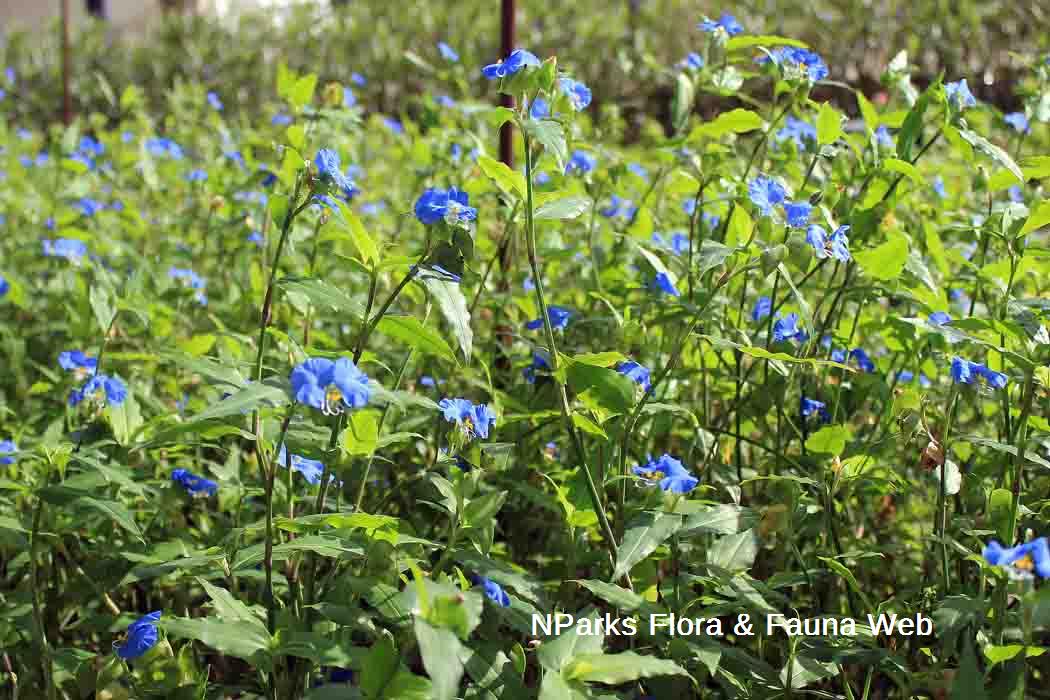
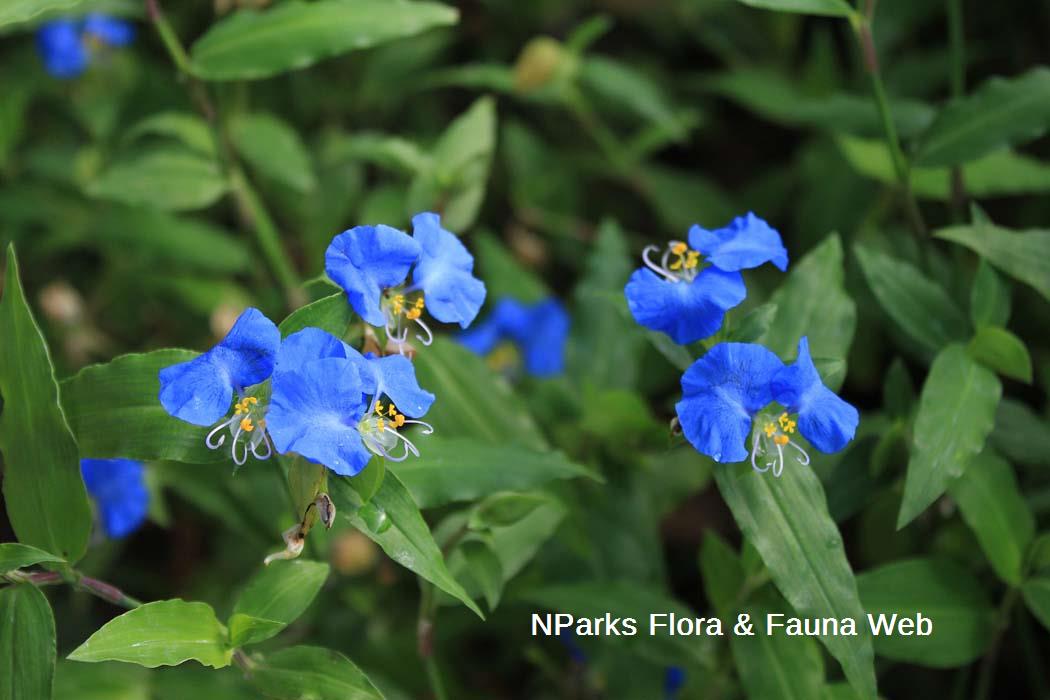
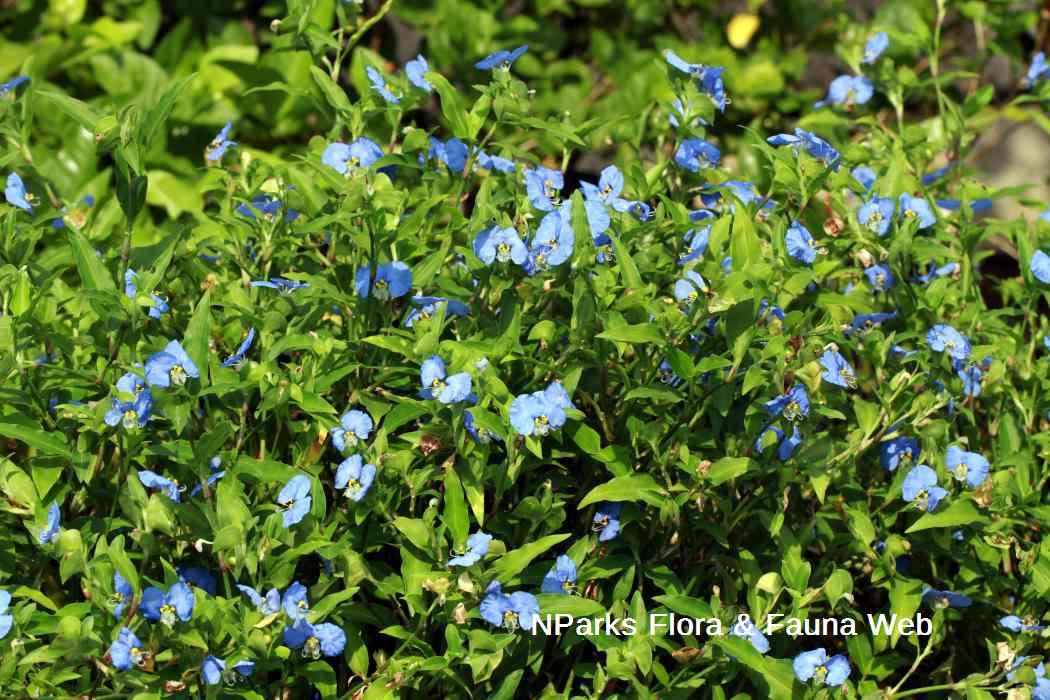
Commelina erecta, also known as Slender Dayflower, is a fast-growing, spreading perennial herb that can reach 0.2–0.5 m tall. It produces clusters of erect to ascending stems, linear to lance-shaped leaves, and ornamental blue flowers that bloom during the day and close past midday. It grows well under full sun and tolerates a variety of soil conditions.

Name
Classifications and Characteristics
| Plant Division | Angiosperms (Flowering Seed Plants) (Monocotyledon) |
|---|---|
| Plant Growth Form | Herbaceous Plant |
| Lifespan (in Singapore) | Perennial |
| Mode of Nutrition | Autotrophic |
| Plant Shape | Leggy, Irregular |
| Maximum Height | 0.2 m to 0.5 m |
Biogeography
| Native Distribution | United States, Mexico, Guatemala, Belize, El Salvador, Honduras, Nicaragua, Costa Rica, Panama, Bahamas, Turks and Caicos Islands, Cuba, Cayman Islands, Jamaica, Haiti, Dominican Republic, Puerto Rico, Leeward Islands, Windward Islands, Trinida and Tobago, Colombia, Venezuela, Guyana, Suriname, French Guiana, Brazil, Ecuador, Peru, Bolivia, Paraguay, northern Argentina, Uruguay, West tropical Africa (Senegal, Gambia, Guinea-Bissau, Mali, Guinea, Sierre Leone, Liberia, Ivory Coast, Burkina, Ghana, Togo, Benin, Nigeria, Niger), Northeast tropical Africa (Chad, Sudan, Ethiopia, Somalia), West-Central tropical Africa (Cameroon, Equatorial Guinea, Congo, Central African Republic, Zaïre, Rwanda, Burundi), East tropical Africa (Uganda, Kenya, Tanzania), South tropical Africa (Angola, Malawi, Zimbabwe, Mozambique), Southern Africa (Namibia, Caprivi Strip, Botswana, Northern Provinces, Swaziland, Free State, KwaZulu-Natal, Cape Provinces), Saudi Arabia & Yemen |
|---|---|
| Native Habitat | Terrestrial (Temperate Forest, Grassland / Savannah/ Scrubland, Disturbed Area / Open Ground) |
| Preferred Climate Zone | Tropical, Sub-Tropical / Monsoonal, Temperate |
| Local Conservation Status | Non-native (Horticultural / Cultivated Only) |
Description and Ethnobotany
| Growth Form | It is a short, perennial herb that grows in dense clumps, with usually erect to ascending stems that can reach 0.2–0.5 m in height. |
|---|---|
| Roots | The roots are fleshy, stout and white, often growing from nodes when in contact with soil. |
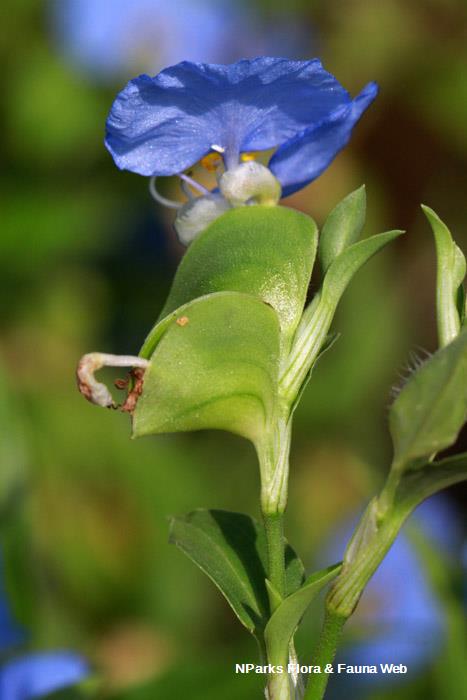
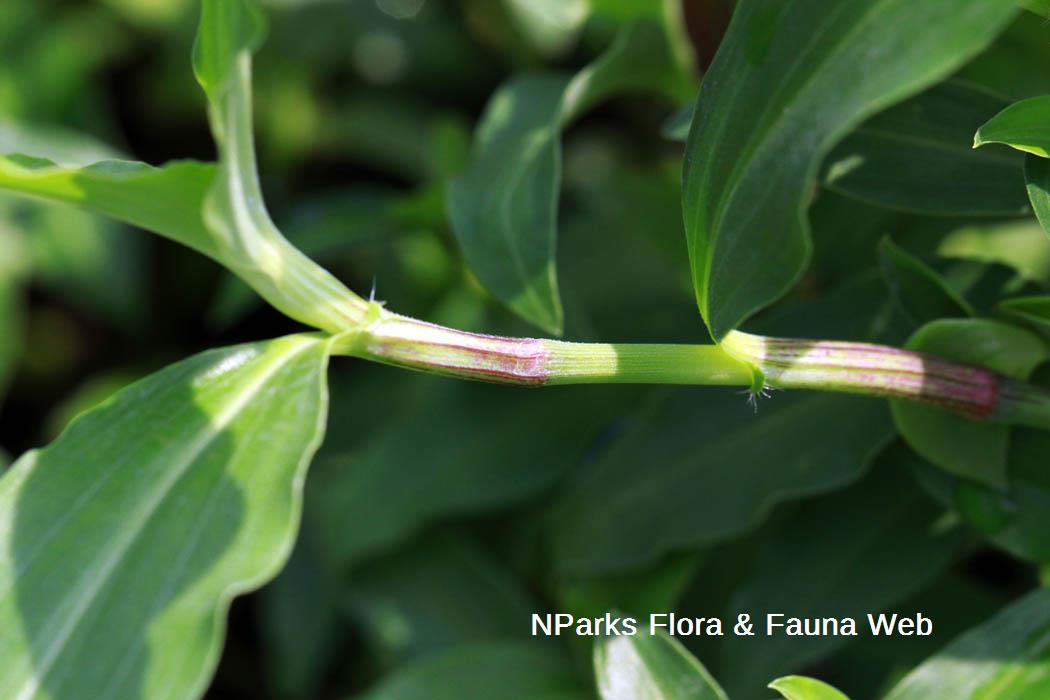
| Foliage | The leaf blades are green, linear to lanceolate, measuring 5–15 cm long × 0.3–4 cm wide. The leaf sheath is closed, forming a tight tube around the stem. Reddish longitudinal ridges are occasionally present along the leaf sheath. Ear-like appendages are present at the top of the leaf sheath, on either side of the leaf blade. |
| Stems | The stems are usually erect to ascending, often rooting from nodes when in contact with soil. |
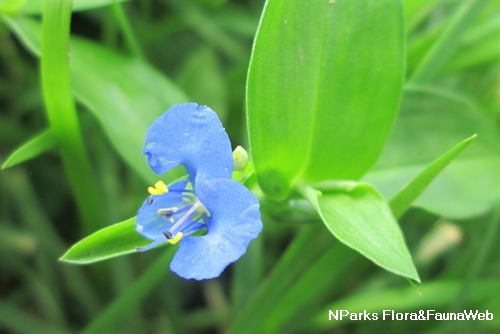
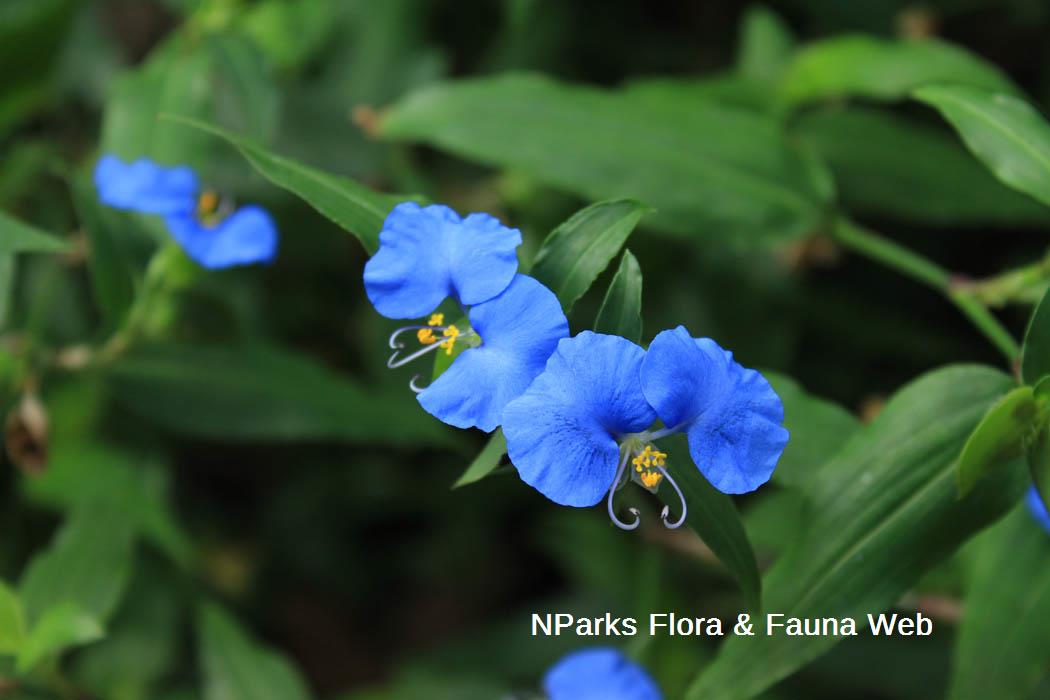
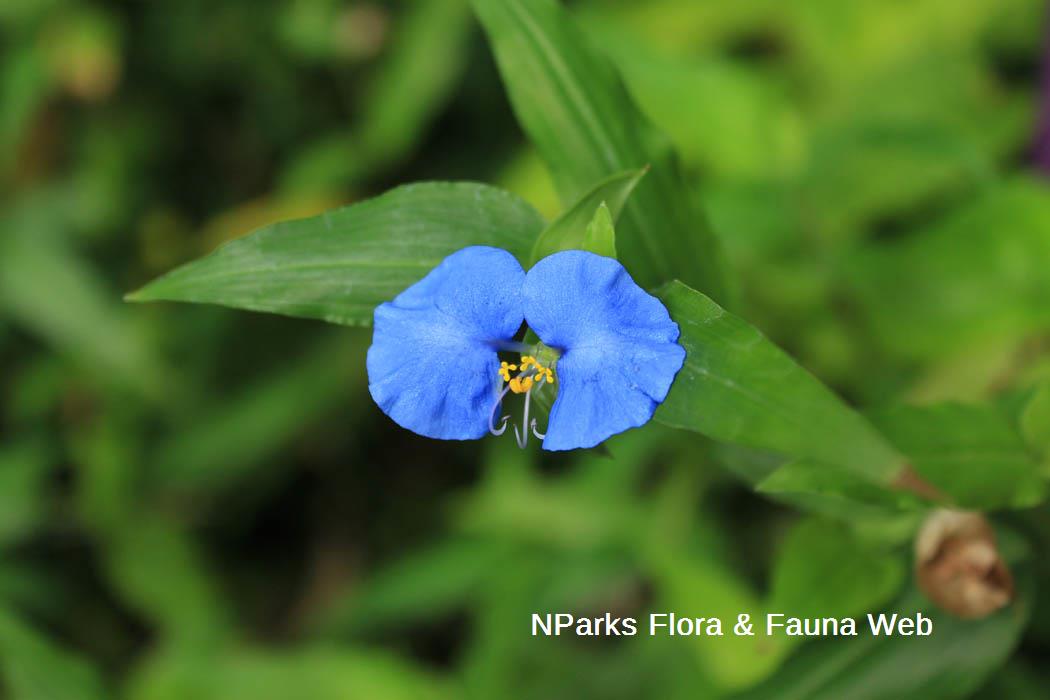
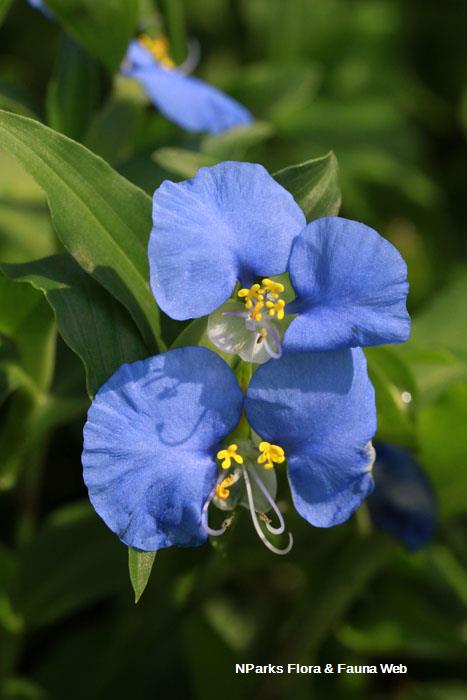
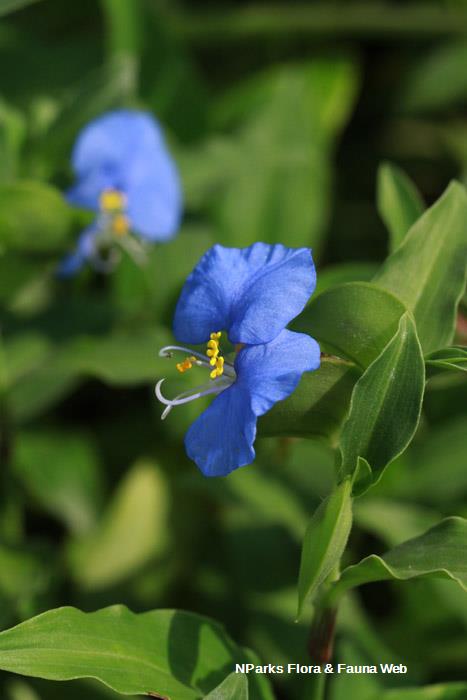
| Flowers | The inflorescence is a cincinnus (a type of one-sided inflorescence in which successive buds develop alternately and arranged in a sort of spiral) with a vestigial tip. The involucral bracts or spathes are either solitary or clustered, boat-shaped, smooth, green, and filled with a mucilaginous liquid. The flower has fused cup-shaped sepals, three ovate petals; a smaller, white or semi-translucent one at the bottom and two prominent blue ones on either side, a yellow medial stamen, two hook-shaped stamens, three yellow cross-shaped staminodes (sterile stamens), and a thin lavender pistil. The flowers open in the morning and closes past noon. |
| Fruit | The fruit is a three-lobed capsule (a type of dry, dehiscent fruit) with the warty, lower lobe not splitting and the smooth, dehiscent upper lobes. The seeds are brown, nearly smooth, with soft, whitish tissue at both ends or in a band. A single capsule produces three seeds. |
| Habitat | It can be found in rocky woodlands and hillsides, scrub oak woods, pine woods and barrens, sand dunes, hummocks, shale barrens, roadsides, railroad rights-of-way, fields, and occasionally a weed in cultivated ground. |
| Similar | This species resembles Commelina diffusa but can be differentiated by its more upright habit and larger flowers. |
| Cultivation | It grows well in dry to moist, well-draining sandy, loamy or rocky soil and under bright, direct sunlight. Leaves will show visible signs of wilting when lacking water. It can be propagated by seeds and cuttings. |
| Etymology | The genus Commelina is named in honour of Johann Commelijn and his nephew, Caspar Commelijn, two 17th Century Dutch botanists. The name was given by Carl Linnaeus, representing the botanists as the two showy petals of type species, Commelina communis. The specific epithet refers to the erect habit of the stems. |
Landscaping Features
| Desirable Plant Features | Ornamental Flowers, Ornamental Form |
|---|---|
| Landscape Uses | Groundcover, Parks & Gardens, Suitable for Hanging Baskets, Suitable for Roadsides, Suitable for Rooftops, Flowerbed / Border, Container Planting |
| Thematic Landscaping | Naturalistic Garden |
| Usage Hazard - Cons | Invasive / Potentially Invasive |
| Usage Hazard - Cons Remarks | Invasive / Potentially Invasive: The stems, including stem fragments, will root easily at the node when in contact with soil. Properly dispose of any pruned or broken stems. |
Plant Care and Propagation
| Light Preference | Full Sun |
|---|---|
| Water Preference | Moderate Water |
| Plant Growth Rate | Fast |
| Rootzone Tolerance | Easy to Grow, Shallow Media, Fertile Loamy Soils, Heavy Clay Soils, Disease / Pest Resistant, Poor Infertile Soils, Well-Drained Soils |
| Transplanting Tolerance | Moderate |
| Maintenance Requirements | Low |
| Pest(s) | Chewing Insects |
| Propagation Method | Stem Cutting (Herbaceous), Seed |
Foliar
| Foliage Retention | Evergreen |
|---|---|
| Mature Foliage Colour(s) | Green |
| Young Flush Texture(s) | Smooth |
| Foliar Modification | Flower/Fruit Bract |
| Foliar Type | Simple / Unifoliate |
| Foliar Arrangement Along Stem | Alternate |
| Foliar Attachment to Stem | Sessile |
| Foliar Shape(s) | Non-Palm Foliage (Linear, Lanceolate) |
| Foliar Venation | Parallel |
| Foliar Apex - Tip | Acuminate |
| Foliar Base | Clasping |
| Leaf Area Index (LAI) for Green Plot Ratio | 3.5 (Shrub & Groundcover - Monocot) |
Floral (Angiosperm)
| Flower & Plant Sexuality | Bisexual Flowers |
| Flower Colour(s) | Blue, White |
|---|---|
| Flower Texture(s) | Thin |
| Flower Grouping | Cluster / Inflorescence |
| Flower Location | Axillary |
| Flower Symmetry | Bilateral |
| Inflorescence Type | Scorpoid Cyme |
| Ovary Position | Superior / Hypogynous |
| Flowering Opening Time | Daytime |
| Flower Lifespan on Plant | Dawn to Noon |
| Flowering Habit | Polycarpic |
Fruit, Seed and Spore
| Mature Fruit Colour(s) | Brown |
|---|---|
| Mature Fruit Texture(s) | Smooth, Rough |
| Fruit Classification | Simple Fruit |
| Fruit Type | |
| Mature Seed Colour(s) | Brown |
| Seed Quantity Per Fruit | Few (1-5) |
References
| References | Flora of North America. http://www.efloras.org/florataxon.aspx?flora_id=1&taxon_id=222000043 |
|---|
Image Repository
Others
| Master ID | 34590 |
|---|---|
| Species ID | 9003 |
| Flora Disclaimer | The information in this website has been compiled from reliable sources, such as reference works on medicinal plants. It is not a substitute for medical advice or treatment and NParks does not purport to provide any medical advice. Readers should always consult his/her physician before using or consuming a plant for medicinal purposes. |