




Back
Abutilon indicum (L.) Sweet
| Family Name: | Malvaceae |
| Common Name: | India Abutilon, Monkey Bush, 磨盘草 |
Name
Classifications and Characteristics
| Plant Division | Angiosperms (Flowering Seed Plants) (Dicotyledon) |
|---|---|
| Plant Growth Form | Shrub |
| Mode of Nutrition | Autotrophic |
| Maximum Height | 2 m |
Biogeography
| Native Distribution | India, China, Australia, Malaysia, Indonesia, Thailand, Seychelles, Mauritius |
|---|---|
| Local Conservation Status | Native to Singapore (Critically Endangered (CR)) |
Description and Ethnobotany
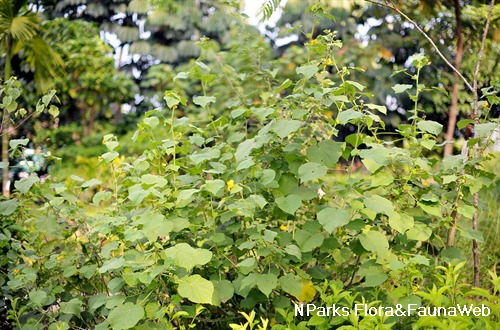
| Growth Form | A multi-branched, erect velvety-pubescent subshrub with round stem, often tinged with purple, up to 2 m in height. |
|---|---|
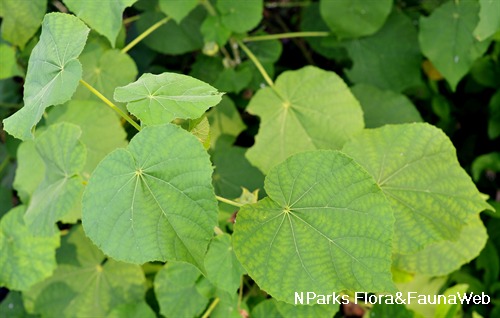
| Foliage | Leaves simple, circular-ovate or heart-shaped, 5-12cm long and wide; both sides softly velvety-pubescent, alternately arranged, with coarsely crenate-serrate margins. Petiole 2-4cm, stipules subulate, 1-2mm, curved outward. |
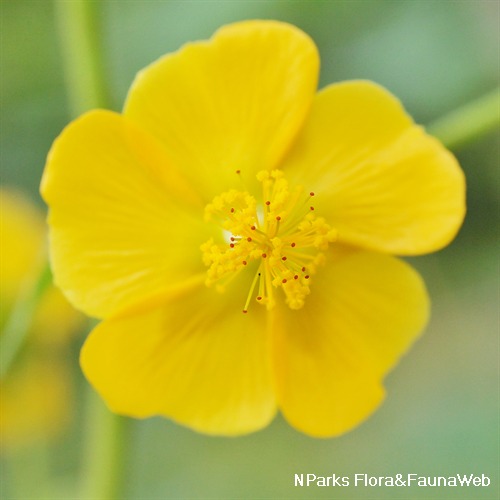
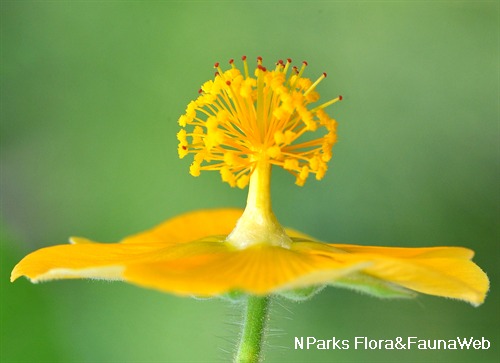
| Flowers | The 5-petalled yellow flowers grow on the leaf axils, solitary, flower size up to 3 cm across. In Pakistan, it is observed that flower anthesis may be affected by temperature and light. At 25-30 degree Celsius, anthesis took place between 1-2pm; while on cloudy days, flowers open at 4pm. <1> |
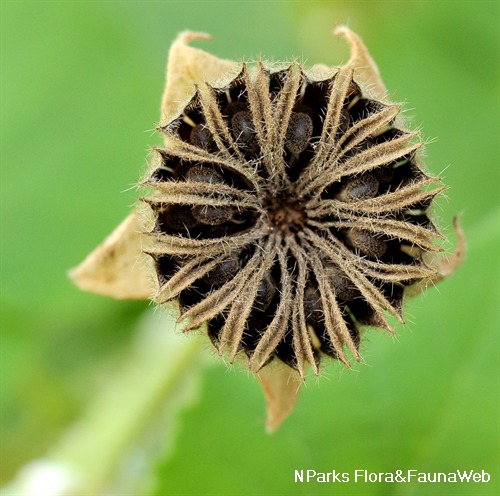
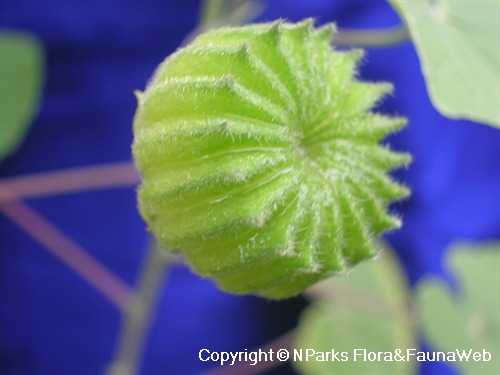
| Fruit | Fruits is a dry schizocarp (splits apart into single-seeded parts), circular, 1.5- 2 cm diameter, green ripening to black, with 11-20 radiating carpels, each carpel flattened, somewhat boat shaped. Seeds reniform (kidney-shaped), slightly stellate, pubescent, dark brown or black. |
| Habitat | Found in coastal areas, open areas, secondary vegetation or along the wayside. |
| Cultivation | Easily grown from seeds. Prefers fertile & well-drained soils. Propagated by seeds or by taking tip cuttings. |
| Etymology | The genus name is derived from Arabic Abutilon which means mallow. Abutilon is a large genus of broadleaf evergreens in the mallow family, Malvaceae, thus the use of the common English name "Mallow" in its range of common names. The species "indicum" means from India or pertaining to Indian in Latin. In this case, refers to the origin of the plant - India. |
| Ethnobotanical Uses | Food (Herb or Spice) Others: Products: Fibres from stems are harvested to make jute & paper. Fibres also used in rope-making - coarse but flexible, strong & take dyes well. Seeds contain approximately 19% of a semi-drying oil. |
Landscaping Features
| Thematic Landscaping | Naturalistic Garden, Wildflower Garden |
|---|
Plant Care and Propagation
| Light Preference | Full Sun |
|---|---|
| Water Preference | Moderate Water |
| Plant Growth Rate | Moderate |
| Rootzone Tolerance | Fertile Loamy Soils, Well-Drained Soils |
| Propagation Method | Seed, Stem Cutting |
Foliar
| Mature Foliage Colour(s) | Green |
|---|---|
| Leaf Area Index (LAI) for Green Plot Ratio | 4.5 (Shrub & Groundcover - Dicot) |
Fruit, Seed and Spore
| Mature Fruit Colour(s) | Green |
|---|
References
| References | <1> Rubina, A., Jan, A. & Qaiser, M. (2010). Pollination mechanism and role of insects in Abutilon indicum (L.) Sweet. Pak. J. Bot, 42(3): 1395-1399. |
|---|
Image Repository
Others
| Master ID | 286 |
|---|---|
| Species ID | 1582 |
| Flora Disclaimer | The information in this website has been compiled from reliable sources, such as reference works on medicinal plants. It is not a substitute for medical advice or treatment and NParks does not purport to provide any medical advice. Readers should always consult his/her physician before using or consuming a plant for medicinal purposes. |