






Name
Classifications and Characteristics
| Plant Division | Angiosperms (Flowering Seed Plants) (Monocotyledon) |
|---|---|
| Plant Growth Form | Herbaceous Plant |
| Lifespan (in Singapore) | Perennial |
| Mode of Nutrition | Autotrophic |
| Plant Shape | Shrubby |
| Maximum Height | 1.2 m |
Description and Ethnobotany
| Growth Form | It is a herbaceous plant that can grow up to 0.3 - 0.5 m in height. |
|---|---|
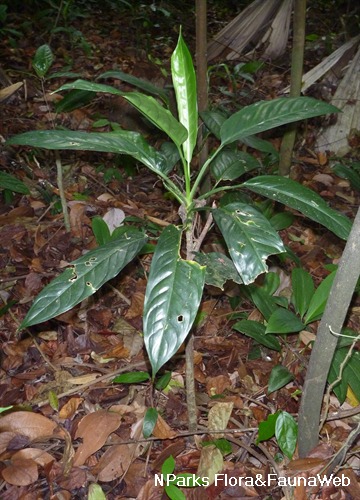
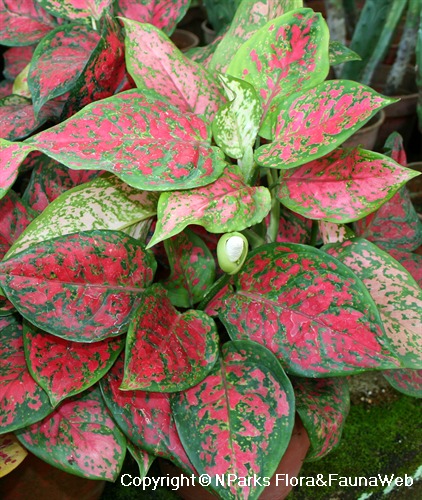
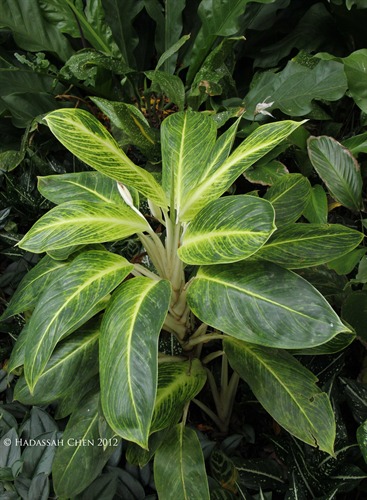
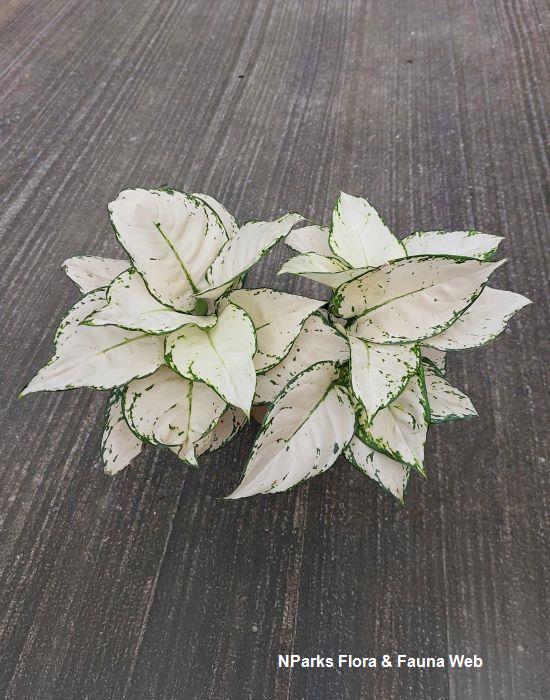
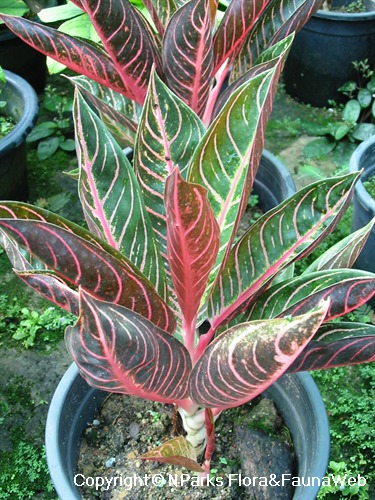
| Foliage | The leaves are broadly egg-shaped that tapers into a soft tip. The leaves are medium to dark green with light pink midrib and veins. The underside of the leaves is bright reddish-pink. The petiole (leaf stalk) is reddish-pink that fades off to white at the base. |
| Flowers | The inflorescence is a spadix, and subtended by a spathe. |
| Taxonomy | One of the parents of this hybrid cultivar is Aglaonema rotundum. |
| Cultivation | It grows best in bright, indirect sunlight or semi-shade and prefers moist, well-draining, loamy soil. Although it tolerates heavy shade, the plant may grow leggy over time. Keep away from bright, direct sunlight to prevent leaves from scorching. |
| Etymology | The generic epithet Aglaonema is derived from Greek aglaos, "bright" and nema, "thread", possibly referring to the stamens. |
Landscaping Features
| Desirable Plant Features | Ornamental Foliage |
|---|---|
| Landscape Uses | Container Planting, Indoor Plant, Parks & Gardens, Small Gardens |
| Usage Hazard - Cons | Toxic Upon Ingestion, Irritant - Sap |
| Usage Hazard - Cons Remarks | All parts of plant contains calcium oxalate crystals in their sap, causing mouth and throat irritation if ingested, and possible itchiness if in contact with the skin. Keep away from pets and children. |
Plant Care and Propagation
| Light Preference | Semi-Shade |
|---|---|
| Water Preference | Moderate Water, Occasional Misting |
| Plant Growth Rate | Moderate |
| Rootzone Tolerance | Easy to Grow, Fertile Loamy Soils, Moist Soils, Well-Drained Soils |
| Pest(s) | Sucking Insects |
| Propagation Method | Stem Cutting |
Foliar
| Foliage Retention | Evergreen |
|---|---|
| Mature Foliage Colour(s) | Green, Pink, Red, Patterned |
| Mature Foliage Texture(s) | Smooth |
| Foliar Type | Simple / Unifoliate |
| Foliar Arrangement Along Stem | Spiral |
| Foliar Attachment to Stem | Petiolate |
| Foliar Shape(s) | Non-Palm Foliage (Elliptical) |
| Foliar Venation | Pinnate / Net |
| Foliar Margin | Entire |
| Foliar Apex - Tip | Acuminate |
| Foliar Base | Rounded / Obtuse |
| Leaf Area Index (LAI) for Green Plot Ratio | 3.5 (Shrub & Groundcover - Monocot) |
Non - Foliar and Storage
| Stem Type & Modification | Herbaceous |
|---|---|
| Root Type | Underground (Fibrous Root) |
| Specialised Storage Organ(s) | Underground (Rhizome) |
Floral (Angiosperm)
| Flower & Plant Sexuality | Unisexual Flowers , Monoecious |
| Flower Colour(s) | White |
|---|
| Flower Grouping | Cluster / Inflorescence |
| Flower Location | Terminal |
| Inflorescence Type | Spathe & Spadix |
Image Repository
Others
| Master ID | 329 |
|---|---|
| Species ID | 1625 |
| Flora Disclaimer | The information in this website has been compiled from reliable sources, such as reference works on medicinal plants. It is not a substitute for medical advice or treatment and NParks does not purport to provide any medical advice. Readers should always consult his/her physician before using or consuming a plant for medicinal purposes. |