








Back
Lespedeza bicolor
| Family Name: | Fabaceae (Leguminosae) |
| Synonyms: | Desmodium bicolor |
| Common Name: | Ezo-Yama-Hagi, Shrub Lespedeza, Shrubby Bush-Clover |
Name
Classifications and Characteristics
| Plant Division | Angiosperms (Flowering Seed Plants) (Dicotyledon) |
|---|---|
| Plant Growth Form | Shrub |
| Lifespan (in Singapore) | Perennial |
| Mode of Nutrition | Autotrophic |
| Plant Shape | Shrubby |
Biogeography
| Native Distribution | Eastern Asia (China, Korea, Japan) |
|---|---|
| Native Habitat | Terrestrial |
| Preferred Climate Zone | Tropical, Sub-Tropical / Monsoonal |
| Local Conservation Status | Non-native (Horticultural / Cultivated Only) |
Description and Ethnobotany
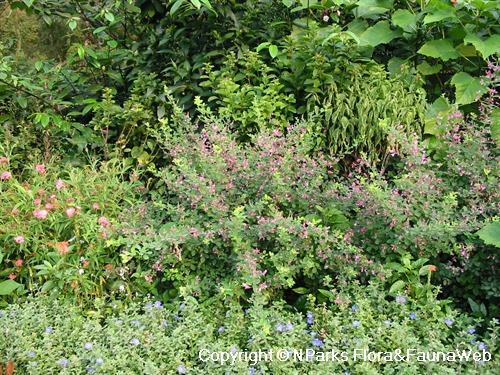
| Growth Form | Multi-branched, erect shrub, able to grow up to about 1 - 3 m tall. |
|---|---|
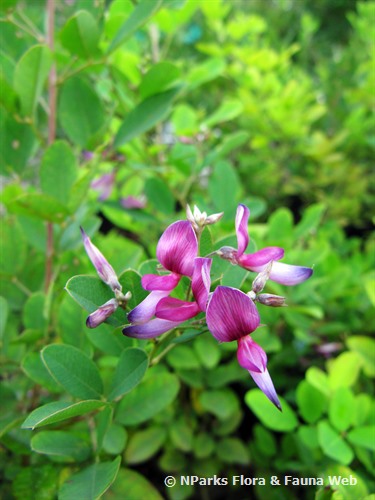
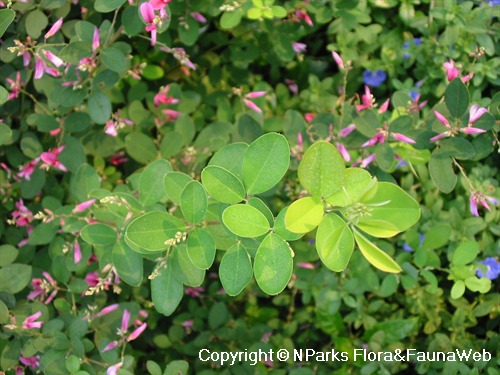
| Foliage | Dark green leaves with 3 leaflets which are elliptical to oval in shape and up to 5 cm long. Leaves are darker green on the upper sides while light green on the under sides. |
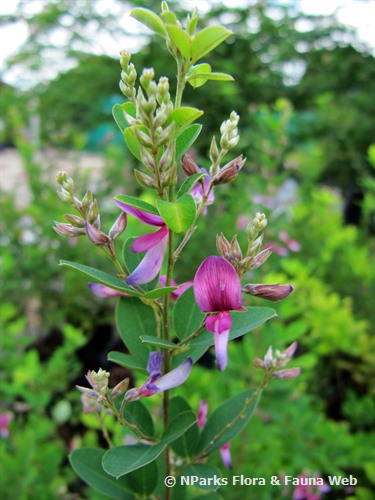
| Flowers | Purple pea-like flowers in a raceme inflorescence, each flower measuring about 1.2 cm long. These flowers bloom both at stem tips and upper leaf axils. |
| Fruit | Fruit is a black, flat pod, rounded to elliptic, indehiscent and contains one seed. |
| Habitat | Found in thickets, slopes, forest margins and along roadsides. |
| Cultivation | Plants grows easily in well-drained soil in full sun. It tolerates infertile or dry-ish soil as well. Ensure there is good drainage. |
| Etymology | Genus Lespedeza is named after V. M. de Lespedez, who was a Spanish Governor of Florida in the 18th century. Species bicolor means of two colours. |
Landscaping Features
| Landscaping | Plants are suitable to be grown in mass and effective on slopes to prevent soil erosion. |
|---|---|
| Desirable Plant Features | Ornamental Flowers |
| Landscape Uses | Parks & Gardens, Small Gardens, Slope Stabilization |
Fauna, Pollination and Dispersal
| Fauna Pollination Dispersal Associated Fauna | Butterfly-Attracting Plant (Flower Nectar) |
|---|---|
| Pollination Method(s) | Biotic (Fauna) (Insects (Butterfly, Moth), Insects (Bee)) |
| Seed or Spore Dispersal | Biotic (Fauna) (Vertebrates (Other Mammal)) |
Plant Care and Propagation
| Light Preference | Semi-Shade, Full Sun |
|---|---|
| Water Preference | Moderate Water |
| Plant Growth Rate | Moderate |
| Rootzone Tolerance | Drought Tolerant, Well-Drained Soils |
| Potential Problems | No serious insect or disease problems. |
| Propagation Method | Seed, Stem Cutting |
Foliar
| Foliage Retention | Deciduous |
|---|---|
| Mature Foliage Colour(s) | Green |
| Prominent Young Flush Colour(s) | Green |
| Foliar Type | Compound (Trifoliate) |
| Foliar Arrangement Along Stem | Alternate |
| Foliar Attachment to Stem | Petiolate |
| Foliar Shape(s) | Non-Palm Foliage |
| Foliar Venation | Pinnate / Net |
| Foliar Margin | Entire |
| Foliar Apex - Tip | Rounded |
| Foliar Base | Rounded / Obtuse |
| Leaf Area Index (LAI) for Green Plot Ratio | 4.5 (Shrub & Groundcover - Dicot) |
Floral (Angiosperm)
| Flower & Plant Sexuality | Bisexual Flowers |
| Flower Colour(s) | Pink, Purple |
|---|---|
| Flower Grouping | Cluster / Inflorescence |
| Flower Location | Axillary, Terminal |
| Flower Symmetry | Bilateral |
| Individual Flower Shape | Papilionaceous / Pea-shaped |
| Inflorescence Type | Raceme |
| Flowering Period | Free-Flowering |
Fruit, Seed and Spore
| Fruit Classification | Simple Fruit |
|---|---|
| Fruit Type | Indehiscent Dry Fruit , Pod |
| Mature Seed Colour(s) | Black |
| Seed Quantity Per Fruit | Few (1-5) |
Image Repository
Others
| Master ID | 900 |
|---|---|
| Species ID | 2194 |
| Flora Disclaimer | The information in this website has been compiled from reliable sources, such as reference works on medicinal plants. It is not a substitute for medical advice or treatment and NParks does not purport to provide any medical advice. Readers should always consult his/her physician before using or consuming a plant for medicinal purposes. |