









Back
Merope angulata (Willd.) Swingle
| Family Name: | Rutaceae |
| Common Name: | Mangrove Lime, Limau Lelang |

Name
Classifications and Characteristics
| Plant Division | Angiosperms (Flowering Seed Plants) |
|---|---|
| Plant Growth Form | Shrub |
| Lifespan (in Singapore) | Perennial |
| Mode of Nutrition | Autotrophic |
Biogeography
| Native Distribution | India, Andaman Islands, Nicobar Islands, Bangladesh, Myanmar, Peninsular Malaysia, Singapore, Borneo, Philippines, Java, Sulawesi, Maluku and New Guinea |
|---|---|
| Native Habitat | Shoreline (Mangrove Forest) |
| Preferred Climate Zone | Tropical, Sub-Tropical / Monsoonal |
| Local Conservation Status | Native to Singapore (Critically Endangered (CR)) |
Description and Ethnobotany
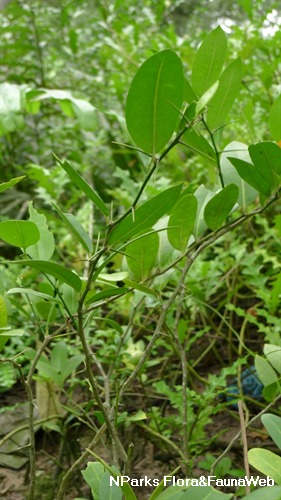
| Growth Form | Erect shrub, with multiple branches, stems sparse and arising from a root crown. Stout spines usually on axils of juvenile stems and are 1.5 - 3.5 cm long. Matured plant grows up to a maximum of 3 m tall. |
|---|---|
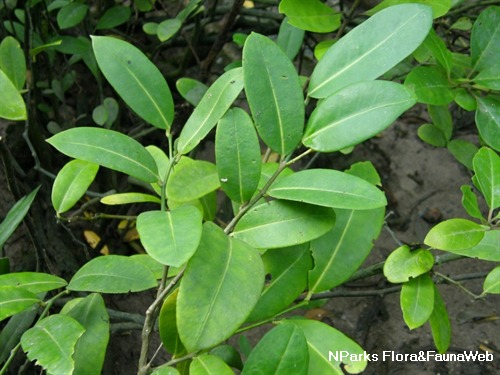
| Foliage | Alternate, thickly leathery, aromatic leaves have transparent dots and measure 4.5 - 16 by 2 - 7 cm, leaf stalks are unwinged, leaf edges are slightly notched, leaf tip blunt or slightly pointed. Leaves are covered with minute glands and have a resinous, lime-like odour if bruised. |
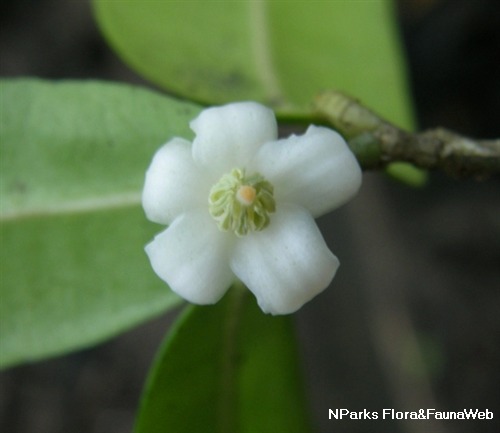
| Flowers | White, bisexual flowers about 2 cm long, fragrant, solitary, occur in leaf axils either in pairs or clusters of only a few flowers, stamens 10 and petals are 7 - 9 mm long. |
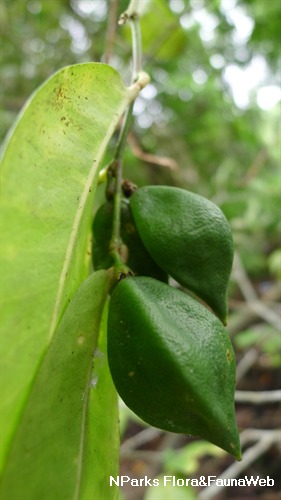
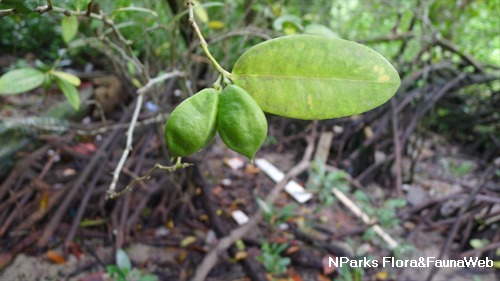
| Fruit | Ovoid, angular berry, with 3-4 flattened sides, aromatic when crushed, 2 - 5 cm long. |
| Habitat | Landward margins of mangroves and along river banks. |
| Ethnobotanical Uses | Medicinal: Traditional Medicinal Uses In India and Malaya, the plant is used for treating abdominal pain and uterine contractions following child birth. <1>
It is important to note that some therapeutic effects from tradtional medicinal uses of plants are not currently supported or verified by scientific research. |
Landscaping Features
| Desirable Plant Features | Ornamental Flowers, Fragrant (Flowers, Fruits) |
|---|---|
| Landscape Uses | Coastal Plant, Beachfront / Shoreline, Riverine |
| Usage Hazard - Cons | Spines/Thorns - Stem/Branch |
Plant Care and Propagation
| Light Preference | Full Sun, Semi-Shade |
|---|---|
| Water Preference | Moderate Water |
| Plant Growth Rate | Moderate |
| Rootzone Tolerance | Saline Soils / Salt Spray |
| Propagation Method | Seed |
Foliar
| Mature Foliage Colour(s) | Green |
|---|---|
| Mature Foliage Texture(s) | Leathery, Thick |
| Foliar Arrangement Along Stem | Alternate |
| Foliar Attachment to Stem | Petiolate |
| Foliar Margin | Entire |
Floral (Angiosperm)
| Flower & Plant Sexuality | Bisexual Flowers |
| Flower Colour(s) | White |
|---|---|
| Flower Grouping | Cluster / Inflorescence |
| Flower Location | Axillary |
Fruit, Seed and Spore
| Mature Fruit Colour(s) | Green |
|---|---|
| Fruit Classification | Simple Fruit |
| Fruit Type | Fleshy Fruit |
| Seed Description | Large, long, flattened seeds |
References
| References | <1> Jones, D.T. (1982). Nat. Malaysiana. 7, 26. <2> Krueger, R.R. & Navarro, L. (2007). Citrus genetics, breeding and biotechnology. CAB International, Wallingford, UK. p, 45 |
|---|
Image Repository
Others
| Master ID | 31832 |
|---|---|
| Species ID | 6232 |
| Flora Disclaimer | The information in this website has been compiled from reliable sources, such as reference works on medicinal plants. It is not a substitute for medical advice or treatment and NParks does not purport to provide any medical advice. Readers should always consult his/her physician before using or consuming a plant for medicinal purposes. |