











Back
Dracaena trifasciata 'Laurentii'
| Family Name: | Asparagaceae |
| Synonyms: | Sansevieria trifasciata 'Laurentii', Sansevieria laurentii, Sansevieria zeylanica var. laurentii, Sansevieria trifasciata var. laurentii |
| Common Name: | Mother-In-Law's Tongue, Variegated Snake Plant, Goldband Sansevieria, 金边虎尾兰, 黃边虎尾兰 |
Name
Classifications and Characteristics
| Plant Division | Angiosperms (Flowering Seed Plants) (Monocotyledon) |
|---|---|
| Plant Growth Form | Herbaceous Plant, Creeper |
| Lifespan (in Singapore) | Perennial |
| Mode of Nutrition | Autotrophic |
| Maximum Height | 0.3 m to 1.2 m |
Biogeography
| Native Habitat | Terrestrial |
|---|---|
| Preferred Climate Zone | Tropical |
| Local Conservation Status | Non-native (Horticultural / Cultivated Only) |
Description and Ethnobotany
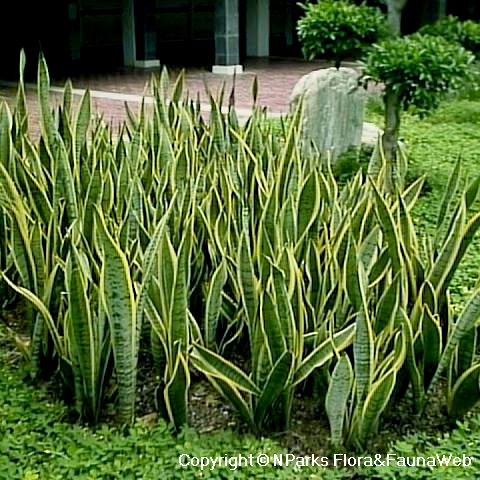
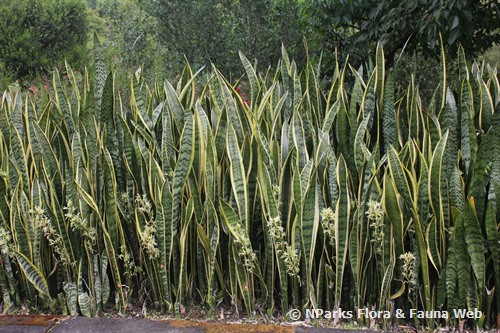
| Growth Form | It is an evergreen, perennial herbaceous plant forming dense stands, reaching 0.3–1.2 m in height, and spreading through underground rhizome. |
|---|---|
| Roots | The roots are thick, fibrous and often orange in colour. |
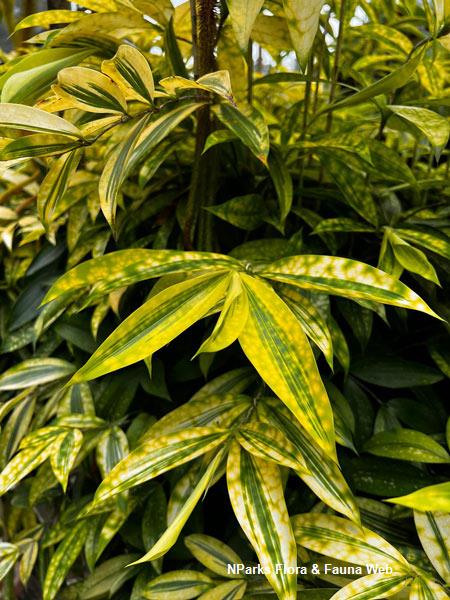
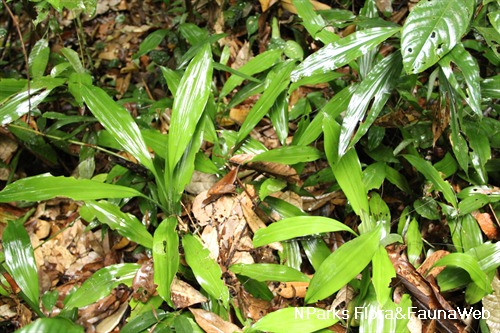
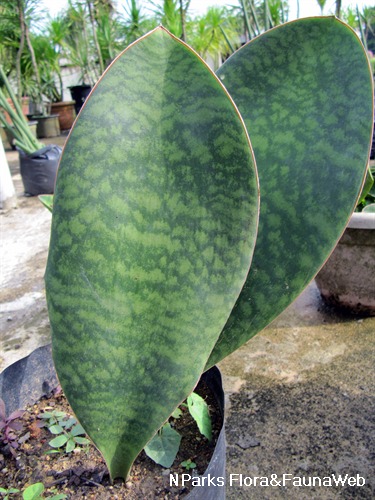
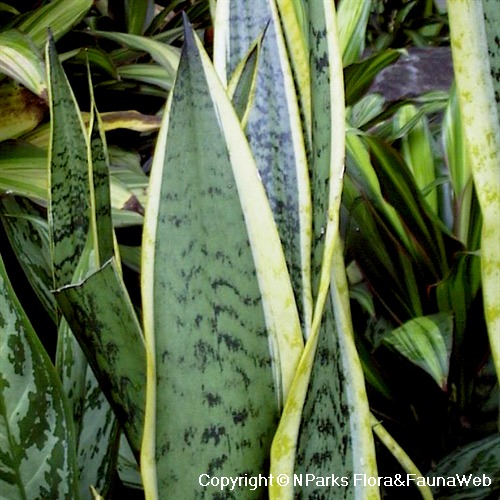
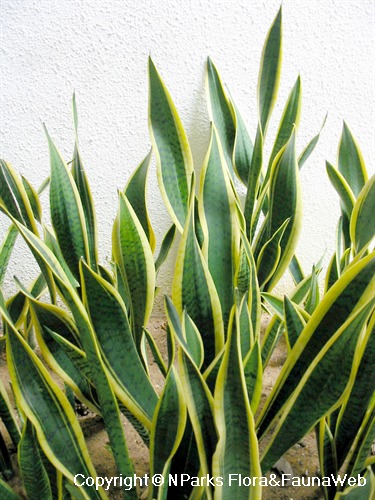
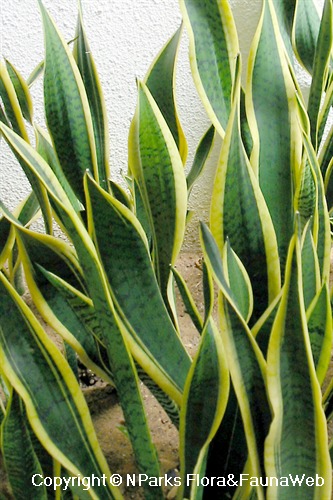
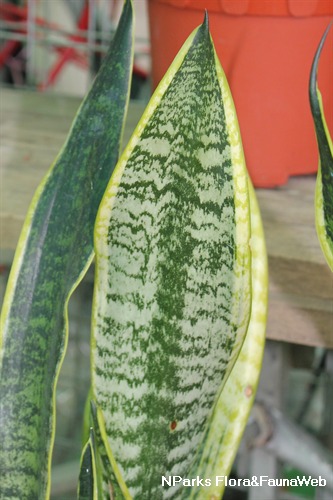
| Foliage | The leaves are erect, long and broad (0.3–1.2 m long × 2.5–7 cm wide), and linear to lanceolate. Each shoot or rosette may hold 1–2(–6) leaves at a time. The leaves are horizontally banded on both surfaces with very distinctively light dull green or clear whitish-green and deep grass-green to almost blackish green, overspread with slight glaucous bloom. The margins are narrow and golden yellow. |
| Stems | The rhizome (thick, horizontal modified stem) is fleshy and ringed with several nodes, terminating with rosetter of leafy shoot. |
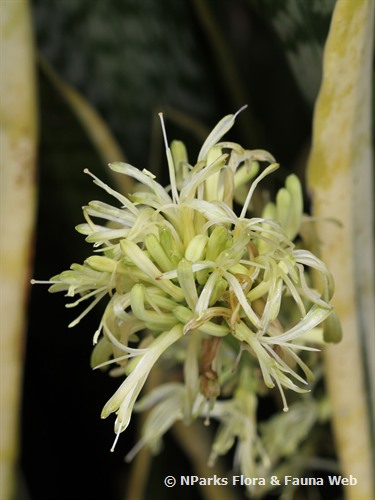
| Flowers | The inflorescence is an erect raceme, reaching (30–)40–75 cm long. The flowers are (1–)3–4 per cluster with each flower attached to a 0.5–0.8 cm long upward-curving pedicel (a flower stalk). The flowers are pale-greenish or greenish white with six slightly recurved tepals (indistinguishable petals and sepals that resemble one another) and six stamens. |
| Fruit | The fruit is a bright orange globose berry, reaching 0.8 cm diameter, and containing 1–3-small seeds. |
| Taxonomy | The latest accepted Family name (APGIII) is Asparagaceae. It was previously placed in Agavaceae, Convallariaceae, Dracaenaceae, Liliaceae, and Ruscaceae. |
| Cultivation | It grows best in porous, well-draining soil under full sun or semi shade. Avoid overwatering or waterlogged soil as it is prone to rotting. It can be propagated by leaf cutting, division and rhizome fragments. Plant propagated through leaf cutting or kept in low light condition may lose their variegation. |
| Etymology | The genus Dracaena is derived from Ancient Greek drakaina for 'dragon (feminine)'. This name likely refers to the scarlet dried resin, known as 'dragon's blood', obtained from various species, including those of Dracaena. The specific epithet trifasciata is Latin for "with three bands", referring to the unique, banded pattern on the leaves. |
Landscaping Features
| Desirable Plant Features | Ornamental Foliage, Ornamental Form |
|---|---|
| Landscape Uses | Coastal Plant, Suitable for Rooftops, Flowerbed / Border, Container Planting, Indoor Plant |
| Thematic Landscaping | Golden Garden, Rockery / Desert Garden |
| Usage Hazard - Cons | Irritant - Sap, Toxic Upon Ingestion |
| Usage Hazard - Cons Remarks | Irritant Sap & Toxic upon Ingestion: All plant parts contain saponins, which are mildly toxic to dogs and cats and can lead to nausea, vomiting, diarrhoea, gastrointestinal upset, lethargy and drooling if consumed. |
Plant Care and Propagation
| Light Preference | Full Sun, Semi-Shade |
|---|---|
| Water Preference | Little Water |
| Plant Growth Rate | Moderate to Slow |
| Rootzone Tolerance | Fertile Loamy Soils, Well-Drained Soils, Poor Infertile Soils, Saline Soils / Salt Spray, Acidic (low pH) Soils, Alkaline high pH Soils, Shallow Media, Easy to Grow, Drought Tolerant |
| Transplanting Tolerance | Moderate |
| Maintenance Requirements | Low |
| Propagation Method | Leaf Cutting, Division, Storage Organ (Rhizome) |
Foliar
| Foliage Retention | Evergreen |
|---|---|
| Mature Foliage Colour(s) | Green, Silver / Grey, Yellow / Golden |
| Mature Foliage Texture(s) | Smooth, Leathery, Thick |
| Foliar Type | Simple / Unifoliate |
| Foliar Arrangement Along Stem | Rosulate / Rosette |
| Foliar Attachment to Stem | Sessile |
| Foliar Shape(s) | Non-Palm Foliage (Linear, Lanceolate) |
| Foliar Venation | Parallel |
| Foliar Margin | Entire |
| Leaf Area Index (LAI) for Green Plot Ratio | 3.5 (Shrub & Groundcover - Monocot) |
Non - Foliar and Storage
| Root Type | Underground (Fibrous Root) |
|---|---|
| Specialised Storage Organ(s) | Underground (Rhizome), Aboveground (Rhizome) |
Floral (Angiosperm)
| Flower & Plant Sexuality | Bisexual Flowers |
| Flower Colour(s) | Cream / Off-White, Green - Light Green, White |
|---|---|
| Flower Grouping | Cluster / Inflorescence |
| Flower Location | Terminal |
| Flower Symmetry | Radial |
| Inflorescence Type | Raceme |
| Flowering Period | Hot & Dry Period |
| Flowering Opening Time | Night (dusk to dawn) |
| Flowering Habit | Polycarpic |
Fruit, Seed and Spore
| Mature Fruit Colour(s) | Orange |
|---|---|
| Mature Fruit Texture(s) | Smooth |
| Fruit Classification | Simple Fruit |
| Fruit Type | |
| Seed Quantity Per Fruit | Few (1-5) |
Image Repository
Others
| Master ID | 1132 |
|---|---|
| Species ID | 2425 |
| Flora Disclaimer | The information in this website has been compiled from reliable sources, such as reference works on medicinal plants. It is not a substitute for medical advice or treatment and NParks does not purport to provide any medical advice. Readers should always consult his/her physician before using or consuming a plant for medicinal purposes. |