






Back
Thalia geniculata L.
| Family Name: | Marantaceae |
| Synonyms: | Maranta geniculata (L.) Lam., Renealmia geniculata (L.) D.Dietr. |
| Common Name: | Alligator Flag, Swamp Lily, Water Canna |
Name
Classifications and Characteristics
| Plant Division | Angiosperms (Flowering Seed Plants) (Monocotyledon) |
|---|---|
| Plant Growth Form | Herbaceous Plant |
| Lifespan (in Singapore) | Perennial |
| Mode of Nutrition | Autotrophic |
| Maximum Height | 3 m |
Biogeography
| Native Distribution | Central Africa, United States, Mexico, Central America, South America |
|---|---|
| Native Habitat | Terrestrial (Riverine), Freshwater (Emergent Freshwater) |
| Preferred Climate Zone | Tropical |
| Local Conservation Status | Non-native (Horticultural / Cultivated Only) |
Description and Ethnobotany
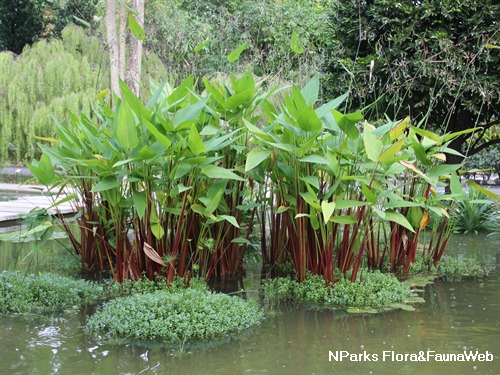
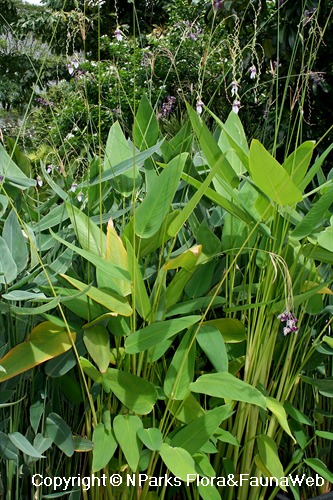
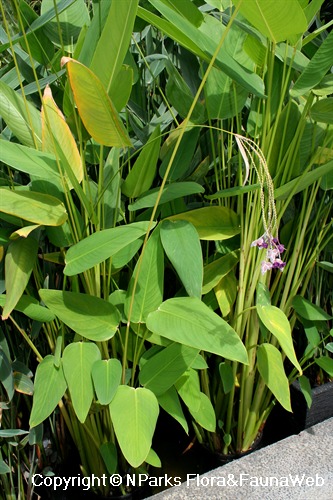
| Growth Form | It is a rhizomatous, emergent aquatic herbaceous plant, up to 3 m tall. |
|---|---|
| Roots | The root system is well-developed and extensively intertwined. |
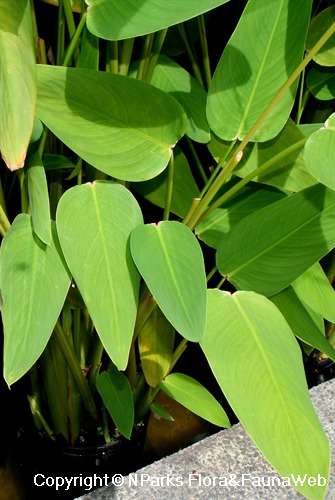
| Foliage | Large leaves are broadly lanceolate, having a rounded base and a pointed apex (> 1 m long). The leaf blade is held by a long, smooth, green or red-purple petiole. |
| Stems | It has a thick rhizome (underground horizontal stem). |
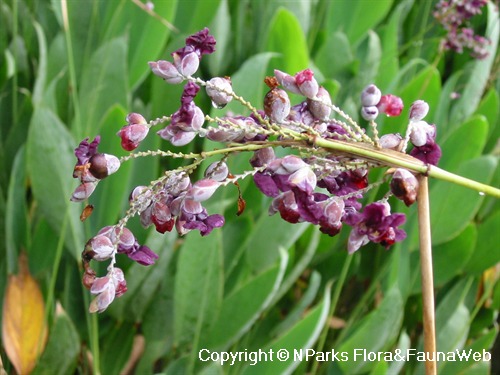
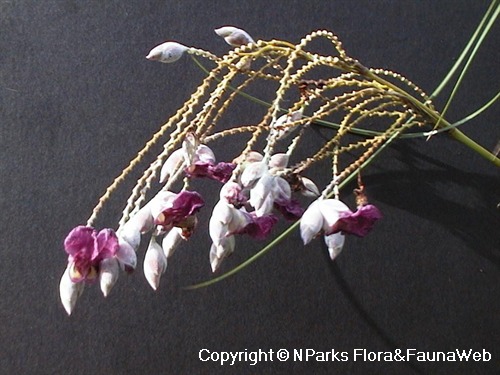
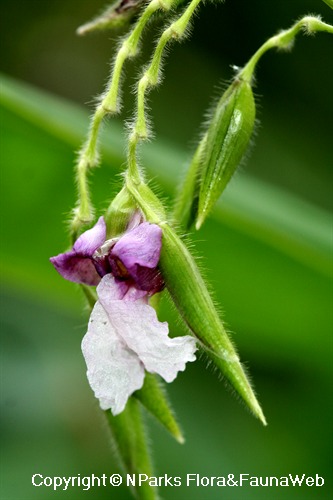
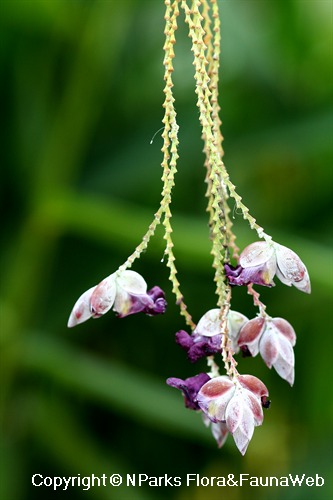
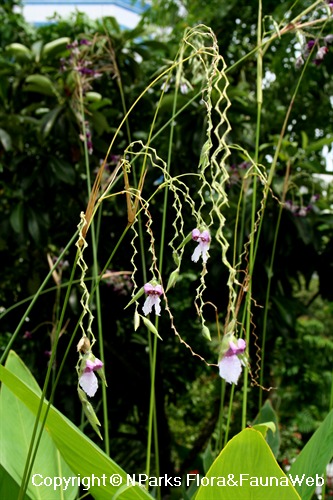
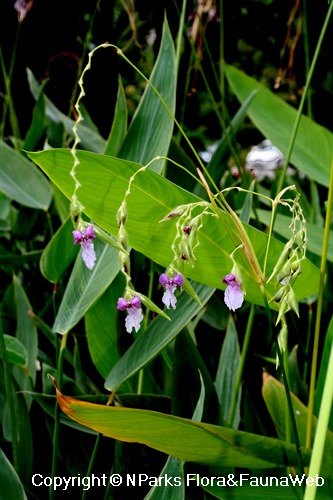
| Flowers | Paired flowers are suspended from a zigzag-shaped inflorescence stalk. Small, purple flowers (2 cm long) are composed of 3 petals and have an irregular shape. A white, petal-like bract hangs below the flowers. |
| Fruit | Fruits are known as utricles, containing a single brown to black seed. |
| Habitat | It can be found in wetlands and marshes. |
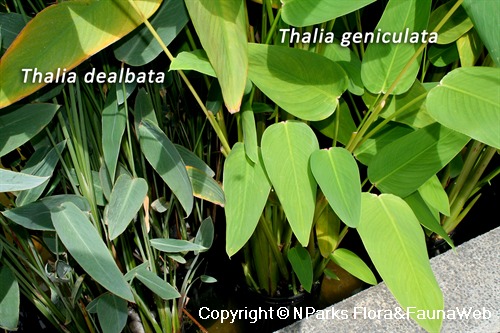
| Similar | This species resembles Thalia dealbata, but it has larger leaves (more than 1 m long) that are narrower and flatter, as well as slightly larger flowers that are borne by a taller inflorescence stalk. Unlike T. dealbata, the leaf is greener without a powdery white surface. |
| Associated Fauna | It provides food and shelter for aquatic birds. |
| Etymology | The genus Thalia is named in honour of Johannes Thal (1542–1583), the German botanist, author of Sylva Hercynia (1588). It can also be derived from Thalia, who was the eighth muse, presiding over comedy and idyllic poetry. she was also one of the three Graces and patroness of festive meetings. The specific epithet geniculata is derived from Latin meaning "bent like a knee" or "with knees", in reference to the distinct, zigzag bends along the inflorescence. The common name Alligator Flag is derived from its use in spotting alligators. The unexpected movement of the leaves is sometimes a sign of an alligator is swimming below. |
Landscaping Features
| Desirable Plant Features | Ornamental Flowers, Ornamental Foliage |
|---|---|
| Landscape Uses | Riverine, Container Planting, Marsh / Bog, Phytoremediation (Ground / Water Contaminant(s)), Focal Plant |
| Thematic Landscaping | Water Garden, Naturalistic Garden, Marsh Garden |
Plant Care and Propagation
| Light Preference | Full Sun |
|---|---|
| Water Preference | Lots of Water |
| Plant Growth Rate | Moderate |
| Rootzone Tolerance | Fertile Loamy Soils, Waterlogged Soils |
| Maintenance Requirements | Moderate |
| Propagation Method | Storage Organ (Rhizome), Division, Seed |
Foliar
| Foliage Retention | Evergreen |
|---|---|
| Mature Foliage Colour(s) | Green |
| Mature Foliage Texture(s) | Smooth, Glossy / Shiny |
| Foliar Type | Simple / Unifoliate |
| Foliar Attachment to Stem | Petiolate |
| Foliar Shape(s) | Non-Palm Foliage (Lanceolate) |
| Foliar Venation | Parallel |
| Foliar Margin | Entire |
| Foliar Apex - Tip | Acute |
| Foliar Base | Rounded / Obtuse |
| Leaf Area Index (LAI) for Green Plot Ratio | 3.5 (Shrub & Groundcover - Monocot) |
Non - Foliar and Storage
| Stem Type & Modification | Acaulescent |
|---|---|
| Root Type | Underground (Fibrous Root) |
| Specialised Storage Organ(s) | Underground (Rhizome) |
Floral (Angiosperm)
| Flower & Plant Sexuality | Bisexual Flowers |
| Flower Colour(s) | Purple, White |
|---|---|
| Flower Grouping | Cluster / Inflorescence |
| Flower Location | Terminal |
| Flower Symmetry | Bilateral |
| Flowering Period | Free-Flowering |
| Flowering Habit | Polycarpic |
| Inflorescence Type Remarks | Paired |
Fruit, Seed and Spore
| Mature Fruit Colour(s) | Black, Brown |
|---|---|
| Fruit Classification | Simple Fruit |
| Fruit Type | Indehiscent Dry Fruit , Utricle |
Image Repository
Others
| Master ID | 1210 |
|---|---|
| Species ID | 2503 |
| Flora Disclaimer | The information in this website has been compiled from reliable sources, such as reference works on medicinal plants. It is not a substitute for medical advice or treatment and NParks does not purport to provide any medical advice. Readers should always consult his/her physician before using or consuming a plant for medicinal purposes. |