








Back
Calamus erinaceus (Becc.) Becc.
| Family Name: | Arecaceae (Palmae) |
| Synonyms: | Calamus aquatilis Ridl. |
| Common Name: | Rotan Bakau, Mangrove Rattan, Hedgehog Rattan |
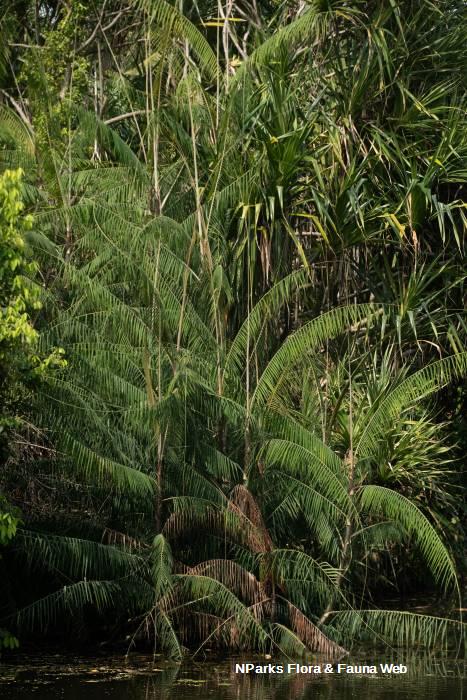
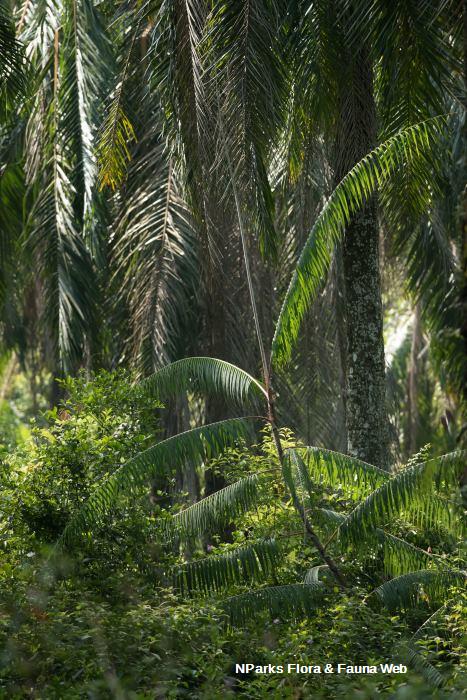
Calamus erinaceus, commonly known as Rotan Bakau, is a native clustering rattan palm, capable of climbing to heights of 15 metres or more. It is the only mangrove rattan species in Singapore and can be found naturally on the landward side of mangroves or behind coastal sandbars. In Peninsular Malaysia, wild elephants are known to feed on the young stems and shoots, expertly avoiding the spiny fronds.
Name
Classifications and Characteristics
| Plant Division | Angiosperms (Flowering Seed Plants) (Monocotyledon) |
|---|---|
| Plant Growth Form | Climber, Palm (Clustered Habit) |
| Lifespan (in Singapore) | Perennial |
| Mode of Nutrition | Autotrophic |
| Plant Shape | Irregular, Leggy |
| Maximum Height | 15 m |
Biogeography
| Native Distribution | Peninsular Malaysia, Singapore, Borneo, Sarawak |
|---|---|
| Native Habitat | Shoreline (Mangrove Forest), Terrestrial (Coastal Forest) |
| Preferred Climate Zone | Tropical |
| Local Conservation Status | Native to Singapore (Least Concern (LC)) |
Description and Ethnobotany
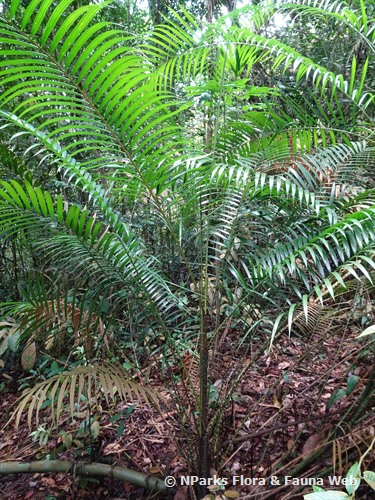
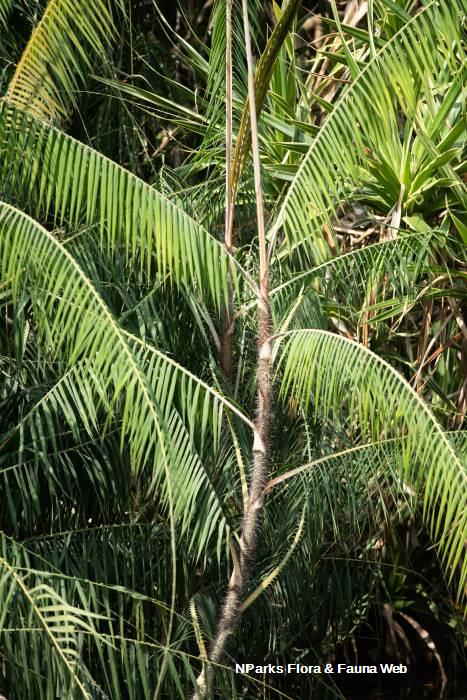
| Growth Form | It is a robust clustering palm with vining stems that can reach up to 15 m or more in height. |
|---|---|
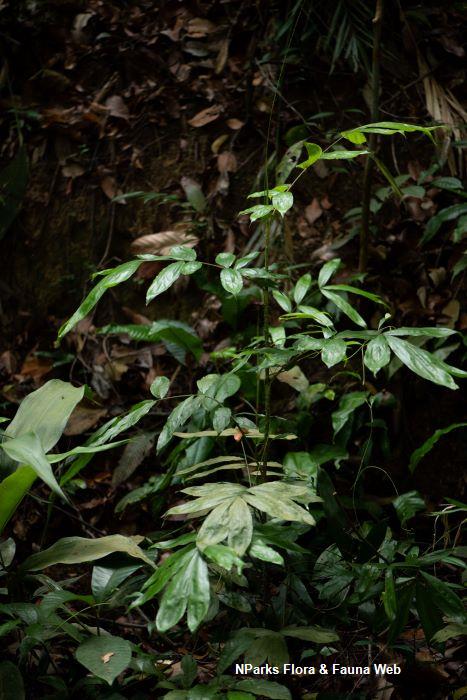
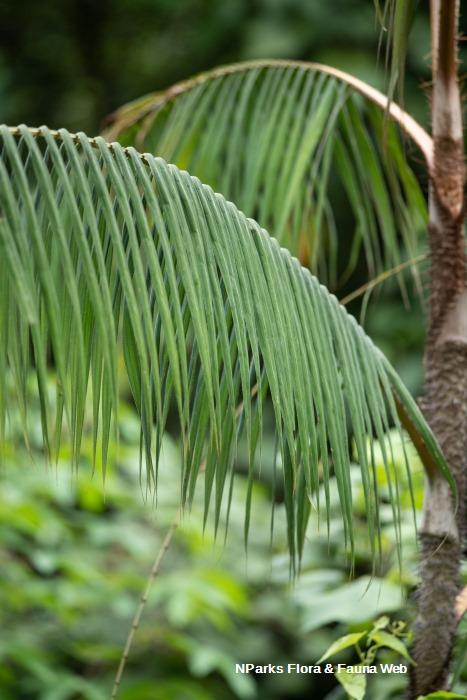
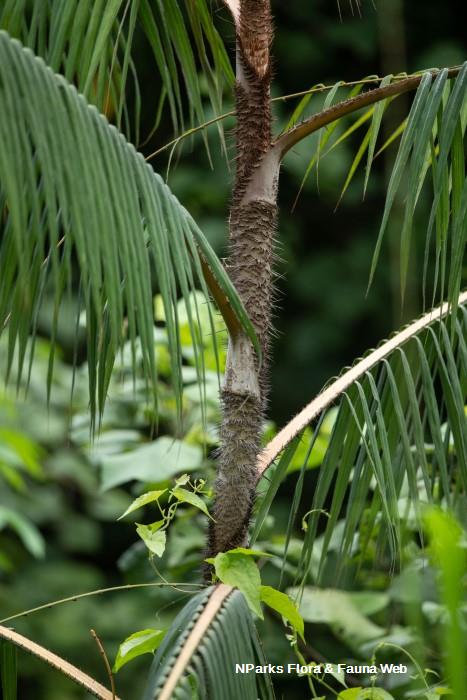
| Foliage | The fronds are spreading, about 2 m long, and even-pinnately compound with regularly arranged 70 or more leaflets on both sides of the rachis (midrib of a compound leaf). The fronds bear a cirrus (an extended portion of the leaf rachis/midrib that aids in climbing in rattan). The leaf sheaths are densely covered in slender, greyish-brown prickles held horizontally and arranged in horizontal or oblique whorls. The petioles (leaf stalks) can reach up to 25 cm long with grouped prickles up to 3 cm longs, except the base of the petioles, which are orange-yellow and unarmed. The leaflets are limply pendulous, gray-green, bristly below and on both margins, and cover in minute brown scales on the undersides. |
| Stems | The flexible stems are covered in orangish-yellow to yellowish-green leaf sheaths. The stems are 2–3.5 cm in diameter without the leaf sheaths or up to 6 cm with leaf sheaths. |
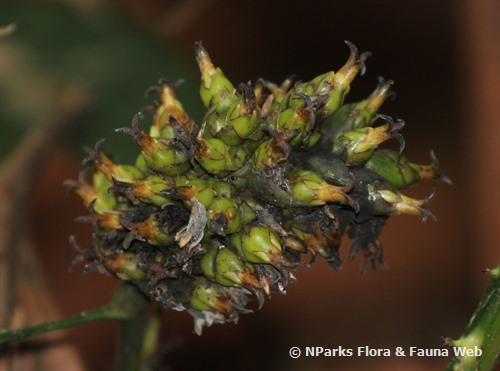
| Flowers | The inflorescences of both sexes are similar; both measure up to 1.5 m long, have short peduncles (inflorescence stalks) enclosed by the leaf sheath, and about 7 partial inflorescences on each side of the axis. The male inflorescence is branched to 3 orders, and has shorter rachillae (minor, secondary axes on inflorescences), up to 1-2 cm long with close distichous flowers. The female inflorescence branches up to 2 orders and has longer rachillae up to 10 cm in length with laxer distichous flowers. The bracts are armed with groups of short prickles. This species lacks a flagellum (a spiny, whip-like, sterile modified inflorescence axis that aids in climbing in rattans). |
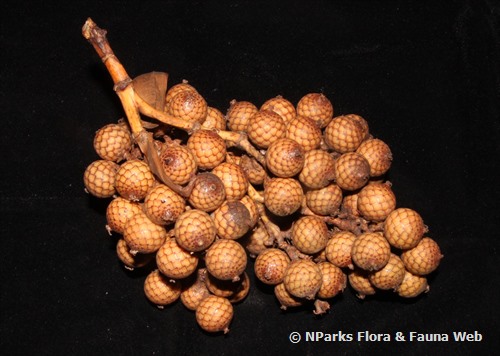
| Fruit | The fruit is scaly and globose, about 1 cm in diameter. |
| Habitat | It can be found on the landward side of mangrove or behind coastal sand bars. In Singapore, it occurs in Admiralty Park, Pulau Ubin, and Sungei Buloh Wetland Reserve, often growing near Oncospermum tigillarium and Nypa fruticans. |
| Associated Fauna | In Peninsular Malaysia, wild elephants are known to feed on the young stems and shoots and have learnt to expertly avoiding the spiny fronds. |
| Cultivation | It can be propagated by seeds. |
| Etymology | The genus Calamus is derived from Greek kálamos 'reed/stalk', referring to the habit of the palm. The specific epithet erinaceus means "of or pertaining to hedgehog", alluding to the spiky nature of the palm. |
| Ethnobotanical Uses | Timber & Products: In its native range, this rattan produces a medium to low quality, coarse cane. |
Landscaping Features
| Desirable Plant Features | Ornamental Form |
|---|---|
| Landscape Uses | Beachfront / Shoreline, Coastal Plant, Riverine |
| Thematic Landscaping | Naturalistic Garden, Marsh Garden |
| Usage Hazard - Cons | Spines/Thorns - Leaf, Spines/Thorns - Flower, Spines/Thorns - Stem/Branch |
| Usage Hazard - Cons Remarks | Spine Thorns Leaf/Flower/Stem/Branch: The palm is covered in sharp spines and bristles and may not be suitable for landscaping in high human traffic. |
Plant Care and Propagation
| Light Preference | Full Sun, Semi-Shade |
|---|---|
| Water Preference | Lots of Water, Moderate Water |
| Plant Growth Rate | Fast |
| Rootzone Tolerance | Waterlogged Soils, Saline Soils / Salt Spray |
| Propagation Method | Seed |
Foliar
| Foliage Retention | Evergreen |
|---|---|
| Mature Foliage Colour(s) | Green - Bluish Green, Yellow / Golden |
| Mature Foliage Texture(s) | Spiny / Bristly / Stinging |
| Foliar Modification | Flower/Fruit Bract, Prickle / Emergence (blade), Spine (marginal) |
| Foliar Type | Compound (Even-Pinnate) |
| Foliar Arrangement Along Stem | Spiral |
| Foliar Attachment to Stem | Petiolate |
| Foliar Shape(s) | Palm Fronds (Pinnate / Feather) |
| Foliar Margin | Ciliate / Hairy |
| Leaf Area Index (LAI) for Green Plot Ratio | 4.0 (Palm - Cluster) |
Non - Foliar and Storage
| Trunk Type (Palm) | Aboveground, Clustering Habit |
|---|---|
| Stem Type & Modification | Thorn / Prickle |
Floral (Angiosperm)
| Flower & Plant Sexuality | Unisexual Flowers , Dioecious |
| Flower Texture(s) | Bristly |
|---|
| Flower Grouping | Cluster / Inflorescence |
| Flower Location | Axillary |
| Inflorescence Type | Spikelet / Pseudospikelet / Compound Spike |
| Ovary Position | Superior / Hypogynous |
| Flowering Habit | Polycarpic |
Fruit, Seed and Spore
| Mature Fruit Texture(s) | Scaly |
|---|---|
| Fruit Classification | Simple Fruit |
| Fruit Type | Fleshy Fruit , Drupe |
| Seed Quantity Per Fruit | Few (1-5) |
References
| References | 15. Calamus erinaceus (Becc.) J.Dransf. e-Flora of Thailand. https://botany.dnp.go.th/eflora/floraspecies.html?tdcode=05123 Yusof, N. N. M., Hatta, S. K. M., Pardi, F., & Ismail, A. (2022). Guidelines for the cultivation of food plants for wildlife. Department of Wildlife and National Parks (PERHILITAN) Peninsular Malaysia. pg 20 & 35 |
|---|
Image Repository
Others
| Master ID | 34791 |
|---|---|
| Species ID | 9204 |
| Flora Disclaimer | The information in this website has been compiled from reliable sources, such as reference works on medicinal plants. It is not a substitute for medical advice or treatment and NParks does not purport to provide any medical advice. Readers should always consult his/her physician before using or consuming a plant for medicinal purposes. |