










Back
Vitex trifolia L.
| Family Name: | Lamiaceae (Labiatae) |
| Common Name: | Legundi, Lemuni, Beach Vitex, Round-Leaved Chaste Tree, Single-Leaf Chaste Tree, 蔓荆 |
Legundi, or Vitex trifolia, is a shrub native to coastal tropical regions, including Singapore, and can grow up to 8 metres tall. It has distinctive compound leaves made up of three elliptical leaflets, with a silvery-white underside that adds to its ornamental appeal. Small clusters of purple to blue flowers can be seen growing at the terminal end of the stems, followed by small, round fruits that turn from green to black as they ripen. Legundi thrives in full sun and prefers moderate watering, making it well suited to warm, tropical environments.
Name
Classifications and Characteristics
| Plant Division | Angiosperms (Flowering Seed Plants) (Dicotyledon) |
|---|---|
| Plant Growth Form | Shrub |
| Lifespan (in Singapore) | Perennial |
| Mode of Nutrition | Autotrophic |
| Maximum Height | 3 m to 8 m |
Biogeography
| Native Distribution | Northeast Tropical Africa (Somalia), East Tropical Africa (Kenya, Tanzania), South Tropical Africa (Mozambique), Southern Africa (KwaZulu-Natal), Comoros, Madagascar, Mauritius, Iran, Afghanistan, Nepal, India (including Assam), Sri Lanka, Bangladesh, China South-Central, China Southeast, Hainan, Taiwan, China North-Central, Nansei-shoto, Andaman Islands, Myanmar, Laos, Vietnam, Cambodia, Thailand, Peninsular Malaysia, Singapore, Borneo, Philippines, Sumatra, Java, Lesser Sunda Islands, Sulawesi, Maluku, New Guinea, Bismarck Archipelago, Solomon Islands, Mariana Islands, Caroline Islands, Wake Islands, Marshall Islands, Nauru, Vanuatu, New Caledonia, Gilbert Islands, Wallis-Futuna Islands, Fiji, Samoa, Tonga, Samoa, Tonga, Niue, Cook Islands, Line Islands, Marquesas, Society Islands, Tubuai Islands, Tuamotu and Australia (Western Australia, Northern Territory, Queensland, New South Wales) |
|---|---|
| Native Habitat | Terrestrial, Shoreline (Sandy Beach) |
| Preferred Climate Zone | Tropical |
| Local Conservation Status | Native to Singapore (Critically Endangered (CR)) |
Description and Ethnobotany
| Growth Form | A large-sized shrub or a small tree, able to grow to 3 - 8 m tall. |
|---|---|
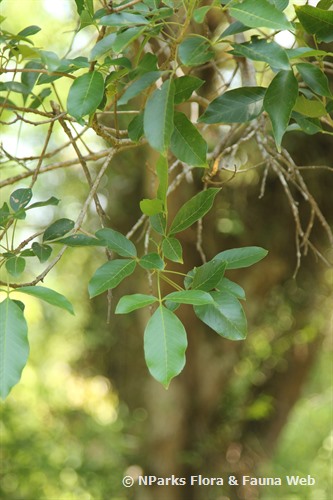
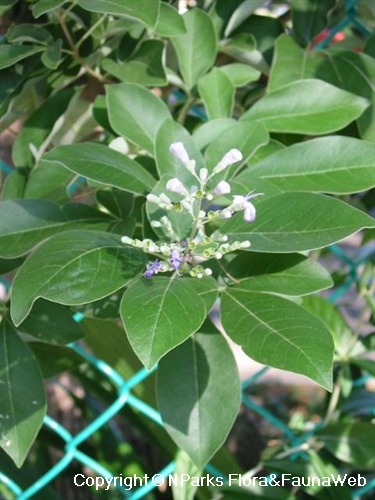
| Foliage | Compound leaves, oppositely arranged along the stem. Each leaf consists of 3 or 5 elliptical leaflets about 3 - 12 cm long, all connected at one point (like fingers of a hand). The underside of the leaf surface is covered with white hairs. |
| Stems | The bark is light grey to brown. |
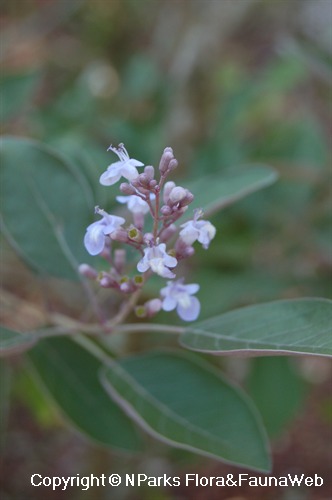
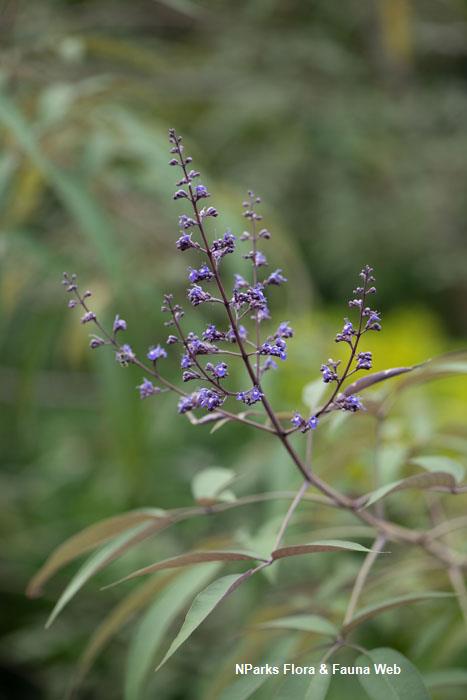
| Flowers | The purple to purplish-blue flowers clustered in a panicle inflorescence up to 18 cm long. Each tubular flower has 5 lobes. |
| Fruit | The fruit is a globose drupe (stone fruit, fleshy with seeds enclosed within a hard shell), turns black when ripen, measuring about 0.5 - 0.7 cm wide and contains 4 black seeds. |
| Habitat | It grows on sand, coral or pumice gravel. |
| Cultivation | Grow on moist, fertile, well-drained soils. Stem cuttings can be rooted in a well-draining rooting medium such as perlite and coconut coir under mist. |
| Etymology | Genus Vitex is the Latin name used by Plinius for the chaste tree. Species epithet trifolia means with three leaflets. |
| Ethnobotanical Uses | Medicinal: Traditional Medicinal Uses In Java, the plant is medically used to treat scabies and eczema. <1> In China, the plant is used in folk medicine as anti-inflammatory medicine. <2> It is important to note that some therapeutic effects from traditional medicinal uses of plants are not currently supported or verified by scientific research. Others: In Southern Thailand and Northeastern Peninsular Malaysia, the local communities are said to use the leaf extract to give the green colour and flavour for traditional dessert. |
Landscaping Features
| Desirable Plant Features | Ornamental Flowers, Ornamental Foliage |
|---|---|
| Landscape Uses | Coastal Plant, Parks & Gardens, Small Gardens, Beachfront / Shoreline |
Fauna, Pollination and Dispersal
| Fauna Pollination Dispersal Associated Fauna | Bird-Attracting Plant, Butterfly-Attracting Plant, Bee-Attracting Plant |
|---|---|
| Seed or Spore Dispersal | Biotic (Fauna) |
Plant Care and Propagation
| Light Preference | Full Sun, Semi-Shade |
|---|---|
| Water Preference | Moderate Water |
| Rootzone Tolerance | Moist Soils, Well-Drained Soils, Saline Soils / Salt Spray |
| Propagation Method | Seed |
Foliar
| Foliage Retention | Evergreen |
|---|---|
| Mature Foliage Colour(s) | Green |
| Prominent Young Flush Colour(s) | Green |
| Foliar Type | Compound |
| Foliar Arrangement Along Stem | Opposite |
| Foliar Attachment to Stem | Petiolate |
| Foliar Shape(s) | Non-Palm Foliage (Elliptical) |
| Foliar Venation | Pinnate / Net |
| Foliar Margin | Entire |
| Foliar Apex - Tip | Obtuse |
| Leaf Area Index (LAI) for Green Plot Ratio | 4.5 (Shrub & Groundcover - Dicot) |
Floral (Angiosperm)
| Flower Colour(s) | Purple |
|---|---|
| Flower Texture(s) | Smooth |
| Flower Grouping | Cluster / Inflorescence |
| Flower Location | Terminal |
| Flower Symmetry | Bilateral |
| Individual Flower Shape | Tubular |
| Inflorescence Type | Panicle |
| Flowering Habit | Polycarpic |
Fruit, Seed and Spore
| Mature Fruit Colour(s) | Black |
|---|---|
| Fruit Classification | Simple Fruit |
| Fruit Type | Fleshy Fruit , Drupe |
| Mature Seed Colour(s) | Black |
| Seed Quantity Per Fruit | Few (1-5) |
References
| References | <1> de Kok, R. (2008). The genus Vitex (Labiatae) in the Flora Malesiana region, excluding New Guinea. Kew Bulletin 63:17-40. <2> Wei, E.C.C., Baba, S., Chan, H.T., Kainuma, M. & Tangah, J. (2016). Medicinal plants of sandy shores: A short review on Vitex trifolia L. and Ipomoea pes-caprae (L.) R.Br. Indian Journal of Natural Products and Resources. Vol. 7(2):107-115 |
|---|
Image Repository
Others
| Master ID | 1254 |
|---|---|
| Species ID | 2547 |
| Flora Disclaimer | The information in this website has been compiled from reliable sources, such as reference works on medicinal plants. It is not a substitute for medical advice or treatment and NParks does not purport to provide any medical advice. Readers should always consult his/her physician before using or consuming a plant for medicinal purposes. |