




Back
Hymenaea courbaril
| Family Name: | Fabaceae (Leguminosae) |
| Common Name: | West Indian Locust Tree, Brazilian Copal, Amami Gum |
Name
Classifications and Characteristics
| Plant Growth Form | Tree |
|---|---|
| Mode of Nutrition | Autotrophic |
| Maximum Height | 25 m to 40 m |
Biogeography
| Native Distribution | South and Central America |
|---|---|
| Native Habitat | Terrestrial |
| Preferred Climate Zone | Tropical |
| Local Conservation Status | Non-native |
Description and Ethnobotany
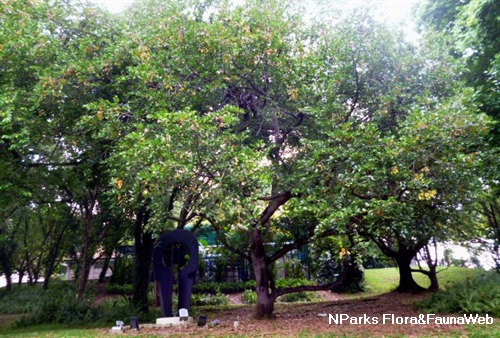
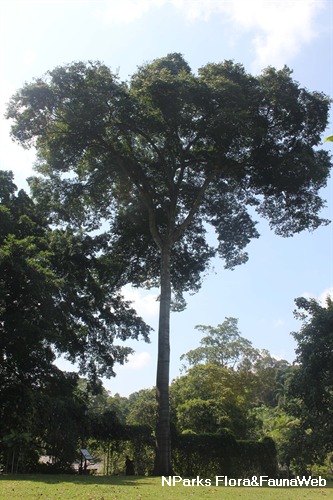
| Growth Form | A large tree, able to grow up to about 25 to 40 m tall, sometimes about 50 m tall in its natural habitat. |
|---|---|
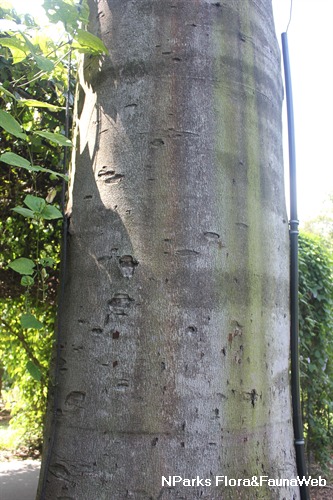
| Trunk | Girth size can reach up to 2 m wide, bark is smooth and grey. |
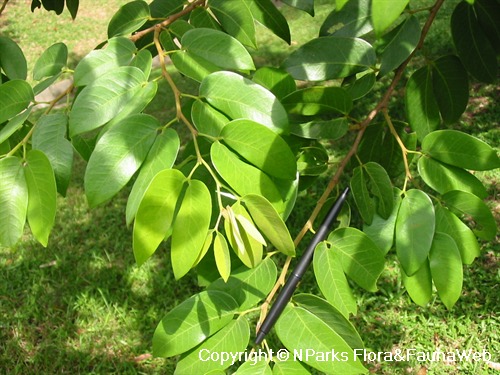
| Foliage | Green compound leaves, alternate arrangement and bifoliate, each leaf has 2 twin ovate to lanceolate leaflets about 3 - 12 cm long and 1.5 - 7 cm wide, surface glabrous, petiolules about 2 - 8 mm long. |
| Flowers | Cream to white flowers borne on a short-stalked terminal panicle inflorescence, pedicel about 3 - 10 mm long, sepals 4 and oblong-obovate in shape about 12 - 22 mm long, stamens 10, anthers about 3 - 8 mm long, ovary is 1-locular. |
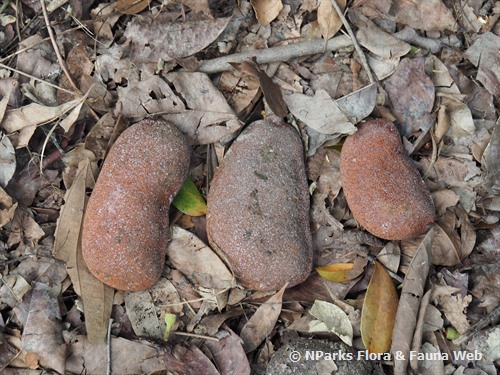
| Fruit | Fruit is an indehiscent woody oblong pod about 8 - 15 cm long and 3 - 5 cm wide, contains 1 - 6 brown flattened seeds. Seeds are embedded in a dry, creamy brown to greenish pulp. |
| Others - Plant Morphology | The tree produces a yellow to red resin-liked gum known commercially as South American copal. |
| Habitat | Can be found in tropical deciduous forest, lowland areas and foothills. |
| Etymology | Genus Hymenaea is named after the Greek god of marriage, Hymen, and it refers to the twin leaflets. Species courbaril is from a vernacular name for the timber. |
| Ethnobotanical Uses | Edible Plant Parts : Edible Fruits Medicinal: The bark is used for treatment for coughs. Tea made from the bark is consumed by lumberjacks as a source of energy. Timber & Products: The wood is used to make furniture, ships, wheels and cogs, musical instruments, plywood and cabinetwork. Agriculture - Forestry: The seeds and pulp are grounded together and used as fodder for livestock. Cultural / Religious: Heritage Tree: There are currently 2 individuals of Hymenaea courbaril listed as Heritage Trees in Singapore. One can be found in Singapore Botanic Gardens, while the other in Istana Grounds. To find out more about these trees, please visit the Heritage Tree Register. |
Landscaping Features
| Desirable Plant Features | Ornamental Flowers |
|---|---|
| Landscape Uses | Parks & Gardens |
Fauna, Pollination and Dispersal
| Fauna Pollination Dispersal Associated Fauna | Bird-Attracting Plant |
|---|---|
| Pollination Method(s) | Biotic (Fauna) |
Plant Care and Propagation
| Light Preference | Full Sun |
|---|---|
| Water Preference | Moderate Water |
| Plant Growth Rate | Moderate |
| Rootzone Tolerance | Moist Soils, Well-Drained Soils |
| Propagation Method | Seed |
Foliar
| Mature Foliage Colour(s) | Green |
|---|---|
| Foliar Type | Compound (Bifoliolate) |
| Foliar Arrangement Along Stem | Alternate |
| Foliar Attachment to Stem | Petiolate |
| Foliar Margin | Entire |
Floral (Angiosperm)
| Flower Colour(s) | White, Cream / Off-White |
|---|---|
| Flower Grouping | Cluster / Inflorescence |
| Flower Location | Terminal |
Fruit, Seed and Spore
| Mature Fruit Colour(s) | Brown |
|---|---|
| Fruit Type | Indehiscent Dry Fruit |
| Mature Seed Colour(s) | Brown |
Image Repository
Others
| Master ID | 1675 |
|---|---|
| Species ID | 2968 |
| Flora Disclaimer | The information in this website has been compiled from reliable sources, such as reference works on medicinal plants. It is not a substitute for medical advice or treatment and NParks does not purport to provide any medical advice. Readers should always consult his/her physician before using or consuming a plant for medicinal purposes. |