



Back
Phanera integrifolia (Roxb.) Benth.
| Family Name: | Fabaceae (Leguminosae) |
| Synonyms: | Bauhinia integrifolia |
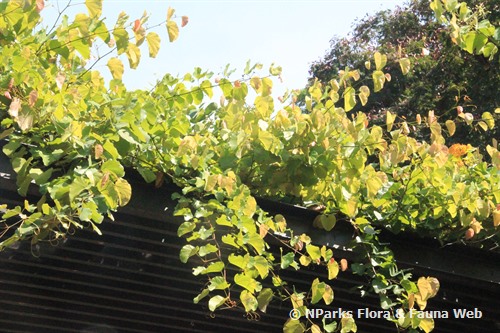
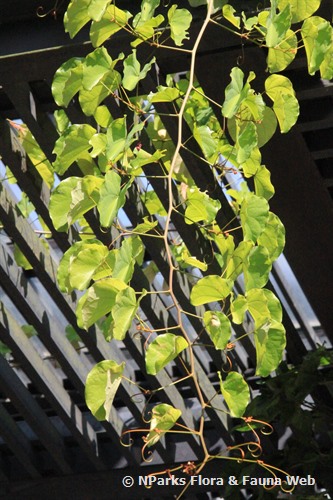
Name
Classifications and Characteristics
| Plant Division | Angiosperms (Flowering Seed Plants) |
|---|---|
| Plant Growth Form | Climber |
| Lifespan (in Singapore) | Perennial |
| Mode of Nutrition | Autotrophic |
Biogeography
| Native Distribution | Sabah, Philippines, Sumatra, Peninsular Malaysia, Thailand, Myanmar |
|---|---|
| Native Habitat | Terrestrial |
Description and Ethnobotany
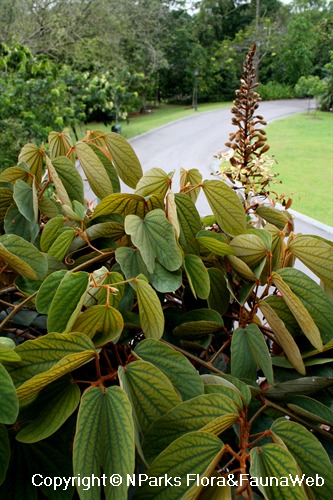
| Growth Form | It is a large, perennial climbing shrub. |
|---|---|
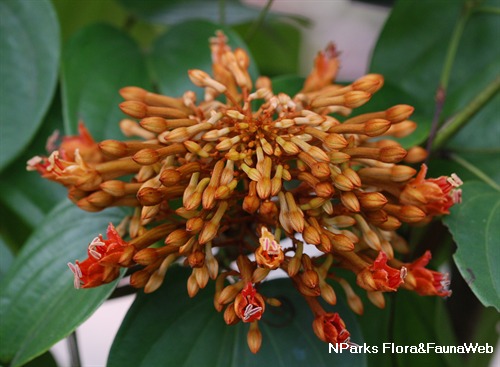
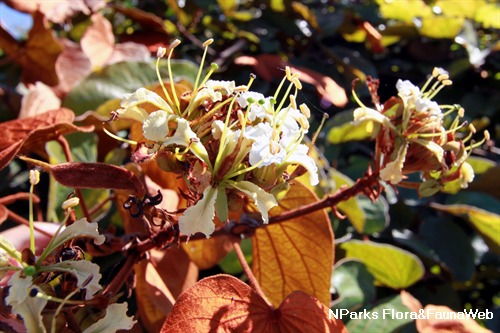
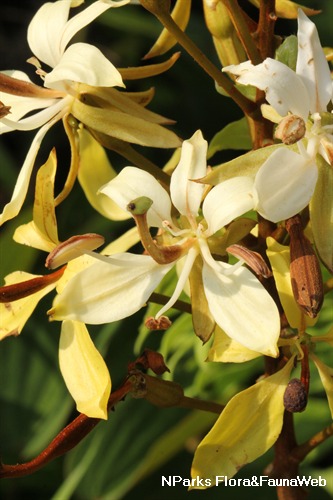
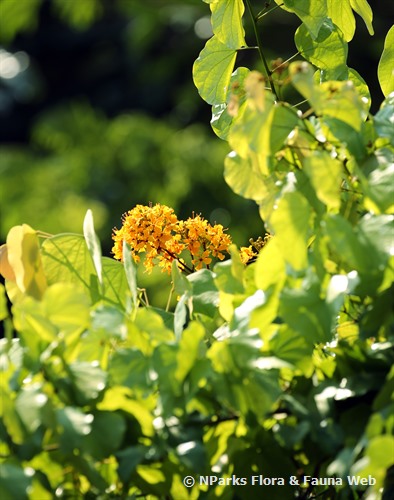
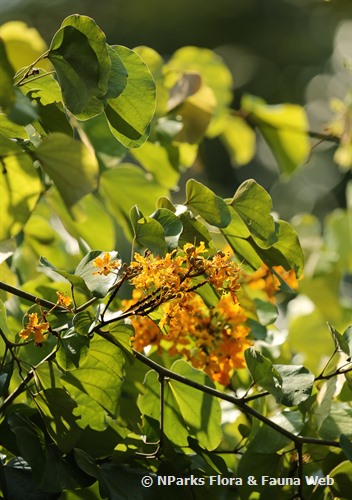
| Flowers | Flowers are borne on large panicles, turning from yellow to orange and then red. |
| Ethnobotanical Uses | Medicinal: An aqueous extract of the roots is given for the treatment of syphilis. |
Landscaping Features
| Desirable Plant Features | Ornamental Flowers, Ornamental Foliage |
|---|---|
| Landscape Uses | Trellis / Arbour / Pergola |
Plant Care and Propagation
| Light Preference | Full Sun |
|---|---|
| Water Preference | Moderate Water |
| Rootzone Tolerance | Well-Drained Soils |
| Propagation Method | Stem Cutting |
Foliar
| Foliage Retention | Evergreen |
|---|---|
| Mature Foliage Colour(s) | Green |
| Mature Foliage Texture(s) | Smooth |
| Prominent Young Flush Colour(s) | Red |
| Young Flush Texture(s) | Smooth |
| Foliar Modification | Foliar Tendril |
| Foliar Type | Simple / Unifoliate |
| Foliar Arrangement Along Stem | Alternate |
| Foliar Attachment to Stem | Petiolate |
| Foliar Shape(s) | Non-Palm Foliage (Cordate) |
| Foliar Margin | Entire - Wavy / Undulate |
| Foliar Base | Cordate |
Floral (Angiosperm)
| Flower & Plant Sexuality | Bisexual Flowers |
| Flower Colour(s) | Orange, Yellow / Golden |
|---|---|
| Flower Texture(s) | Smooth |
| Flower Grouping | Cluster / Inflorescence |
| Flower Location | Axillary |
| Flower Symmetry | Radial |
| Flowering Period | Free-Flowering |
Image Repository
Others
| Master ID | 29086 |
|---|---|
| Species ID | 3399 |
| Flora Disclaimer | The information in this website has been compiled from reliable sources, such as reference works on medicinal plants. It is not a substitute for medical advice or treatment and NParks does not purport to provide any medical advice. Readers should always consult his/her physician before using or consuming a plant for medicinal purposes. |