




Back
Baccaurea angulata Merr.
| Family Name: | Phyllanthaceae |
| Common Name: | Red Angle Tampoi |
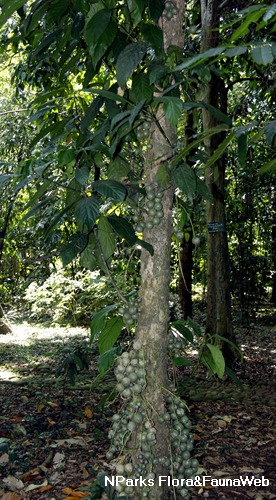
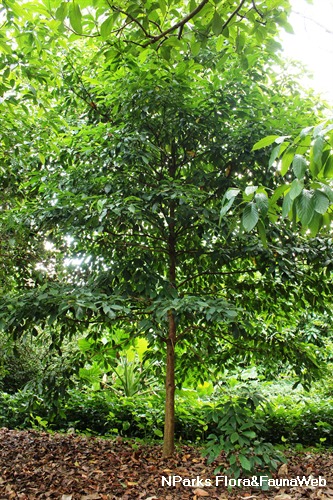
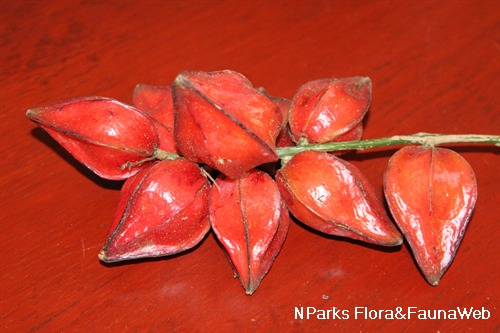
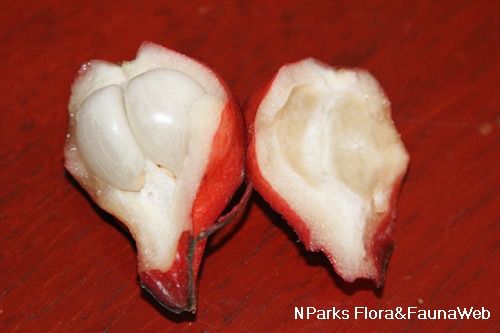
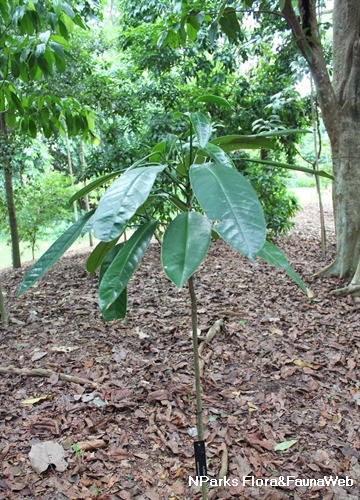
Baccaurea angulata, commonly known as Red Angled Tampoi, is a tree that can grow up to 21 m tall. Its angular fruit ripens to a vibrant red, enclosing a white aril that has a sweet and sour taste. The aril can be enjoyed fresh or cooked.
Name
Classifications and Characteristics
| Plant Division | Angiosperms (Flowering Seed Plants) (Dicotyledon) |
|---|---|
| Plant Growth Form | Tree |
| Lifespan (in Singapore) | Perennial |
| Mode of Nutrition | Autotrophic |
| Plant Shape | Irregular |
| Maximum Height | 21 m |
Biogeography
| Native Distribution | Borneo |
|---|---|
| Native Habitat | Terrestrial (Primary Rainforest, Secondary Rainforest, Riverine) |
| Preferred Climate Zone | Tropical |
| Local Conservation Status | Non-native (Horticultural / Cultivated Only) |
Description and Ethnobotany
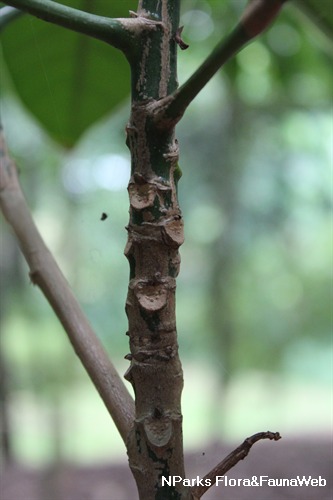
| Growth Form | It is a tree, 6-21 m tall, and without buttresses. |
|---|---|
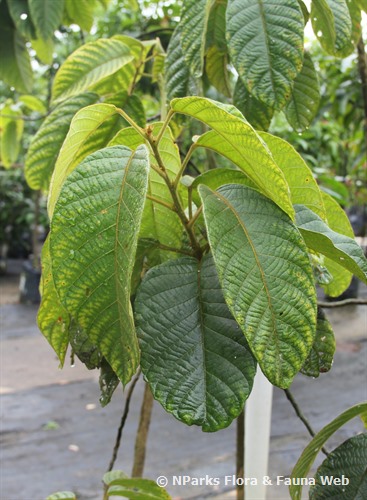
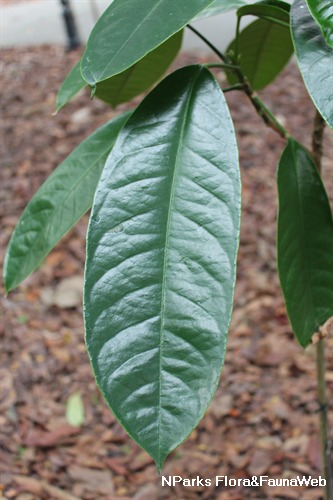
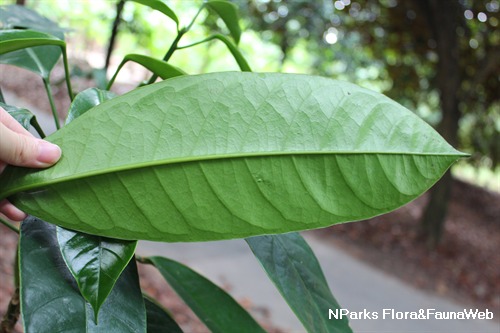
| Foliage | Its alternate, stalked leaves have think leathery leaf blades that are elliptic to obovate, 12-39 cm long and 4-13.6 cm wide. |
| Flowers | Its male and female flowers are borne on separate trees (dioecious). The small male flowers are 2-2.6 mm wide and densely hairy, borne on an inflorescence. The female flowers are slightly larger, 4-10 mm wide and densely hairy, pale yellow to creamy yellow in colour, borne on an inflorescence. |
| Fruit | Its fruits obovoid or lantern-shaped berries, with raised longitudinal ridges from the top to the tip, 3-5.2 cm long, ripening red to pink. The seeds are covered by a sweet-sour aril that is edible. |
| Habitat | It grows in lowland primary and secondary forests, and also in riverine forests. |
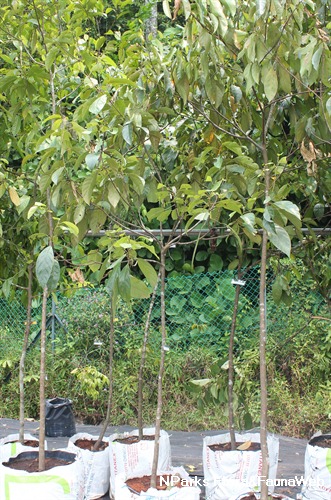
| Cultivation | It can be propagated by seed. |
| Ethnobotanical Uses | Edible Plant Parts : Edible Fruits Food (Fruit or Vegetable) |
Landscaping Features
| Landscaping | It is suitable for parks and gardens for its attractive edible fruits. |
|---|---|
| Desirable Plant Features | Ornamental Fruits |
| Landscape Uses | General, Parks & Gardens, Small Gardens, Riverine |
Fauna, Pollination and Dispersal
| Pollination Method(s) | Biotic (Fauna) |
|---|---|
| Seed or Spore Dispersal | Biotic (Fauna) |
Plant Care and Propagation
| Light Preference | Full Sun |
|---|---|
| Water Preference | Lots of Water, Moderate Water |
| Plant Growth Rate | Moderate |
| Rootzone Tolerance | Moist Soils, Well-Drained Soils, Fertile Loamy Soils |
| Maintenance Requirements | Moderate |
| Propagation Method | Seed |
Foliar
| Foliage Retention | Evergreen |
|---|---|
| Mature Foliage Colour(s) | Green |
| Mature Foliage Texture(s) | Leathery, Thick |
| Foliar Type | Simple / Unifoliate |
| Foliar Arrangement Along Stem | Alternate |
| Foliar Attachment to Stem | Petiolate |
| Foliar Shape(s) | Non-Palm Foliage (Obovate, Elliptical) |
| Foliar Venation | Pinnate / Net |
| Foliar Margin | Ciliate / Hairy |
| Foliar Apex - Tip | Acuminate, Cuspidate, Obtuse |
| Foliar Base | Cuneate, Attenuate |
Floral (Angiosperm)
| Flower & Plant Sexuality | Unisexual Flowers , Dioecious |
| Flower Colour(s) | Cream / Off-White, Yellow / Golden |
|---|
| Flower Grouping | Cluster / Inflorescence |
| Flower Location | Cauliflorous |
Fruit, Seed and Spore
| Mature Fruit Colour(s) | Red, Pink |
|---|---|
| Fruit Classification | Simple Fruit |
| Fruit Type | Fleshy Fruit , Non-Accessory Fruit |
Image Repository
Others
| Master ID | 29691 |
|---|---|
| Species ID | 4000 |
| Flora Disclaimer | The information in this website has been compiled from reliable sources, such as reference works on medicinal plants. It is not a substitute for medical advice or treatment and NParks does not purport to provide any medical advice. Readers should always consult his/her physician before using or consuming a plant for medicinal purposes. |