





Back
Sagittaria latifolia
| Family Name: | Alismataceae |
| Common Name: | Broadleaf Arrowhead, Common Arrowhead |
Name
Classifications and Characteristics
| Plant Division | Angiosperms (Flowering Seed Plants) |
|---|---|
| Plant Growth Form | Freshwater (Emergent Freshwater) |
| Lifespan (in Singapore) | Perennial |
| Mode of Nutrition | Autotrophic |
Biogeography
| Native Distribution | North America and British Columbia |
|---|---|
| Native Habitat | Freshwater, Freshwater |
| Local Conservation Status | Non-native |
Description and Ethnobotany
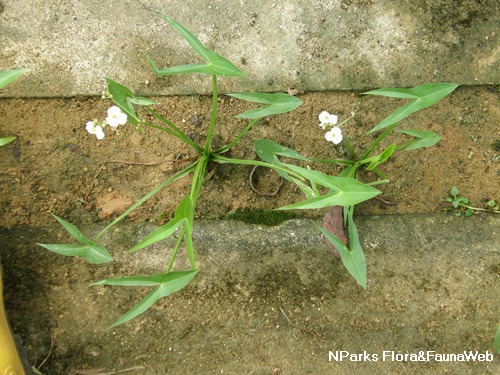
| Growth Form | An aquatic emergent. |
|---|---|
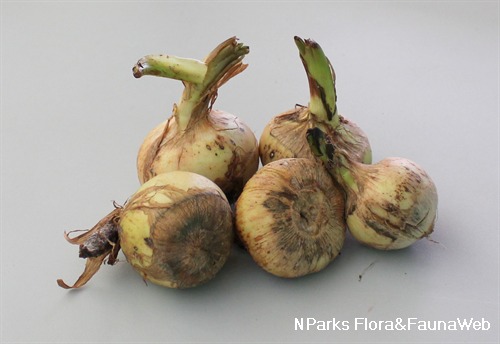
| Roots | The rots are rough and develop starchy tubers. |
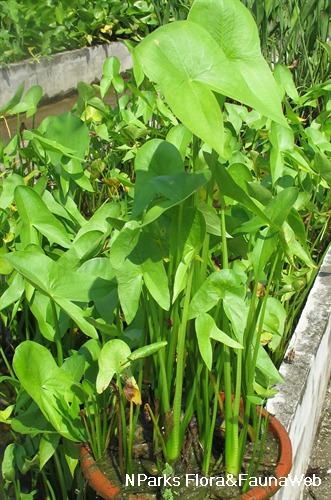
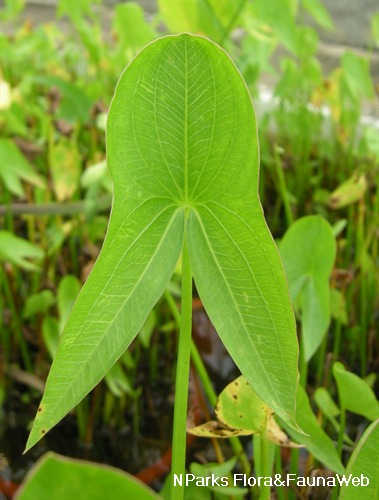
| Foliage | The leaves are arranged in a rosette and are sagittate, have an entire margin and conspicuous parallel veins. The petioles are long and are wider and sheath-like at the base. |
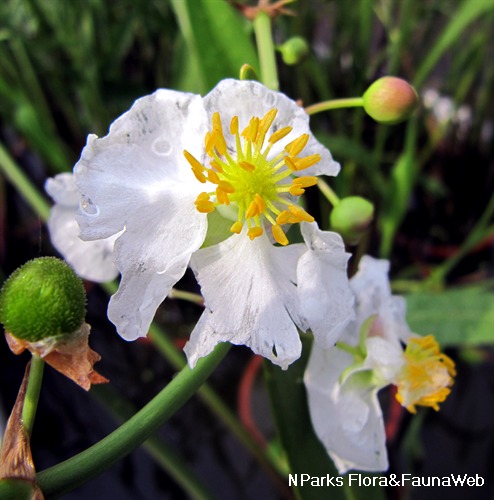
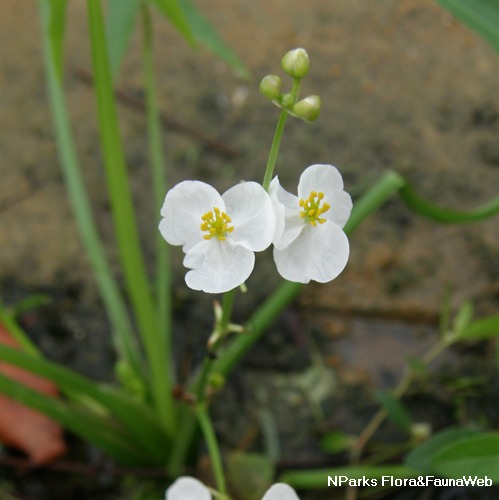
| Flowers | The flowers are borne on long stalks of the same length or more than that of the leaves and are arranged in whorls. The white flowers are monoecious, the male flowers which have multiple yellow stamens and are located on the upper end of the inflorescence while the female flowers have multiple green pistils and are located at the lower end. Each flowers have 3 soft and thin petals and green sepals. |
| Fruit | The fruit is an achene, are 3-angled and winged. |
| Habitat | It is found in marshes, swamps, ditches and shallow areas of ponds, lakes and streams. |
| Cultivation | It is ideally grown under full or partial sun in soil rich in organic matter in shallow water with pH levels of 6.0 to 6.5. |
| Ethnobotanical Uses | Others: The starchy tubers are eaten as a food source by waterfowl, muskrats and beavers in the wild. |
Landscaping Features
| Desirable Plant Features | Ornamental Flowers, Ornamental Form |
|---|---|
| Landscape Uses | Parks & Gardens, Pond / Lake / River |
| Thematic Landscaping | Water Garden |
Plant Care and Propagation
| Light Preference | Full Sun, Semi-Shade |
|---|---|
| Water Preference | Lots of Water |
| Rootzone Tolerance | Waterlogged Soils, Acidic (low pH) Soils |
| Propagation Method | Seed, Storage Organ (Root Tuber) |
Foliar
| Foliage Retention | Evergreen |
|---|---|
| Mature Foliage Colour(s) | Green |
| Mature Foliage Texture(s) | Smooth |
| Foliar Type | Simple / Unifoliate |
| Foliar Arrangement Along Stem | Rosulate / Rosette |
| Foliar Attachment to Stem | Petiolate |
| Foliar Shape(s) | Non-Palm Foliage (Sagittate) |
| Foliar Venation | Parallel |
| Foliar Margin | Entire |
Non - Foliar and Storage
| Specialised Storage Organ(s) | Underground |
|---|
Floral (Angiosperm)
| Flower & Plant Sexuality | Unisexual Flowers |
| Flower Colour(s) | White |
|---|---|
| Flower Texture(s) | Thin |
| Flower Grouping | Cluster / Inflorescence |
Fruit, Seed and Spore
| Fruit Type | Indehiscent Dry Fruit , Achene |
Image Repository
Others
| Master ID | 30352 |
|---|---|
| Species ID | 4661 |
| Flora Disclaimer | The information in this website has been compiled from reliable sources, such as reference works on medicinal plants. It is not a substitute for medical advice or treatment and NParks does not purport to provide any medical advice. Readers should always consult his/her physician before using or consuming a plant for medicinal purposes. |