




Back
Lasianthus attenuatus Jack var. attenuatus
| Family Name: | Rubiaceae |
Lasianthus attenuatus is a understorey shrub that grows to 2 m tall. It has hairy leaves that are broadly lanceolate to oblong-ovate and leaf bases that are asymmetrical, rounded or cordate. White tubular flowers and blue fruits are hairy, produced directly the nodes. Lasianthus attenuatus is a vulnerable species, native to Singapore.
Name
Classifications and Characteristics
| Plant Division | Angiosperms (Flowering Seed Plants) |
|---|---|
| Plant Growth Form | Shrub |
| Lifespan (in Singapore) | Perennial |
| Maximum Height | 2 |
Biogeography
| Native Distribution | Tropical & Subtropical Asia |
|---|---|
| Native Habitat | Terrestrial |
| Preferred Climate Zone | Tropical |
| Local Conservation Status | Native to Singapore (Endangered (EN)) |
Description and Ethnobotany
| Growth Form | A hairy shrub that grows to 1 - 2 m tall. |
|---|---|
| Foliage | Its leaves are thin, papery, smooth to hairy, arranged oppositely. They are broadly lanceolate to oblong-ovate in shape with a pointed tip. The base of the leaves are asymmetrical (oblique), rounded, or cordate. Stipules are triangular, covered in hairs. |
| Flowers | Its flowers are white, tubular, covered in hairs. Flowers are 4-petalled, produced directly at the nodes (axillary). Bracts are linear to lance-shaped. |
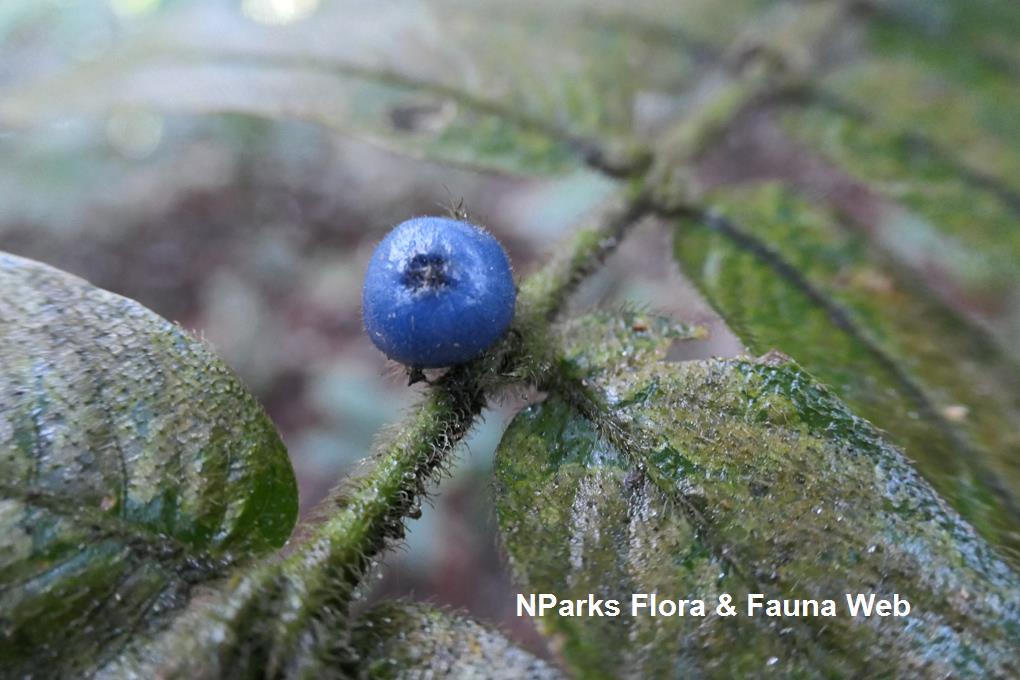
| Fruit | Its fruits are blue, round and small with fine hairs. |
| Habitat | It is found in the understorey of swamp forest and lowland forest |
| Etymology | The specific epithet 'attenuatus' means impaired, weak, meagre, reduced in thickness or become slender referring to the overall appearance of the plant. |
Plant Care and Propagation
| Light Preference | Semi-Shade |
|---|---|
| Water Preference | Moderate Water |
| Plant Growth Rate | Fast |
| Rootzone Tolerance | Well-Drained Soils, Moist Soils |
Foliar
| Foliage Retention | Evergreen |
|---|---|
| Mature Foliage Texture(s) | Velvety / Furry / Tomentose |
Image Repository
Others
| Master ID | 34072 |
|---|---|
| Species ID | 5118 |
| Flora Disclaimer | The information in this website has been compiled from reliable sources, such as reference works on medicinal plants. It is not a substitute for medical advice or treatment and NParks does not purport to provide any medical advice. Readers should always consult his/her physician before using or consuming a plant for medicinal purposes. |