




Back
Oryza sativa L.
| Family Name: | Poaceae (Gramineae) |
| Synonyms: | Oryza communissima Lour., Oryza glutinosa Lour., Oryza ruribaris (Desv.) Steud. |
| Common Name: | Padi, Paddy, Rice, Asian Cultivated Rice, 稻米 |
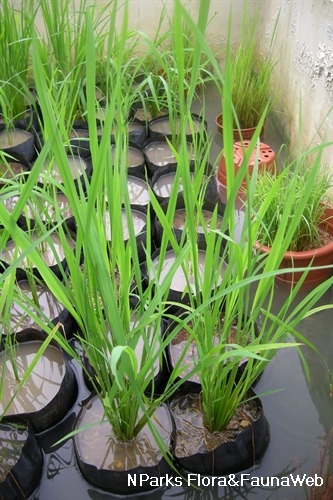
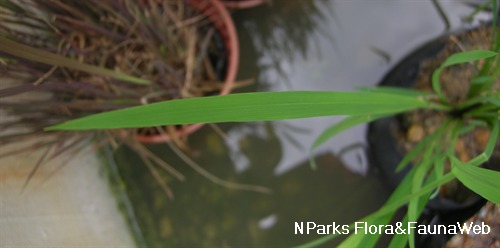
Oryza sativa, commonly known as Rice or Padi, is an annual, aquatic, clump-forming grass that grows up to 0.5–2.0 m tall. It has strap-like, green, drooping leaves and produces a terminal cluster of spikelets. Rice grains are a staple food in Asia, typically boiled or steamed, and are also used in religious and cultural practices, such as creating kolam or rangoli designs with ground, dyed rice powder during Hindu festivals.
Name
Classifications and Characteristics
| Plant Division | Angiosperms (Flowering Seed Plants) (Monocotyledon) |
|---|---|
| Plant Growth Form | Grass or Grass-like Plant (Tall Grass (Poaceae)) |
| Lifespan (in Singapore) | Annual |
| Mode of Nutrition | Autotrophic |
| Chromosome Number | 24 |
| Maximum Height | 0.5 m to 2 m |
Biogeography
| Native Distribution | China |
|---|---|
| Native Habitat | Freshwater (Emergent Freshwater) |
| Preferred Climate Zone | Temperate |
| Local Conservation Status | Non-native |
Description and Ethnobotany
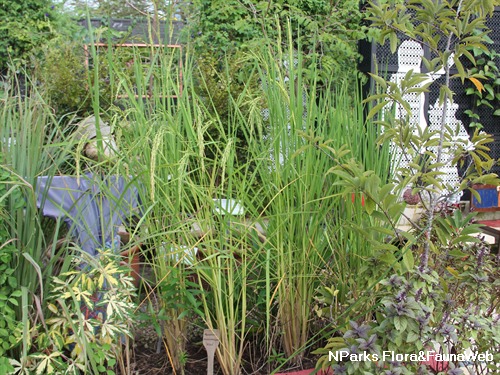
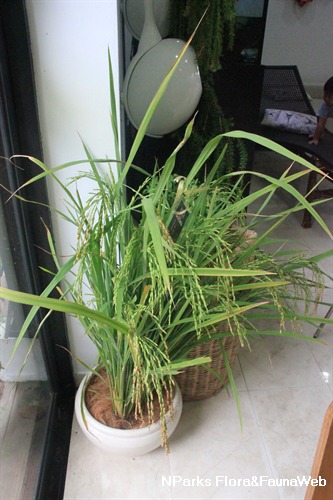
| Growth Form | It is an annual, aquatic, clump-forming grass that grows up to 0.5–2.0 m tall. |
|---|---|
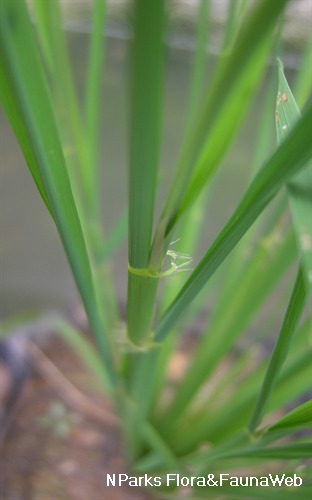
| Foliage | The leaves are smooth on both sides or slightly rough on the underside. The leaf blades are green, strap-like, held erect but drooping towards the tip and reach 24–60 cm long × 0.6–2.2 cm wide. The leaf margins are rough with short stiff hairs. The leaf sheaths are rolled tightly at the base, forming a pseudostem. The auricles (ear-shaped or triangular lateral extensions at the top of leaf sheaths in grasses) are rarely absent, being minuscule (1–5 mm long × 0.5–1 mm wide), narrowly lance-shaped or sickle-shaped, deciduous and hairy. Ligules (projection at the top of the leaf sheath) are present, being minute (10–36 mm long × 2.5–8 mm wide) and triangular or egg-shaped. The leaves are arranged alternately in two ranks. |
| Stems | The culms (aboveground stems of grasses and grass-like monocots) are erect and smooth, growing up to 0.5–2.0 m tall. The clump-forming habit arise from tillers (suckers from the base of the stem). |
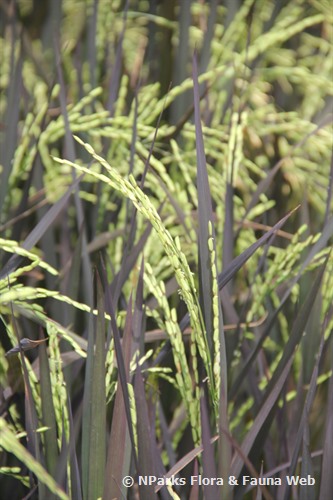
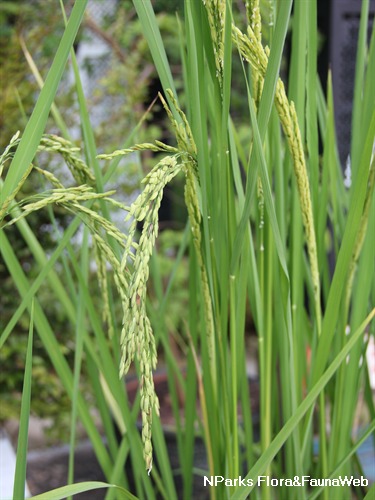
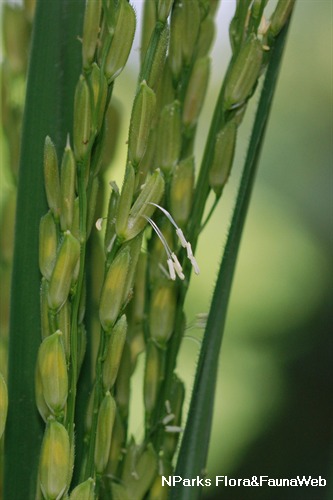
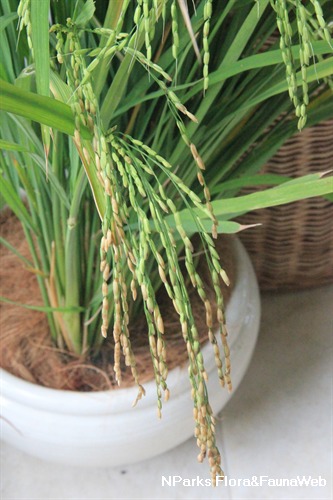
| Flowers | The inflorescence is a pale green to yellow, pendulous panicle with spikelets. Each spikelet comprises a single fertile floret, each consisting of heavily reduced petals and sepals, six drooping anthers, and two feathery stigmas. The glumes are highly reduced. Fertile lemmas (the two bracts enclosing a grass floret) are present and covered in glassy hairs. Sterile lemmas (the remaining highly reduced, bracts of vestigial florets) are also present at the base of the single floret. |
| Fruit | The fruit is a yellowish-white to brown-black caryopsis (a type of dry, indehiscent fruit, commonly known as a grain). |
| Habitat | It can be found in marshes and wet, inundated fields, in fresh and brackish water, or on dry hill slopes. |
| Similar | It is similar to its progenitor Oryza rufipogon but differs in being an annual, having a shorter, upright habit, and non-shattering seeds. Oryza rufipogon are perennial, tall and spreading grasses with deciduous spikelets that easily disperse its seeds. |
| Taxonomy | This species is considered a cultigen, having been domesticated from Oryza rufipogon in China about 9,000 years ago. An ancestral Oryza had a three-floret spikelet; two of which became vestigial and reduced to their lemmas, and the topmost remaining fertile in the domesticated O. sativa and other O. species. |
| Cultivation | It is best grown under full sun, partially submerged in water in fertile, clayey or silty clay soils. The optimal pH range for flooded soils is 6.5 to 7.0. It can be propagated by seed, where it takes 100-150 days to reach harvest. |
| Etymology | The genus Oryza is derived from Greek Oruza "rice". The specific epithet sativa means "cultivated" in Latin, referring to its domestication. |
| Ethnobotanical Uses | Edible Plant Parts : Edible Seeds Timber & Products: The rice husks are used as fuel, bedding, and soil additives, and, when charred, as a filter for impurities in water and for the manufacture of charcoal briquettes. Rice straw is used in the manufacturing of straw boards, paper pulp and as animal feed and bedding. |
Landscaping Features
| Desirable Plant Features | Ornamental Form |
|---|---|
| Landscape Uses | Parks & Gardens, Pond / Lake / River, Marsh / Bog |
| Thematic Landscaping | Water Garden, Economic Garden |
Plant Care and Propagation
| Light Preference | Full Sun |
|---|---|
| Water Preference | Lots of Water |
| Plant Growth Rate | Fast |
| Rootzone Tolerance | Waterlogged Soils (Does not Drain Site), Heavy Clay Soils |
| Maintenance Requirements | Moderate |
| Pest(s) | Chewing Insects |
| Propagation Method | Seed |
| Propagation Method Remarks | Oryza sativa generally takes 100–150 days from seed germination to harvest. |
Foliar
| Foliage Retention | Evergreen |
|---|---|
| Mature Foliage Colour(s) | Green |
| Mature Foliage Texture(s) | Smooth |
| Foliar Type | Simple / Unifoliate |
| Foliar Arrangement Along Stem | Alternate |
| Foliar Attachment to Stem | Sessile |
| Foliar Shape(s) | Non-Palm Foliage (Linear) |
| Foliar Venation | Parallel |
| Foliar Apex - Tip | Acuminate |
| Foliar Base | Clasping |
Non - Foliar and Storage
| Stem Type & Modification | Culm, Herbaceous |
|---|---|
| Root Type | Underground (Reduced Root) |
Floral (Angiosperm)
| Flower & Plant Sexuality | Bisexual Flowers , Bisexual Flowers |
| Flower Colour(s) | Yellow / Golden, Green - Light Green |
|---|
| Flower Grouping | Cluster / Inflorescence |
| Flower Location | Terminal |
| Inflorescence Type | Spikelet / Pseudospikelet / Compound Spike |
| Ovary Position | Superior / Hypogynous |
Fruit, Seed and Spore
| Mature Fruit Colour(s) | Cream / Off-White, Brown, Black |
|---|---|
| Fruit Classification | Simple Fruit |
| Fruit Type | Indehiscent Dry Fruit , Caryopsis / Grain |
| Seed Quantity Per Fruit | Few (1-5) |
References
| References | 4. Oryza sativa Linnaeus. Flora of China.http://www.efloras.org/florataxon.aspx?flora_id=2&taxon_id=200025789 (Accessed 6 Jan 2026) Lombardo, F. & Yoshida, H. (2015). Interpreting lemma and palea homologies: a point of view from rice floral mutants. Front. Plant Sci. 6:61. (Accessed on 6 Jan 2026). Veldkamp, J.F., Duistermaat, H., Wong, K.M., & Middleton, D.J. (2019). Poaceae (Gramineae). Flora of Singapore, Volume 7. Singapore: National Parks Board. pp. 219-501. |
|---|
Image Repository
Others
| Master ID | 30848 |
|---|---|
| Species ID | 5218 |
| Flora Disclaimer | The information in this website has been compiled from reliable sources, such as reference works on medicinal plants. It is not a substitute for medical advice or treatment and NParks does not purport to provide any medical advice. Readers should always consult his/her physician before using or consuming a plant for medicinal purposes. |