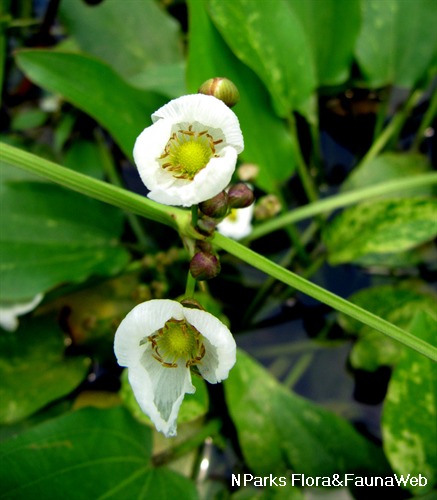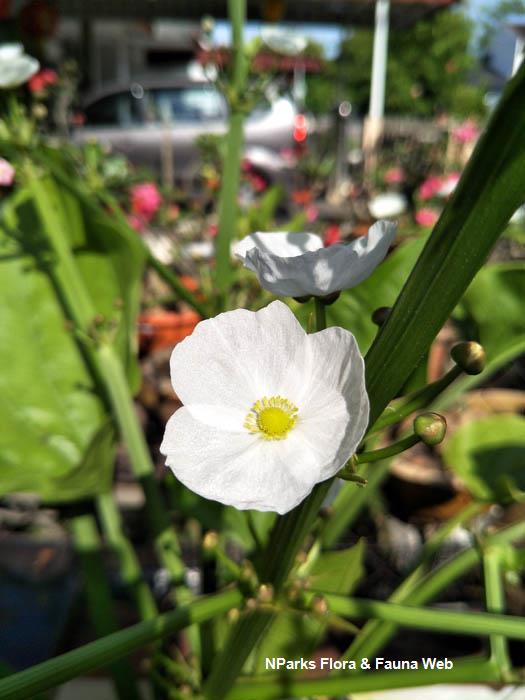






Name
Classifications and Characteristics
| Plant Division | Angiosperms (Flowering Seed Plants) (Monocotyledon) |
|---|---|
| Plant Growth Form | Freshwater (Emergent Freshwater, Submerged Freshwater) |
| Lifespan (in Singapore) | Perennial |
| Mode of Nutrition | Autotrophic |
Biogeography
| Native Distribution | Of horticultural origin. Hybrid between Echinodorus schluteri 'Leopard' and Echinodorus barthii. |
|---|---|
| Native Habitat | Freshwater |
Description and Ethnobotany
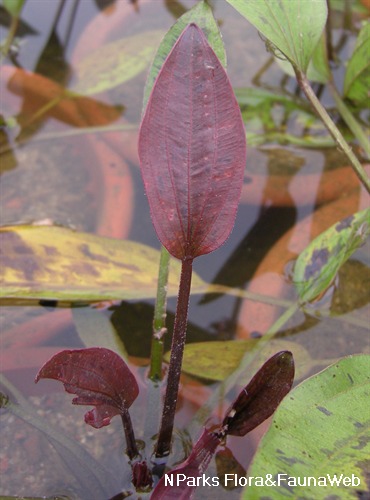
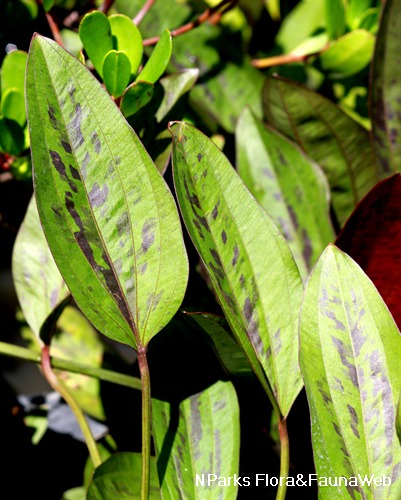
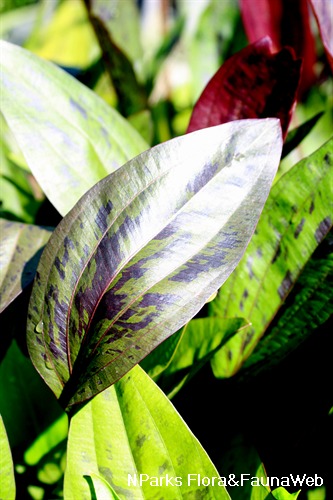
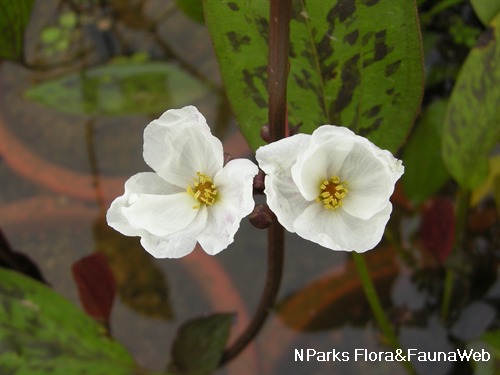
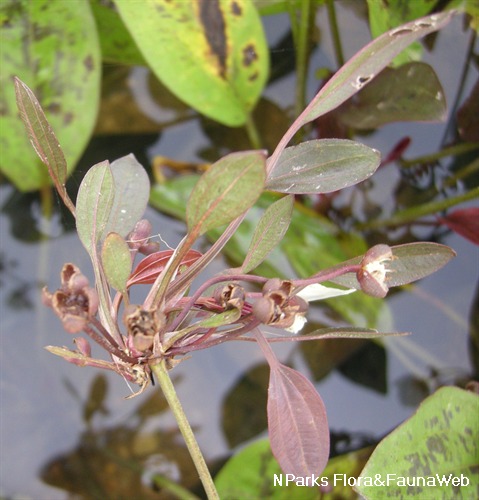
| Foliage | The leaves are red-brown with black spots and gradually transform to a shinny-green as the leaves age, but will retain their dark spots. The spots are darkest on the youngest leaves and older leaves tend to have dark red spots. |
|---|---|
| Cultivation | They are easy to grow in a wide variety of water and lighting conditions, but the best results will be obtained with medium to high light and pressurized CO2. |
Landscaping Features
| Desirable Plant Features | Ornamental Foliage |
|---|---|
| Landscape Uses | Terrarium, Aquarium / Aquascape |
Fauna, Pollination and Dispersal
| Pollination Method(s) | Abiotic (Self-Pollinated) |
|---|
Plant Care and Propagation
| Light Preference | Semi-Shade |
|---|---|
| Water Preference | Lots of Water |
| Rootzone Tolerance | Waterlogged Soils (Does not Drain Site) |
| Propagation Method | Seed, Storage Organ (Rhizome), Division |
| Seed / Spore Germination Duration | 14 days to 30 days |
Foliar
| Foliage Retention | Evergreen |
|---|---|
| Mature Foliage Colour(s) | Green |
| Mature Foliage Texture(s) | Smooth |
| Foliar Type | Simple / Unifoliate |
| Foliar Arrangement Along Stem | Basal |
| Foliar Attachment to Stem | Petiolate |
| Foliar Shape(s) | Non-Palm Foliage (Lanceolate) |
| Foliar Margin | Entire |
| Foliar Apex - Tip | Acuminate |
| Foliar Base | Cuneate, Rounded / Obtuse |
Image Repository
Others
| Master ID | 31210 |
|---|---|
| Species ID | 5604 |
| Flora Disclaimer | The information in this website has been compiled from reliable sources, such as reference works on medicinal plants. It is not a substitute for medical advice or treatment and NParks does not purport to provide any medical advice. Readers should always consult his/her physician before using or consuming a plant for medicinal purposes. |