






Back
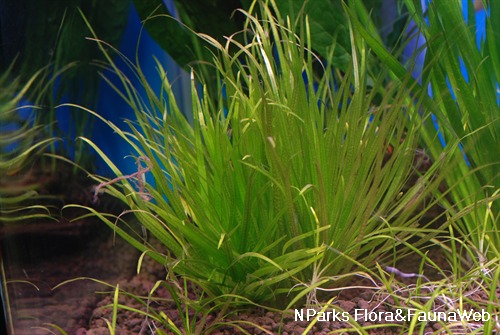
Blyxa japonica (Miq.) Maxim. ex Asch. & Gürke
| Family Name: | Hydrocharitaceae |
| Synonyms: | Hydrilla japonica Miq. |
| Common Name: | Japanese Blyxa, Dwarf Asian Grass |
Name
Classifications and Characteristics
| Plant Division | Angiosperms (Flowering Seed Plants) (Monocotyledon) |
|---|---|
| Plant Growth Form | Herbaceous Plant |
| Lifespan (in Singapore) | Perennial |
| Mode of Nutrition | Autotrophic |
| Maximum Height | 0.1 m to 0.25 m |
Biogeography
| Native Distribution | India, Bangladesh, Nepal, China South-Central, China Southeast, Hong Kong, Hainan, Taiwan, Manchuria, Korea, Japan, Ryukyu Islands, Myanmar, Laos, Vietnam, Cambodia, Thailand, Peninsular Malaysia, Singapore, Borneo, Sumatra, Sulawesi & New Guinea |
|---|---|
| Native Habitat | Freshwater |
| Preferred Climate Zone | Tropical |
| Local Conservation Status | Native to Singapore (Critically Endangered (CR)) |
Description and Ethnobotany
| Growth Form | It is an herbaceous, grass-like, submerged perennial. |
|---|---|
| Foliage | The leaves are lanceolate with tapering tips and grow in staggered spirals on the stem. This, giving it an aesthetic appeal. The leaves are dark green but get a reddish hue under strong light and can grow up to 6 to 8cm in length. |
| Habitat | It can be found in stagnant shallow water from ponds and swamps and in slowly flowing, iron-rich forest waters, as well as in paddy fields, and ditches. |
| Cultivation | The plant is ideally grown in water pH levels of 6.0 to 7.0 and in water temperatures of 24 to 28°C under bright light. It does well, grown in water with low carbonate hardness (soft water). The plant does not tolerate changes to its environment, and any changes will affect its growth and will cause it to take a long time to re-establish itself. |
| Etymology | The genus Blyxa is derived from Greek blyzein 'to flow', referring to the locations of several Blyxa species, which inhabit streams. The specific epithet refers to its occurrence in Japan, one of the countries within its native distribution. |
Landscaping Features
| Desirable Plant Features | Ornamental Foliage, Ornamental Form |
|---|---|
| Landscape Uses | Aquarium / Aquascape |
Plant Care and Propagation
| Light Preference | Full Sun |
|---|---|
| Water Preference | Lots of Water |
| Rootzone Tolerance | Waterlogged Soils |
| Propagation Method | Stem Cutting (Herbaceous) |
| Propagation Method Remarks | Stem cuttings of the side shoots can used for propagation. |
Foliar
| Foliage Retention | Evergreen |
|---|---|
| Foliar Type | Simple / Unifoliate |
| Foliar Attachment to Stem | Sessile |
| Foliar Shape(s) | Non-Palm Foliage |
Image Repository
Others
| Master ID | 31427 |
|---|---|
| Species ID | 5824 |
| Flora Disclaimer | The information in this website has been compiled from reliable sources, such as reference works on medicinal plants. It is not a substitute for medical advice or treatment and NParks does not purport to provide any medical advice. Readers should always consult his/her physician before using or consuming a plant for medicinal purposes. |