










Back
Hydnophytum formicarum Jack
| Family Name: | Rubiaceae |
| Common Name: | Ant Plant, Dedalu Api Laut, Kepala Beruk, Hempedal Itik, Pedal Itik, Baboon's Head |
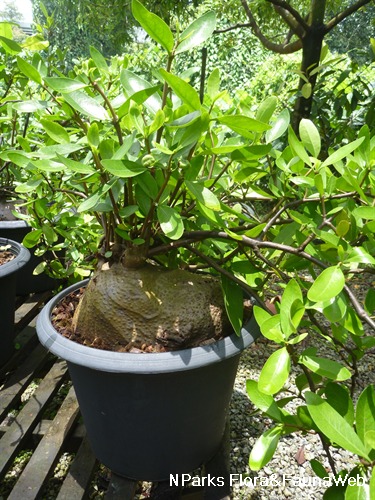
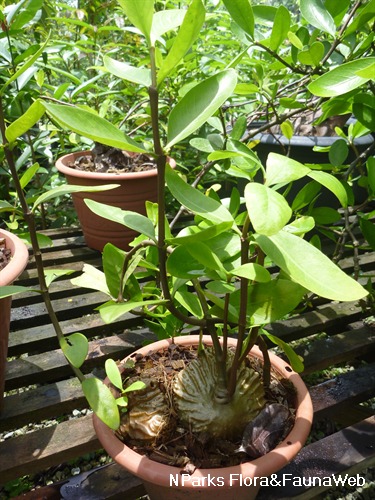
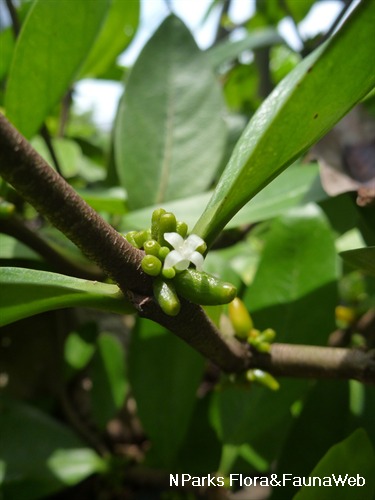
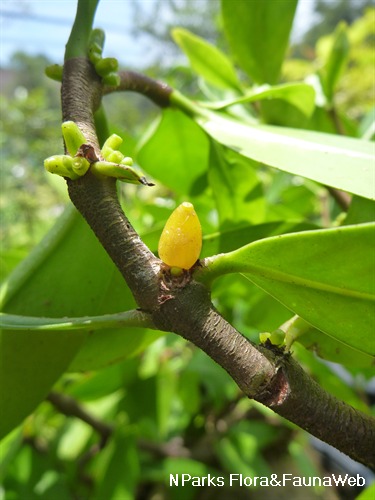
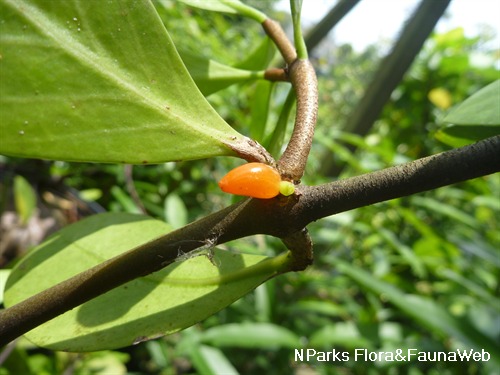
Hydnophytum formicarum is an epiphytic myrmecophyte (ant-plant), forms a symbiotic relationship with ants, providing shelter within its swollen, hollow stem. This stem resembles a potato and typically grows to 20 cm across. This plant features small, elliptic leaves and produces white tubular flowers which are pollinated by its ants inhabitants. Its green, egg-shaped berries ripen to orange-red, attracting small birds.
Name
Classifications and Characteristics
| Plant Division | Angiosperms (Flowering Seed Plants) (Dicotyledon) |
|---|---|
| Plant Growth Form | Shrub, Epiphyte |
| Lifespan (in Singapore) | Perennial |
| Mode of Nutrition | Autotrophic |
| Maximum Plant Spread / Crown Width | 50 cm |
Biogeography
| Native Distribution | Andaman Islands, Myanmar, Vietnam, Cambodia, Thailand, Peninsular Malaysia, Singapore, Borneo, Philipppines, Sumatra, Java, Sulawesi, Maluku and New Guinea |
|---|---|
| Native Habitat | Terrestrial (Primary Rainforest, Mountain, Coastal Forest, Freshwater Swamp Forest) |
| Preferred Climate Zone | Tropical |
| Local Conservation Status | Native to Singapore (Critically Endangered (CR)) |
Description and Ethnobotany
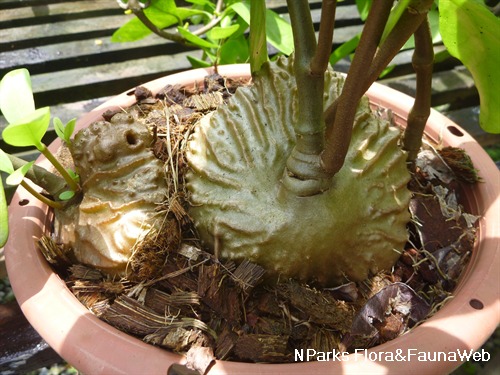
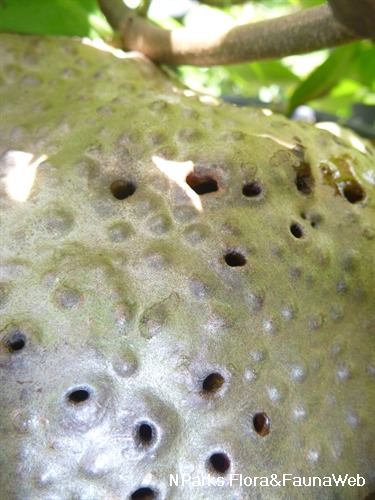
| Growth Form | It is an epiphytic shrub with a tuber at its base. Its fleshy tuber is irregularly lobed, brown, 15–20 cm across, tunneled, and perforated where ants would reside. |
|---|---|
| Foliage | Its opposite, short-stalked leaves have leathery leaf blades that are elliptic and 4–15 by 2.5–6.4 cm. The leaf tip is rounded to acute (sharp pointed), and base cuneate (wedge-like shape), and the leaf texture is smooth. |
| Stems | The swollen main stem (or caudex) is slightly bumpy and has many holes on the surface to allow ants into the caudex that is filled with numerous tunnels where the ants inhabit. The slender, flexible branches grow out from the tip of the caudex, on which the leaves and flowers are borne. |
| Flowers | Its flowers are white, 2-3 mm long, and develop in in clusters of 3–5 in flowering shoots (inflorescence) that occur in the leaf axils. The flower has 4 triangular petals spreading and recurved (curved backward) when open. |
| Fruit | Its fruits are drupes that are ovoid (egg-shaped), ripening from green to orange-red, and 4-7 by 3-5 mm. Fruit has acute tip (sharp pointed) and rounded base. |
| Habitat | It grows on trees in lowland evergreen, montane, mangrove, peat swamp, heath, and beach forests. |
| Associated Flora | It has been observed growing on the branches of Lumnitzera littorea and the trunk and prop roots of Rhizophora apiculata in Singapore. In mangrove area of Terengganu, Malaysia, it has been observed growing on Heritiera littoralis and Rhizophora apiculata. <3> |
| Associated Fauna | Its tuber is inhabited by ants that pollinate the flowers and might help to disperse its seeds. The ripe berries are eaten by small birds. |
| Cultivation | It can be propagated by seed or stem cutting (from the slender, flexible branches). However, plants propagated through stem cutting do not form the caudex. |
| Etymology | The genus Hydnophytum arised from a Greek word hydnos means tuber and phyton which means plant, referring to the tuberous form. The species epithet formicarum is from Latin formicarum which means associated with ants, referring to the swollen tuber inhabited by ants. |
| Ethnobotanical Uses | Medicinal: Traditional Medicinal Uses Dried slices of tubers are sold in some Southeast Asian markets for their anti-tumour effects. <2>
It is important to note that some therapeutic effects from traditional medicinal uses of plants are not currently supported or verified by scientific research. Others: It is cultivated as an ornamental plant. |
Landscaping Features
| Landscaping | It may be suitable for parks and roadsides as it is an interesting and attractive epiphyte that can be grown on trees. It can tolerate hot, sunny conditions. |
|---|---|
| Desirable Plant Features | Ornamental Form |
| Landscape Uses | Container Planting, Suitable for Hanging Baskets, Suitable for Bonsai |
Fauna, Pollination and Dispersal
| Fauna Pollination Dispersal Associated Fauna | Bird-Attracting Plant (Fruits) |
|---|---|
| Pollination Method(s) | Biotic (Fauna) (Insects (Ant, Beetle, Fly, Thrip, Wasp)) |
| Seed or Spore Dispersal | Biotic (Fauna) |
Plant Care and Propagation
| Light Preference | Full Sun, Semi-Shade |
|---|---|
| Water Preference | Little Water |
| Plant Growth Rate | Moderate |
| Propagation Method | Seed, Stem Cutting |
Foliar
| Foliage Retention | Evergreen |
|---|---|
| Mature Foliage Colour(s) | Green |
| Mature Foliage Texture(s) | Leathery |
| Prominent Young Flush Colour(s) | Green |
| Young Flush Texture(s) | Leathery |
| Foliar Type | Simple / Unifoliate |
| Foliar Arrangement Along Stem | Opposite |
| Foliar Attachment to Stem | Petiolate |
| Foliar Shape(s) | Non-Palm Foliage (Ovate, Elliptical) |
| Foliar Venation | Pinnate / Net |
| Foliar Margin | Entire |
| Foliar Apex - Tip | Acute, Obtuse |
| Foliar Base | Cuneate |
Non - Foliar and Storage
| Stem Type & Modification | Caudex |
|---|
Floral (Angiosperm)
| Flower & Plant Sexuality | Bisexual Flowers |
| Flower Colour(s) | White |
|---|---|
| Flower Grouping | Cluster / Inflorescence |
| Flower Location | Axillary |
| Flower Symmetry | Radial |
| Individual Flower Shape | Tubular |
Fruit, Seed and Spore
| Mature Fruit Colour(s) | Orange, Red |
|---|---|
| Mature Fruit Texture(s) | Glossy / Shiny |
| Fruit Classification | Simple Fruit |
| Fruit Type | |
| Seed Quantity Per Fruit | Few (1-5) |
References
| References | <1> Yang et al. (2013). The current status of mangrove forests in Singapore. Proceedings of Nature Society, Singapore's conference on 'Nature Conservation for a Sustainable Singapore' - 16th October 2011. pp 99 - 120. <2> Wong et al. (2019). Rubiaceae. Flora of Singapore, vol. 13, pp. 131–134. Singapore: Singapore Botanic Gardens, National Parks Board. <3> Shahrudin, R., Yusoff, A.S., Kamaruzzaman, M.F & Salam, M.R. (2017). Distribution and host identification of epiphytic plant, Hydnophytum formicarum Jack, in Pulau Telaga Tujuh, Setiu, Terengganu. Journal of Sustainability Science and Management, Vol. 12 (2): 128-134. |
|---|
Image Repository
Others
| Master ID | 31317 |
|---|---|
| Species ID | 5714 |
| Flora Disclaimer | The information in this website has been compiled from reliable sources, such as reference works on medicinal plants. It is not a substitute for medical advice or treatment and NParks does not purport to provide any medical advice. Readers should always consult his/her physician before using or consuming a plant for medicinal purposes. |