





Back
Barringtonia reticulata (Blume) Miq.
| Family Name: | Lecythidaceae |
| Synonyms: | Barringtonia sumatrana Miq. |
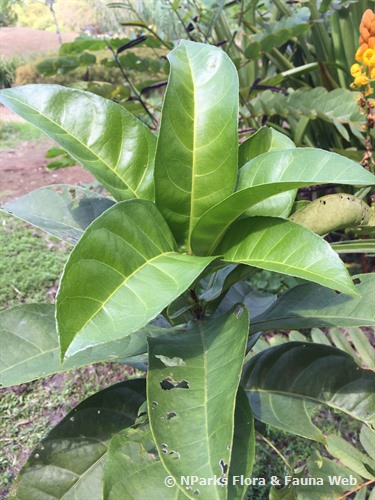
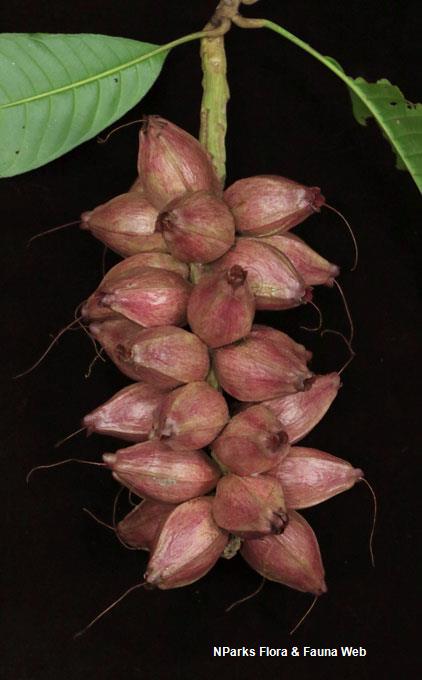
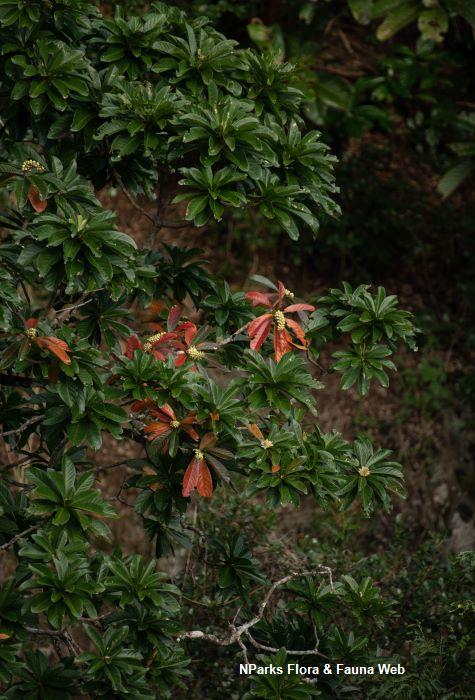
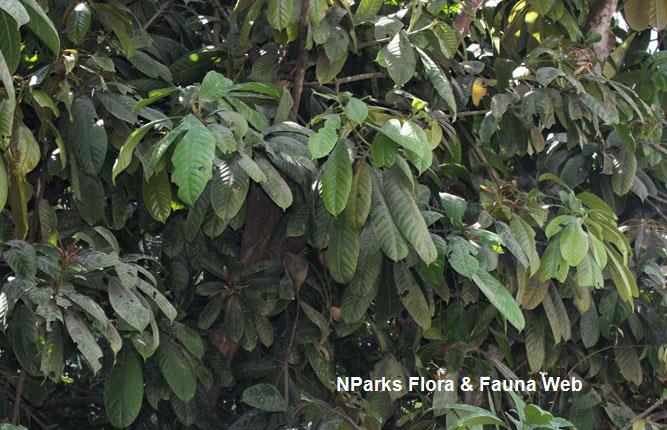
Barringtonia reticulata is a large shrub to small tree native to Singapore. Growing to 10 m tall, it has leathery, elliptic leaves with revolute margins and ladder-like veins. Flowers are 4-petalled, white, reddish-white or pink with numerous white stamens held on a long pendulous inflorescence of up to 30 flowers. The fruit is a single-seeded, tear to spindle-shaped berry with a box-like tip and tapering base.

Name
Classifications and Characteristics
| Plant Division | Angiosperms (Flowering Seed Plants) (Dicotyledon) |
|---|---|
| Plant Growth Form | Tree (Shrubby (1m-5m), Small (6m-15m)) |
| Maximum Height | 10 m |
Biogeography
| Native Distribution | Sumatra, Peninsular Malaysia, Borneo (Brunei, Sarawak, Sabah, E Kalimantan), Philippines and Singapore |
|---|---|
| Native Habitat | Terrestrial (Primary Rainforest) |
| Preferred Climate Zone | Tropical |
| Local Conservation Status | Native to Singapore (Critically Endangered (CR)) |
Description and Ethnobotany
| Growth Form | It is a large shrub to small tree that can reach between 2 - 10 m tall. |
|---|---|
| Foliage | Leaves are leathery, elliptic, measuring 11 - 22 cm long by 3 - 8 cm wide with a tail-like tip measuring 5 - 14 mm long. The leaves have 9 - 18 pairs of looping lateral veins that rarely meet at the margin. Margins are faintly toothed, curls towards the underside. Veinlets found in between the lateral veins are ladder-like and visible on both sides. |
| Flowers | Flowers are held on a long pendulous inflorescence of up to 30 flowers directly attached to the main flower stalk. The inflorescence is found along the tip measuring 30 - 65 cm long. Flowers are 4 petalled, white, reddish white or pink with numerous white stamens. |
| Fruit | The fruit is a single-seeded, tear to spindle-shaped berry with a box-like tip and tapering base measuring 6 - 10.5 cm long, 2.5 - 7 cm wide and 2.5 - 6 cm thick. The seed is tear-shaped, deeply fissured that is 2 cm long. |
| Habitat | Occurs in primary hillside forest and mixed dipterocarp forest, up to 1700 m in altitude. <1 &2> |
| Cultivation | It can be propagated by seed. |
| Etymology | The genus Barringtonia, is named after an English natralist, The Hon. Daines Barrington (1727–1800). The species epithet reticulata, Latin reticulatus meaning reticulate; referring to the reticulate network of leaf veins |
Landscaping Features
| Desirable Plant Features | Fragrant (Flowers), Ornamental Flowers |
|---|---|
| Usage Hazard - Cons | Toxic Upon Ingestion |
Fauna, Pollination and Dispersal
| Fauna Pollination Dispersal Associated Fauna | Bat Food, Moth Food Plant |
|---|---|
| Pollination Method(s) | Biotic (Fauna) (Insects (Butterfly, Moth), Vertebrates (Bat)) |
Plant Care and Propagation
| Light Preference | Semi-Shade |
|---|---|
| Water Preference | Moderate Water |
| Plant Growth Rate | Moderate |
| Rootzone Tolerance | Fertile Loamy Soils, Moist Soils, Well-Drained Soils |
| Propagation Method | Seed |
Foliar
| Foliage Retention | Evergreen |
|---|---|
| Mature Foliage Colour(s) | Green |
| Foliar Type | Simple / Unifoliate |
| Foliar Arrangement Along Stem | Spiral |
| Foliar Attachment to Stem | Petiolate |
| Foliar Shape(s) | Non-Palm Foliage (Elliptical) |
| Foliar Venation | Reticulate |
| Foliar Margin | Crenulate, Serrate / Toothed |
| Foliar Apex - Tip | Acuminate |
| Foliar Base | Cuneate |
Non - Foliar and Storage
| Stem Type & Modification | Woody |
|---|
Floral (Angiosperm)
| Flower & Plant Sexuality | Bisexual Flowers , Bisexual Flowers |
| Flower Colour(s) | White, Red, Pink |
|---|
| Flower Grouping | Cluster / Inflorescence |
| Flower Location | Terminal |
| Flower Symmetry | Radial |
| Flowering Opening Time | Night (dusk to dawn) |
| Flowering Habit | Polycarpic |
Fruit, Seed and Spore
| Mature Fruit Colour(s) | Red |
|---|---|
| Fruit Classification | Simple Fruit |
| Fruit Type | Fleshy Fruit , Berry |
References
| References | <1> Prance, G.T. (2012) Barringtonia. In: Kiew, R., Chung, R.C.K., Saw, L.G. & Soepadmo, E. (ed.) Lecythidaceae. Flora of Peninsular Malaysia, ser. II: Seed Plants, vol. 3, pp. 75 - 77. Selangor: Forest Research Institute Malaysia. <2> Prance, G.T., Kartawinata, E.K. (2013). Lecythidaceae. In: Van Steenis, C.G.G.J. (ed.) Flora Malesiana, ser. 1, Seed Plants, vol. 21, pp. 205-207. Jakarta: Noordhoff-Kolff N.V. |
|---|
Image Repository
Others
| Master ID | 33920 |
|---|---|
| Species ID | 8336 |
| Flora Disclaimer | The information in this website has been compiled from reliable sources, such as reference works on medicinal plants. It is not a substitute for medical advice or treatment and NParks does not purport to provide any medical advice. Readers should always consult his/her physician before using or consuming a plant for medicinal purposes. |