

Back
Echinodiscus truncatus Agassiz, 1841
| Family Name: | Astriclypeidae |
| Taxonomic Group: | Invertebrates (Echinoderm) |
| Common Name: | Key-hole Sand Dollar |
Name
Description
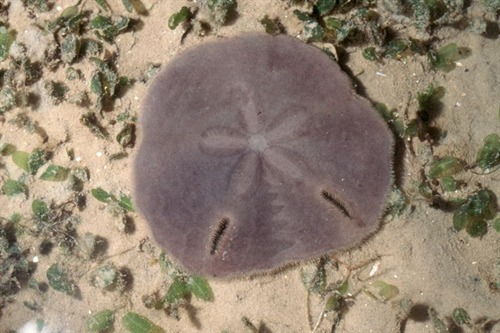
| Description | A large sand dollar about 8-9cm across, with a pair of elongated holes or lunules close to the disc edge. |
|---|
Ecology, Habitat & Location
| Ecological Notes | Using its velvet-like covering of small, short spines it burrows just beneath the surface of intertidal sands. |
|---|---|
| Habitats | Marine, Sandy Shore |
| Distribution | Indo-west Pacific from East Africa to New Caledonia. |
| Nature Areas | Pulau Tekong, Pulau Ubin |
Conservation
| Trends & Threats | This uncommon species, restricted to very few sites, mainly in the Pulau Ubin/Tekong area, is under threat from coastal development in land scarce Singapore. |
|---|---|
| Scientific Interest & Potential Value | Various explanations for the adaptive value of the lunules have been put forward. One theory is that the lunule spines assist in burrowing while another idea is that the holes have a hydrodynamic function in reducing lift in strong currents and thus preventing dislodgement. |
| Conservation Notes | The only location where these sand dollars are known to occur in significant numbers is the sandy foreshore at Chek Jawa on Pulau Ubin. Effective conservation of this sand dollar (and the rich assemblage of many other invertebrate species) hinges on designation of this site as an MPA (Marine Protected Area). |
Status
| Singapore Red Data Book Status | Vulnerable (VU) [3rd Edition] |
|---|
Photos
References
| References | Davison G.W.H., Gan J.W.M., Huang D., Hwang W.S., Lum S.K.Y., Yeo D.C.J. (eds.). 2024. The Singapore Red Data Book: Red Lists of Singapore Biodiversity, Third Edition. National Parks Board, Singapore. |
|---|