






Back
Caladium humboldtii (Raf.) Schott
| Family Name: | Araceae |
| Synonyms: | Podospadix humboldtii Raf., Caladium argyrites Lem., Caladium humboldtii var. myriostigma (K.Koch) Engl., Caladium myriostigma K.Koch, Caladium schillerianum F.F.Stange |
| Common Name: | Humboldt Caladium, Mini Variegated Caladium, Mini Angel Wings, Keladi Liliput |
.jpg)
.jpg)
Name
Classifications and Characteristics
| Plant Division | Angiosperms (Flowering Seed Plants) (Monocotyledon) |
|---|---|
| Plant Growth Form | Herbaceous Plant |
| Lifespan (in Singapore) | Perennial |
| Mode of Nutrition | Autotrophic |
| Maximum Height | 0.2 m to 0.3 m |
Biogeography
| Native Distribution | Venezuela & Northern Brazil |
|---|---|
| Native Habitat | Terrestrial (Primary Rainforest) |
| Preferred Climate Zone | Tropical |
| Local Conservation Status | Non-native (Horticultural / Cultivated Only) |
Description and Ethnobotany
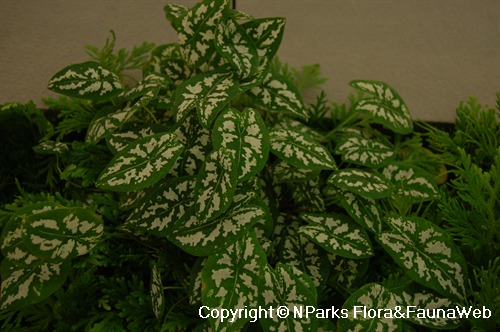
| Growth Form | Herbaceous perennial grows from a tuber and forms dense clumps. |
|---|---|
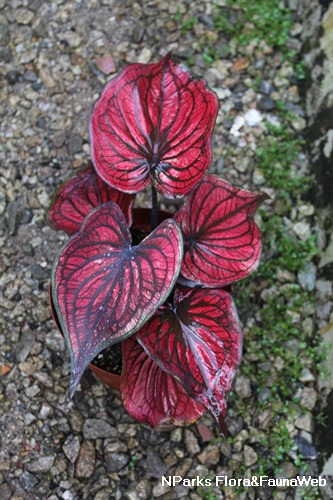
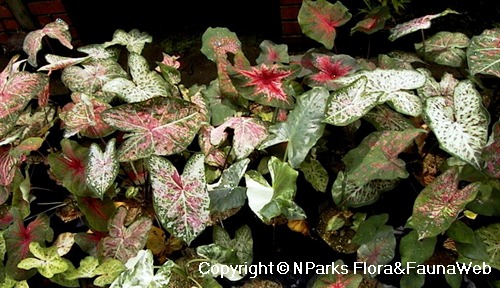
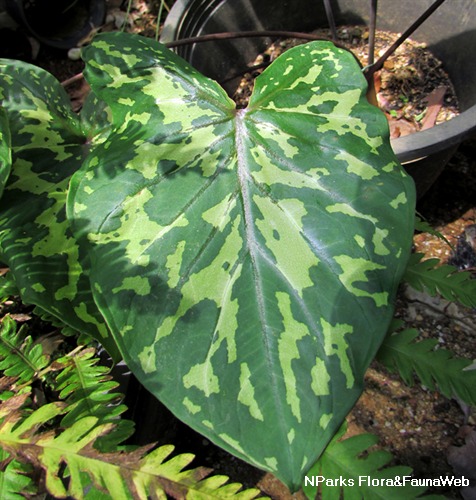
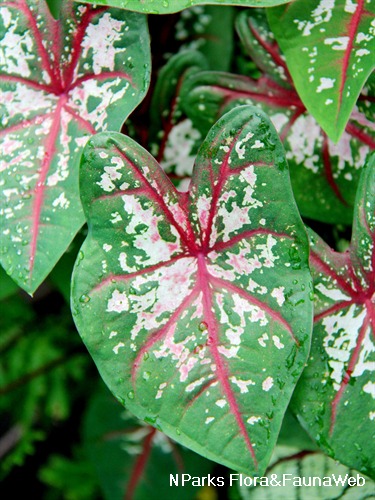
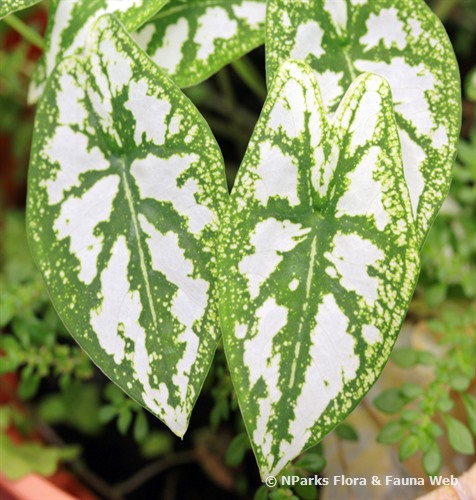
| Foliage | Thin, arrow-shaped leaves with entire leaf margin are dark green with irregular white patches (10 - 14 cm long, 4 -7 cm wide). Leaves are borne on long petioles (10 - 25 cm long) without a stem. |
| Flowers | This species does not produce flowers or fruits in cultivation. |
| Cultivation | It grows best in a moist, well-draining soil in semi-shade and a humid environment. The tuber should be planted at a depth of twice its height. Feed regularly with balanced NPK fertilizer. It is prone to attack by mealy bugs, spider mites, and aphids, as well as susceptible to tuber rot, leaf spot and leaf burn. It is propagated by corms & division. |
| Etymology | The genus Caladium is derived from Malay keladi (Taro-yam), referring to the similar appearance to Colocasia, a closely-allied genus. The specific epithet humboldtii was named in honour of Alexander von Humboldt (1769 - 1859), a German naturalist and explorer who documented plant species in Latin America. His research formed the basis of the field of biogeography. |
Landscaping Features
| Desirable Plant Features | Ornamental Foliage |
|---|---|
| Landscape Uses | Indoor Plant |
| Usage Hazard - Cons | Irritant - Hairs, Toxic Upon Ingestion |
| Usage Hazard - Cons Remarks | Irritant Sap/ Toxic Upon Ingestion: All plant parts contain calcium oxalate raphides, which are needle-shaped crystals that can cause irritation to skin, mouth and throat. Keep plants out of reach of children and pets. |
Plant Care and Propagation
| Light Preference | Semi-Shade |
|---|---|
| Water Preference | Lots of Water, Occasional Misting |
| Plant Growth Rate | Slow |
| Rootzone Tolerance | Moist Soils, Well-Drained Soils |
| Pest(s) | Sucking Insects |
| Propagation Method | Storage Organ (Corm), Division |
Foliar
| Mature Foliage Colour(s) | Green, White |
|---|---|
| Leaf Area Index (LAI) for Green Plot Ratio | 3.5 (Shrub & Groundcover - Monocot) |
Non - Foliar and Storage
| Root Type | Underground (Fibrous Root) |
|---|---|
| Specialised Storage Organ(s) | Underground (Corm) |
Image Repository
Others
| Master ID | 448 |
|---|---|
| Species ID | 1744 |
| Flora Disclaimer | The information in this website has been compiled from reliable sources, such as reference works on medicinal plants. It is not a substitute for medical advice or treatment and NParks does not purport to provide any medical advice. Readers should always consult his/her physician before using or consuming a plant for medicinal purposes. |