





Back
Epidendrum ibaguense Kunth
| Family Name: | Orchidaceae |
| Synonyms: | Epidendrum radicans |
| Common Name: | Crucifix Orchid, Epidendrum Orchid |
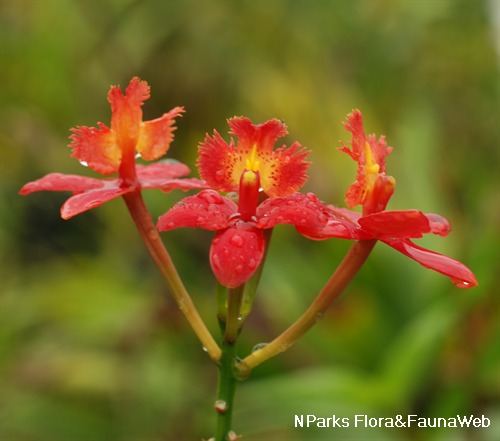
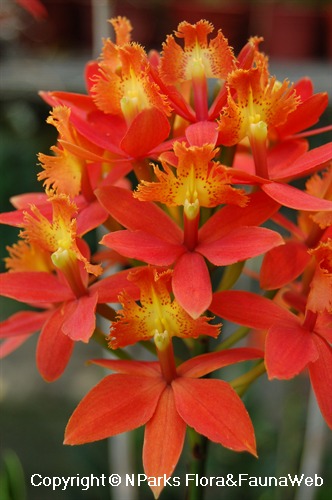
Crucifix Orchid (scientifically known as Epidendrum ibaguense) is a terrestrial orchid that typically reaches up to 1 m tall. This species produces clusters of vibrant, often orange or red flowers with distinctive crucifix-shaped lips. It is free-flowering all year round, and thrives in full sun with moderate watering needs.
Name
Classifications and Characteristics
| Plant Division | Angiosperms (Flowering Seed Plants) (Monocotyledon) |
|---|---|
| Plant Growth Form | Herbaceous Plant, Lithophyte |
| Lifespan (in Singapore) | Perennial |
| Mode of Nutrition | Autotrophic |
| Maximum Height | 1 m |
Biogeography
| Native Distribution | Colombia, Bolivia, Venezuela, Trinidad-Tobago, Guyana, French Guiana and North Brazil |
|---|---|
| Native Habitat | Terrestrial |
| Preferred Climate Zone | Tropical |
| Local Conservation Status | Non-native |
Description and Ethnobotany
| Growth Form | An herbaceous orchid with erect clumps, with new growth arising from the base. |
|---|---|
| Roots | The roots are located at the stem base. |
| Foliage | The leaves are measuring 6 - 10 cm long and 1 - 2 cm wide, oblong to elliptic in shape. |
| Stems | The stems are cane-like, erect and branched. |
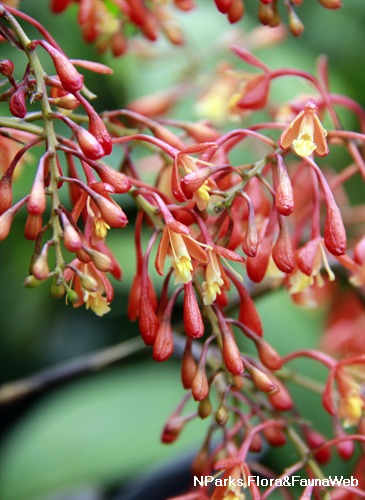
| Flowers | The inflorescence type is raceme, located at the tip of the stem, measuring about 20 - 40 cm long with a long inflorescence stalk. Each flower is 2 - 3 cm across, resupinate (twisted about 180 degrees, appearing upside down compared to its initial position), and varied in colour from mauve, red, orange to yellow. The labellum (lip) projects outwards like crucifx, with three fringed lobes. |
| Habitat | It is found growing at elevations above 1,800 m as a large sized, erect terrestrial or lithophytic species. |
| Similar | It is similar to Epidendrum radicans but E. radicans has adventitious roots along the stem, unlike E. ibaguense that has roots only at the base. |
Landscaping Features
| Desirable Plant Features | Ornamental Flowers |
|---|---|
| Landscape Uses | Flowerbed / Border, General, Small Gardens |
Plant Care and Propagation
| Light Preference | Semi-Shade, Full Sun |
|---|---|
| Water Preference | Moderate Water |
| Plant Growth Rate | Moderate |
| Propagation Method | Division |
Foliar
| Foliage Retention | Evergreen |
|---|---|
| Mature Foliage Colour(s) | Green |
| Mature Foliage Texture(s) | Leathery |
| Prominent Young Flush Colour(s) | Green |
| Young Flush Texture(s) | Leathery |
| Foliar Type | Simple / Unifoliate |
| Foliar Arrangement Along Stem | Alternate |
| Foliar Attachment to Stem | Sessile |
| Foliar Shape(s) | Non-Palm Foliage (Elliptical, Oblong) |
| Foliar Venation | Parallel |
| Foliar Margin | Entire |
| Foliar Apex - Tip | Acute |
| Foliar Base | Clasping |
| Leaf Area Index (LAI) for Green Plot Ratio | 3.5 (Shrub & Groundcover - Monocot) |
Floral (Angiosperm)
| Flower & Plant Sexuality | Bisexual Flowers |
| Flower Colour(s) | Orange, Red, Yellow / Golden |
|---|---|
| Flower Texture(s) | Smooth |
| Flower Grouping | Cluster / Inflorescence |
| Flower Location | Terminal |
| Flower Symmetry | Bilateral |
| Individual Flower Shape | Labiate / Lipped |
| Inflorescence Type | Raceme |
| Flowering Period | Free-Flowering |
| Flower Size | 2 cm |
References
| References | <1> Jones, D.L. Epidendrum ibaguense, Flora of Australia. Australian Biological Resources Study, Department of Climate Change, Energy, the Environment and Water: Canberra. https://profiles.ala.org.au/opus/foa/profile/Epidendrum%20ibaguense [Date Accessed: 28 August 2026] |
|---|
Image Repository
Others
| Master ID | 692 |
|---|---|
| Species ID | 1987 |
| Flora Disclaimer | The information in this website has been compiled from reliable sources, such as reference works on medicinal plants. It is not a substitute for medical advice or treatment and NParks does not purport to provide any medical advice. Readers should always consult his/her physician before using or consuming a plant for medicinal purposes. |
| Suggest Species |