





Back
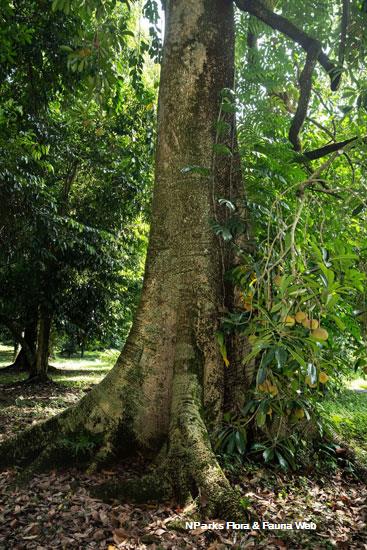
Parartocarpus venenosus (Zoll. & Moritzi) Becc.
| Family Name: | Moraceae |
| Common Name: | Ara Berteh Paya |
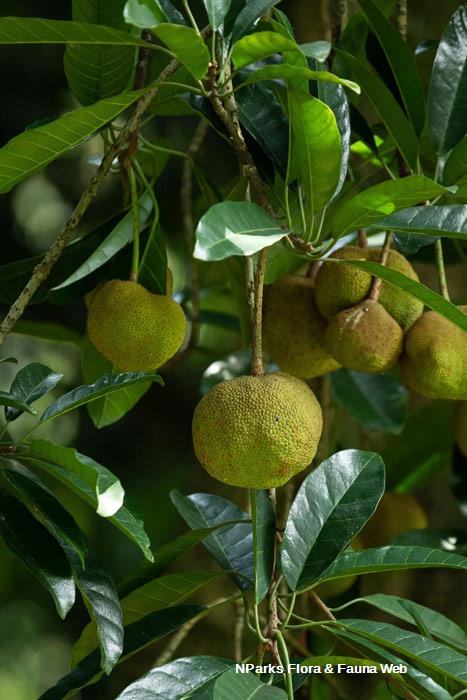
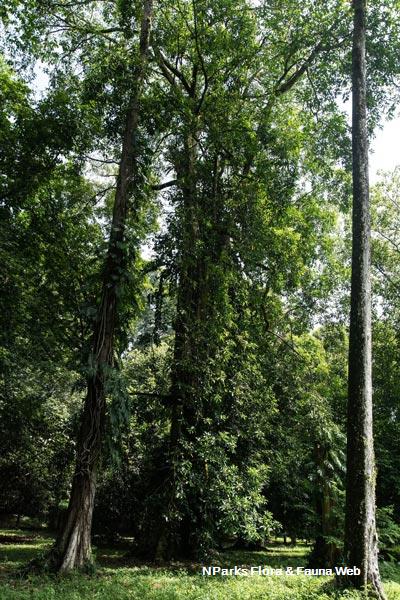
Parartocarpus venenosus, also known as Ara Berteh Paya, is native to Singapore, although it is presumed to be nationally extinct locally. Growing up to 35 m tall, it is notable for its large fruiting heads, which can reach 18 cm in diameter. The nearly spherical heads may be slightly to distinctly lobed and are covered with spine-like structures. The wood of Parartocarpus species has a range of uses, from flooring and furniture to boat building, musical instruments and toys.
Name
Classifications and Characteristics
| Plant Division | Angiosperms (Flowering Seed Plants) |
|---|---|
| Plant Growth Form | Tree |
| Lifespan (in Singapore) | Perennial |
| Mode of Nutrition | Autotrophic |
| Maximum Height | 35 m |
Biogeography
| Native Distribution | Peninsular Thailand, Sumatra, Peninsular Malaysia, Singapore, Java, Borneo, the Philippines, Sulawesi, Aru Islands, Papua New Guinea, Bismarck Archipelago, and Solomon Islands. |
|---|---|
| Native Habitat | Terrestrial |
| Preferred Climate Zone | Tropical |
| Local Conservation Status | Native to Singapore (Presumed Nationally Extinct (NEx)) |
Description and Ethnobotany
| Growth Form | It is a tree which can reach up to 35 m tall and sometimes develop buttresses. It produces white sap when any part of the plant is injured. |
|---|---|
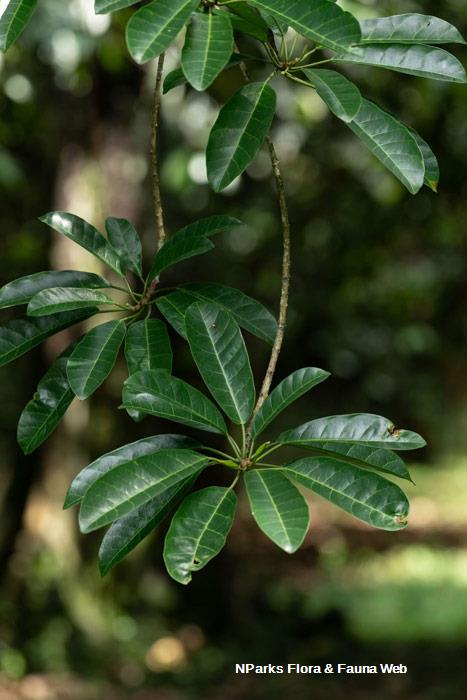
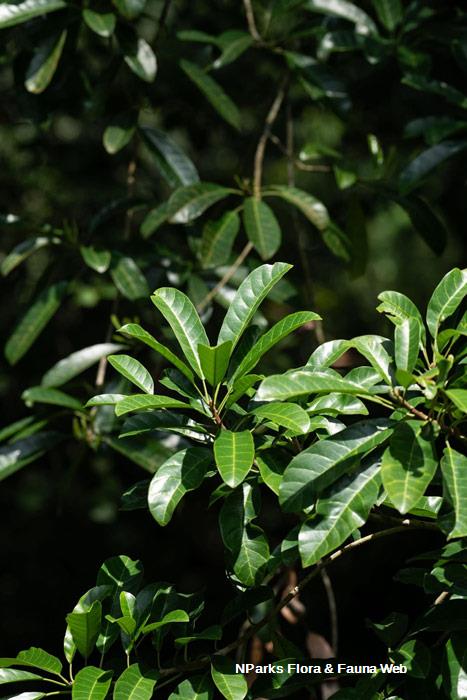
| Foliage | The leaves are leathery and spirally arranged. They are elliptic to obovate to subobovate to narrowly obovate, about (4–20(–30) cm long and 2.5–8(–10) cm wide. The leaf tip can be rounded to short tapering point (short-acuminate). While the leaf base can be wedge shaped (cuneate), rounded to subcordate. Both the upper and lower leaf surface can be subglabrous or sparsely to densely hairy, with hairs mainly found along the main veins. Each leaf has 6 – 16 pairs of lateral veins. Petiole is 1.5 – 5.5 cm long, and sparsely to densely covered with whitish hairs. Stipule is hairy, 0.2 – 0.4 cm long and falls out early. |
| Flowers | Inflorescence are unisexual and occurs at the axillary position. The flower heads of male inflorescence are globose to obovoid (1.5 – 3 cm diameter) and covered spine-like structures. Female flower heads are globose (2 – 3.5 cm diameter) and similarly covered with spine-like structures which are usually joined in groups of 2 – 4, but may sometimes be free. The involucral bracts are well-developed, with 3–4(–8) ovate bracts measuring 0.2–0.6 cm long. They are present below both male and female inflorescences. |
| Fruit | The fruiting head (syncarp) is subglobose, up to 5 – 18 cm diameter, and may be slightly lobed to distinctly lobed. It is covered with spine-like structures (up to 1 cm long) and contains numerous ellipsoid fruits. |
| Habitat | It is found in rainforests, up to 1000 m altitude |
| Associated Fauna | The flowers are pollinated by insects. |
| Cultivation | It can be propagated by seed. |
| Etymology | The genus epithet Parartocarpus, means similar to Artocarpus, referring to the resemblance in their appearance. The specific epithet venenosus, in Latin, means very poisonous, and refers to the tree's latex. |
| Ethnobotanical Uses | Timber & Products: The wood of Parartocarpus species is used for light construction such as flooring, furniture, and door and window frames. It is also used to make blockboard, plywood, crates, pallets, boats, musical instruments and toys. Others: The latex is traditionally used as arrow poison by indigenous communities in parts of its native range. |
Fauna, Pollination and Dispersal
| Pollination Method(s) | Biotic (Fauna) |
|---|
Plant Care and Propagation
| Light Preference | Full Sun |
|---|---|
| Water Preference | Moderate Water |
| Plant Growth Rate | Moderate |
Foliar
| Mature Foliage Colour(s) | Green |
|---|---|
| Mature Foliage Texture(s) | Leathery |
| Foliar Type | Simple / Unifoliate |
| Foliar Arrangement Along Stem | Spiral |
| Foliar Attachment to Stem | Petiolate |
| Foliar Apex - Tip | Rounded, Acuminate |
| Foliar Base | Cuneate, Rounded / Obtuse |
Non - Foliar and Storage
| Trunk Type (Non Palm) | Woody |
|---|---|
| Root Type | Underground |
Floral (Angiosperm)
| Flower & Plant Sexuality | Unisexual Flowers |
| Flower Grouping | Cluster / Inflorescence |
|---|---|
| Flower Location | Axillary |
Fruit, Seed and Spore
| Mature Fruit Colour(s) | Green |
|---|---|
| Fruit Classification | Aggregate Fruit (Syncarp) |
| Fruit Type | Fleshy Fruit |
References
| References | Berg, C.C., Corner, E.J.H. & Jarrett, F.M. (2006). Moraceae – Genera other than Ficus. Flora Malesiana, ser. 1, Seed Plants, vol. 17, pt. 1. Leiden: Nationaal Herbarium Nederland. Sosef, M.SM., Hong, L.T., and Prawirohatmodjo, S. (Editors). 1998. Plant Resources of South-East Asia Volume 5 (3). Timber Trees: Lesser known timbers. Leiden: Prosea Foundation. 859 pages. |
|---|
Image Repository
Others
| Master ID | 34438 |
|---|---|
| Species ID | 8851 |
| Flora Disclaimer | The information in this website has been compiled from reliable sources, such as reference works on medicinal plants. It is not a substitute for medical advice or treatment and NParks does not purport to provide any medical advice. Readers should always consult his/her physician before using or consuming a plant for medicinal purposes. |