









Back
Leea rubra Blume
| Family Name: | Vitaceae |
| Common Name: | Mali-mali Puchok Merah, Red Leea, Mali-Mali, Red Tree-Vine, Red Tree Shrub |
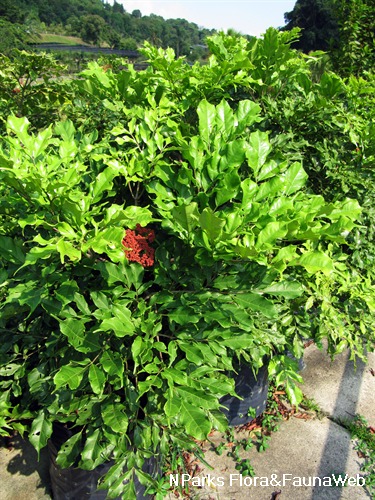
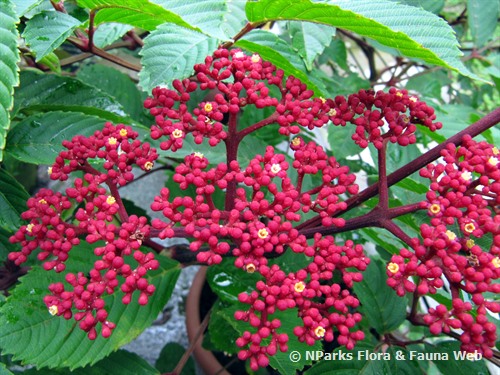
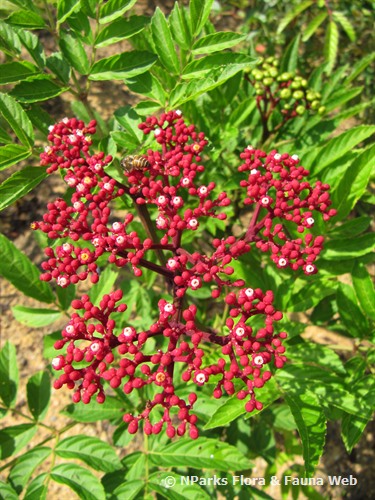
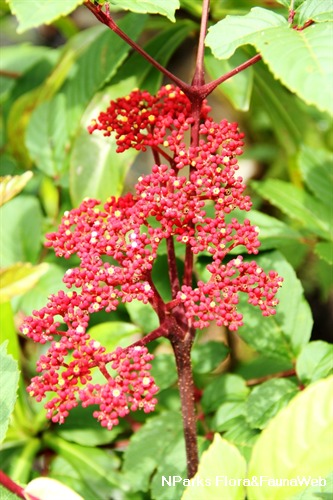
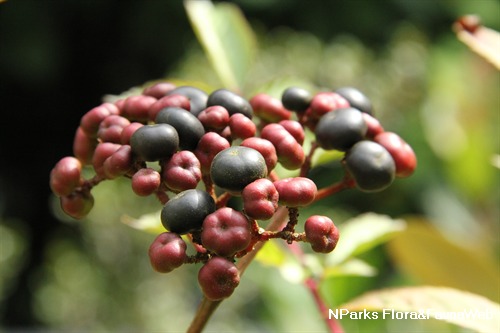
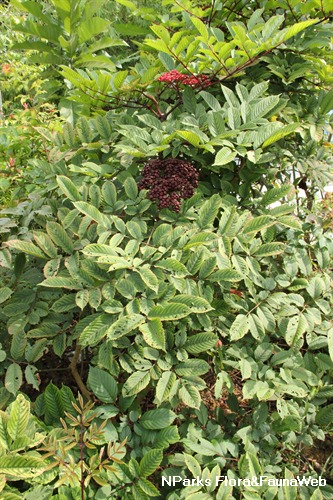
Leea rubra, commonly known as Mali-mali Puchok Merah is a shrub that can reach 3 m tall with bright scarlet flowers. Young leaves are reddish, maturing into dark green leaves. The round fruit ripen from rusty red to black. This ornamental shrub grows best in full sun and well draining soil with moderate watering.
Name
Classifications and Characteristics
| Plant Division | Angiosperms (Flowering Seed Plants) (Dicotyledon) |
|---|---|
| Plant Growth Form | Shrub |
| Lifespan (in Singapore) | Perennial |
| Mode of Nutrition | Autotrophic |
| Plant Shape | Irregular |
| Maximum Height | 3 m |
Biogeography
| Native Distribution | India, Bangladesh, Myanmar, Thailand, Cambodia, Laos, Vietnam, Malaysia, Singapore, Philippines, Indonesia, New Guinea to northern Australia |
|---|---|
| Native Habitat | Terrestrial (Secondary Rainforest, Monsoon Forest, Grassland / Savannah/ Scrubland, Primary Rainforest) |
| Preferred Climate Zone | Tropical, Sub-Tropical / Monsoonal |
| Local Conservation Status | Native to Singapore (Presumed Nationally Extinct (NEx)) |
Description and Ethnobotany
| Growth Form | It is a semi-woody shrub up to 3 m tall. |
|---|---|
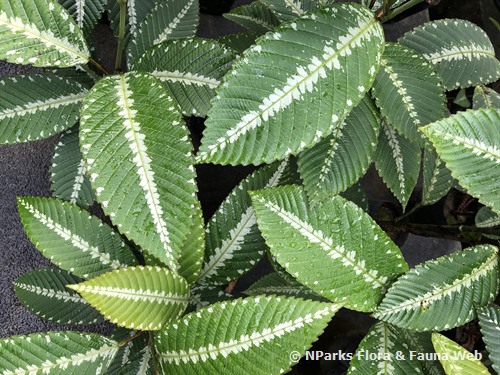
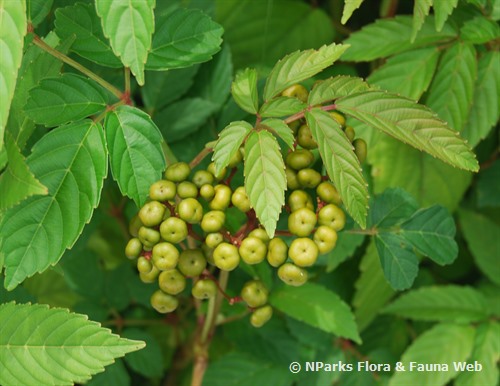
| Foliage | The leaves are 2-4 pinnate with numerous leaflets. Leaf blades are ovate, sometimes elliptic to lanceolate, measuring 3-15 cm long and 1.5-5 cm wide. The leaf edges are toothed (crenate). The leaf stalks are red. |
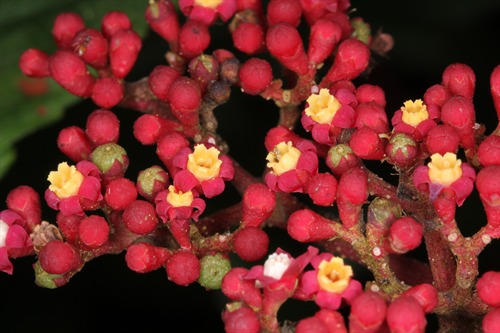
| Flowers | Its flowering shoots are compact and 4-16 cm long. Flowers are bright red in colour with a yellow central disc. |
| Fruit | It fruit are round berries with flattened tip, turning from red to black when ripe, 6-seeded, 7-10 mm wide. |
| Habitat | It grows in dry monsoon forest, savanna, primary and secondary forests up to 500 m altitude. |
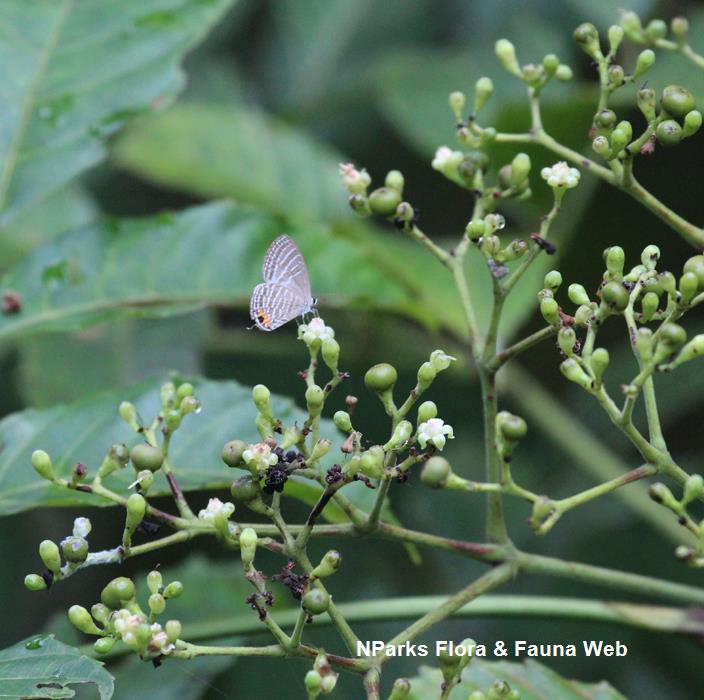
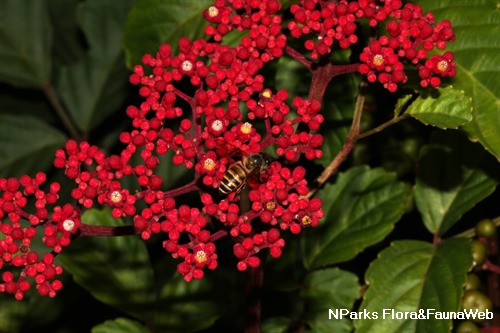
| Associated Fauna | Its flowers are pollinated by insects and butterflies. The fruit are eaten by birds and other small mammals. |
| Cultivation | It can be propagated by seed or stem cutting. |
| Etymology | Latin Leea, a name for tropical small trees or shrubs named for James Lee (1715–1795), who was a nurseryman; Latin rubra means red, referring to the colour of the flowers. |
| Ethnobotanical Uses | Medicinal: Scientific Evidence of Medicinal Properties Based on clinical trials where the effect of Leea rubra was studied on animals, it has anti-microbial property. <1>
Traditional Medicinal Uses In Thailand, the root and stem of Leea rubra are used for treating intestinal diseases. <2> It is important to note that some therapeutic effects from traditional medicinal uses of plants are currently not supported or verified by scientific research. |
Landscaping Features
| Landscaping | It is suitable for planting along streetscapes, parks and gardens for its attractive bright red flowers, reddish young leaves and red leaf stalks. |
|---|---|
| Desirable Plant Features | Ornamental Flowers, Ornamental Stems, Ornamental Foliage, Ornamental Fruits |
| Landscape Uses | General, Flowerbed / Border, Hedge / Screening, Suitable for Roadsides, Parks & Gardens, Small Gardens |
Fauna, Pollination and Dispersal
| Fauna Pollination Dispersal Associated Fauna | Bird-Attracting Plant (Fruits), Butterfly-Attracting Plant (Flower Nectar), Bee-Attracting Plant |
|---|---|
| Pollination Method(s) | Biotic (Fauna) (Insects (Bee), Insects (Butterfly, Moth), Insects (Ant, Beetle, Fly, Thrip, Wasp)) |
| Seed or Spore Dispersal | Biotic (Fauna) |
Plant Care and Propagation
| Light Preference | Full Sun |
|---|---|
| Water Preference | Moderate Water |
| Plant Growth Rate | Moderate |
| Rootzone Tolerance | Moist Soils, Well-Drained Soils, Fertile Loamy Soils |
Foliar
| Mature Foliage Colour(s) | Green, Red |
|---|---|
| Prominent Young Flush Colour(s) | Red |
| Foliar Arrangement Along Stem | Alternate |
| Leaf Area Index (LAI) for Green Plot Ratio | 4.5 (Shrub & Groundcover - Dicot) |
Floral (Angiosperm)
| Flower & Plant Sexuality | Bisexual Flowers |
| Flower Colour(s) | Red, White, Yellow / Golden |
|---|---|
| Flower Grouping | Cluster / Inflorescence |
| Flower Location | Terminal |
| Flower Symmetry | Radial |
Fruit, Seed and Spore
| Mature Fruit Colour(s) | Red, Purple |
|---|---|
| Mature Fruit Texture(s) | Smooth |
| Fruit Classification | Simple Fruit |
| Fruit Type | |
| Seed Quantity Per Fruit | Moderate (6-10) |
References
| References | <1> Das, N., Hossain, S., Barmon, J., Parvin, S., Hasan, M., Akter, M., & Islam, E. (2021). Evaluation of Leea rubra leaf extract for oxidative damage protection and antitumor and antimicrobial potential. Journal of Tropical Medicine. <2> Kadchhumsang, S., Sirisa-ard, P., Sookkhee, S., Eakanunkul, S., & Chansakaow, S. (2014). Antibacterial and antioxidant activities of various fraction of Leea rubra (Leeaceae) J. Nat. Sci. Res. 4(11):1-4. <3> PlantUse English contributors, "Leea rubra (PROSEA)," PlantUse English. https://uses.plantnet-project.org/e/index.php?title=Leea_rubra_(PROSEA)&oldid=215889. Accessed 12 Oct. 2022. |
|---|
Image Repository
Others
| Master ID | 898 |
|---|---|
| Species ID | 2192 |
| Flora Disclaimer | The information in this website has been compiled from reliable sources, such as reference works on medicinal plants. It is not a substitute for medical advice or treatment and NParks does not purport to provide any medical advice. Readers should always consult his/her physician before using or consuming a plant for medicinal purposes. |