







Back
Pistia stratiotes L.
| Family Name: | Araceae |
| Common Name: | Water Lettuce, Kiamfang, Water-Bonnet, Nile Cabbage, Shell-Flower, 水浮莲, 大萍 |
Name
Classifications and Characteristics
| Plant Division | Angiosperms (Flowering Seed Plants) (Monocotyledon) |
|---|---|
| Plant Growth Form | Herbaceous Plant |
| Lifespan (in Singapore) | Perennial |
| Mode of Nutrition | Autotrophic |
| Maximum Height | 0.2 m |
| Maximum Plant Spread / Crown Width | 0.3 m |
Biogeography
| Native Distribution | Pantropical |
|---|---|
| Native Habitat | Freshwater (Floating Freshwater) |
| Preferred Climate Zone | Tropical |
| Local Conservation Status | Non-native (Spontaneous (Naturalised)) |
Description and Ethnobotany
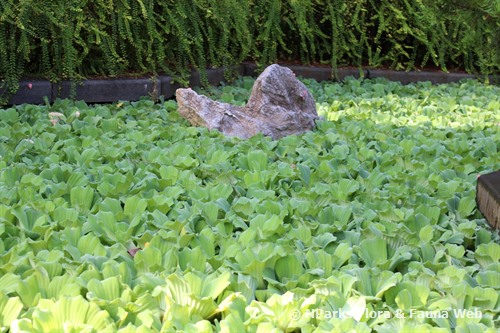
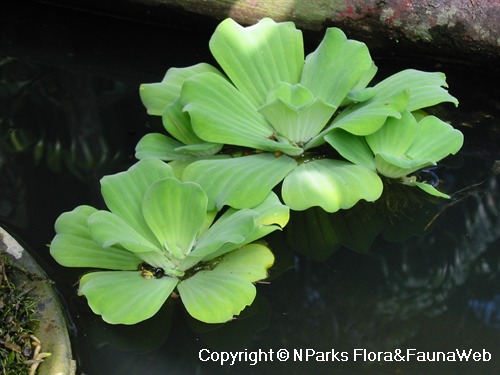
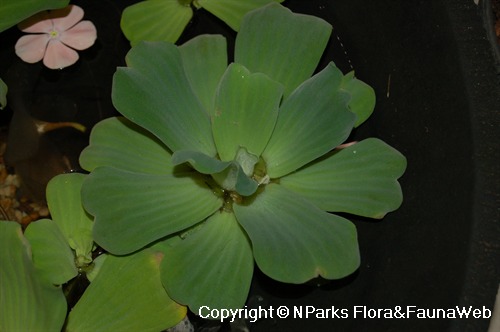
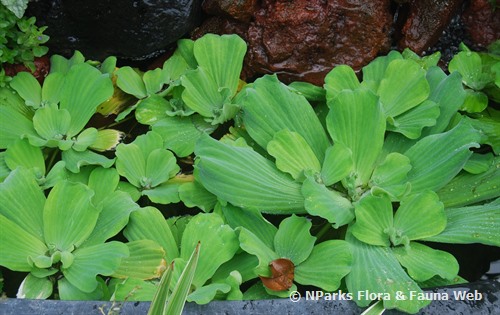
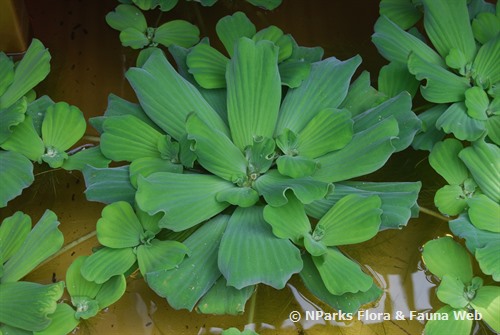
| Growth Form | It is an evergreen, herbaceous plant that form free-floating rosettes. New plants are often produced vegetatively by stolons results in large colonies. |
|---|---|
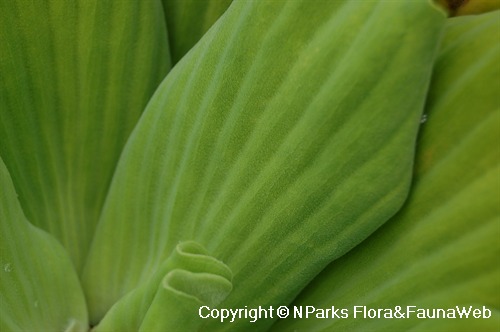
| Foliage | The leaves are fleshy, obovate (25 cm long × 10 cm wide), and arranged in rosettes that resemble flattened, loose heads of lettuce. The leaf blades are covered in soft hairs that trap air bubbles, allowing the plant to float. The hairs on the leaf underside are thicker and longer, giving a whitish-green appearance. The leaves are ribbed due to parallel venation. The leaf margin is entire or undulate. Leaf apex is truncate and slightly curled backwards. The leaves form a cuplike shape that folds inward after dark. |
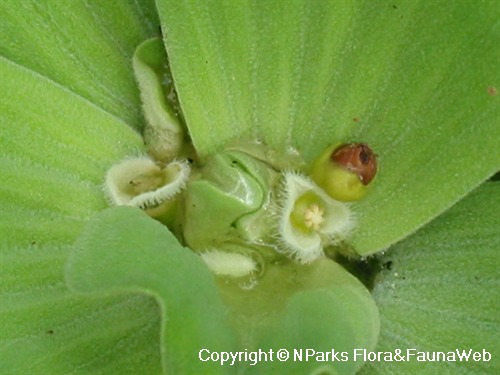
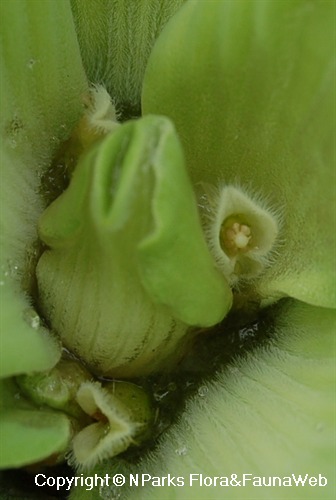
| Flowers | The inflorescence occurs at the center of the plant. The spathe is short and hairy (2 - 4 cm tall). The spadix contains 3 - 8 male flowers and 1 female flower. Folds in the spathe separate the male flowers from the female flower. Flowers may be self-pollinated or insect pollinated. |
| Fruit | The fruits are berries that contain many seeds and retain remnants of the stigma. Seeds are dispersed by water. |
| Habitat | It can be found on the surface of ponds and lakes. Sometimes, it becomes rooted in bogs. |
| Cultivation | This species is easy-to-grow; plants are simply placed on the surface of water. This species can be aggressive, so its growth must be carefully contained through consistent thinning of excess plants. Prevent the leaves from getting wet to avoid sun scorch. In hot climates, plants will benefit from partial shade. Yellowing plants can be placed in a separate container with fertilizer until they recover. After moving plants from a greenhouse to the outdoors, allow them to acclimate by protecting them from full sun. It propagated by division or separating plantlets produced on stolons that grow near the base of the parent plant. |
| Etymology | The genus Pistia is derived from the Greek pistos, 'watery'. The specific epithet stratiotes is derived from the Greek stratiótēs , 'soldier', a possible reference to the genus Stratiotes which contains an aquatic plant species with leaves shaped like swords. |
| Ethnobotanical Uses | Medicinal: In India, this plant is used as an antiseptic and a treatment for asthma and dysentery. Others: In Bengal, the leaves are fed to livestock, such as pigs and ducks. It is sometimes used as an insecticide in India. This species is used to purify water in parts of Asia, because heavy metals accumulate in its foliage. It has potential as a fuel source, because decomposing foliage releases methane gas. |
Landscaping Features
| Landscaping | This species is often used in water gardens. Plants will move across the surface of the pond according to wind direction. The presence of floating plants, like Pistia stratiotes, in water gardens helps to control excessive growth of green algae and blanketweed by competing for light and nutrients. Goldfish and koi feed on the leaves and roots of Pistia stratiotes, as well as hide among the roots. Consider decorating your patio or balcony by filling a large, shallow container with water and allowing them to float on the surface. |
|---|---|
| Desirable Plant Features | Ornamental Foliage, Ornamental Form |
| Landscape Uses | Riverine, Aquarium / Aquascape, Phytoremediation (Ground / Water Contaminant(s)), Marsh / Bog |
| Thematic Landscaping | Water Garden |
| Usage Hazard - Cons | Invasive / Potentially Invasive |
| Usage Hazard - Cons Remarks | Invasive/ Potentially Invasive: This species may become invasive, possibly clogging canals and dominating wetland environments. |
Fauna, Pollination and Dispersal
| Pollination Method(s) | Abiotic (Self-Pollinated), Biotic (Fauna) (Insects (Ant, Beetle, Fly, Thrip, Wasp)) |
|---|---|
| Seed or Spore Dispersal | Abiotic (Water) |
Plant Care and Propagation
| Light Preference | Semi-Shade, Full Sun |
|---|---|
| Water Preference | Lots of Water |
| Plant Growth Rate | Fast |
| Rootzone Tolerance | Easy to Grow |
| Maintenance Requirements | Low |
| Pest(s) | Chewing Insects |
| Propagation Method | Stolon / Runner, Division |
Foliar
| Foliage Retention | Evergreen |
|---|---|
| Mature Foliage Colour(s) | Green |
| Mature Foliage Texture(s) | Velvety / Furry / Tomentose |
| Foliar Type | Simple / Unifoliate |
| Foliar Arrangement Along Stem | Rosulate / Rosette |
| Foliar Shape(s) | Non-Palm Foliage (Obovate) |
| Foliar Venation | Parallel |
| Foliar Margin | Entire - Wavy / Undulate |
| Foliar Apex - Tip | Truncate |
| Foliar Base | Truncate / Square |
| Typical Foliar Area | Mesophyll ( 45cm2 - 182.25 cm2 ) |
Non - Foliar and Storage
| Root Type | Underground (Fibrous Root) |
|---|
Floral (Angiosperm)
| Flower Colour(s) | White |
|---|---|
| Flower Symmetry | Bilateral |
Fruit, Seed and Spore
| Mature Fruit Colour(s) | Green |
|---|---|
| Fruit Classification | Simple Fruit |
| Fruit Type | Fleshy Fruit , Berry |
Image Repository
Others
| Master ID | 1050 |
|---|---|
| Species ID | 2343 |
| Flora Disclaimer | The information in this website has been compiled from reliable sources, such as reference works on medicinal plants. It is not a substitute for medical advice or treatment and NParks does not purport to provide any medical advice. Readers should always consult his/her physician before using or consuming a plant for medicinal purposes. |