


Back
Gymnostoma sumatranum (Jungh. ex de Vriese) L.A.S.Johnson
| Family Name: | Casuarinaceae |
| Synonyms: | Casuarina sumatrana |
| Common Name: | Sumatran Ru |
Name
Classifications and Characteristics
| Plant Division | Angiosperms (Flowering Seed Plants) |
|---|---|
| Plant Growth Form | Tree |
Biogeography
| Native Distribution | Sumatra and Borneo |
|---|---|
| Native Habitat | Terrestrial |
| Preferred Climate Zone | Tropical |
| Local Conservation Status | Non-native |
Description and Ethnobotany
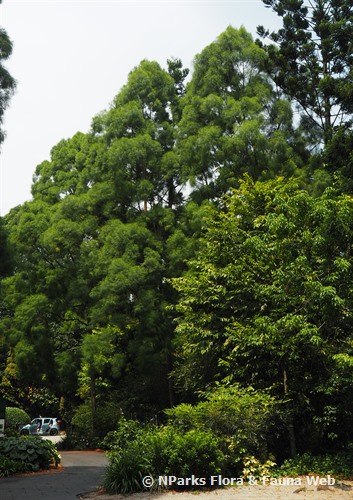
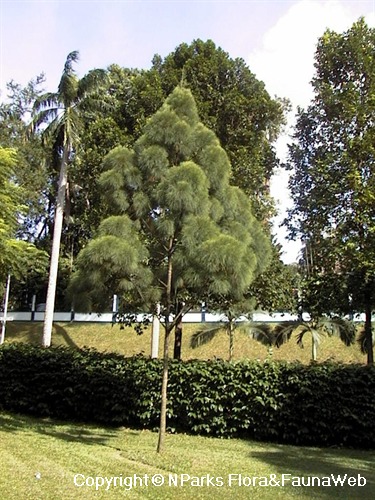
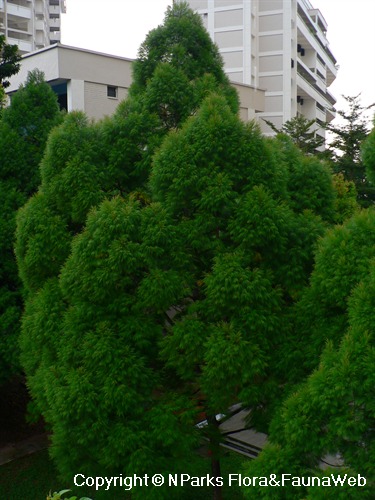
| Growth Form | It is a tree, up to 20 m tall with twisted or shortly fluted buttress. |
|---|---|
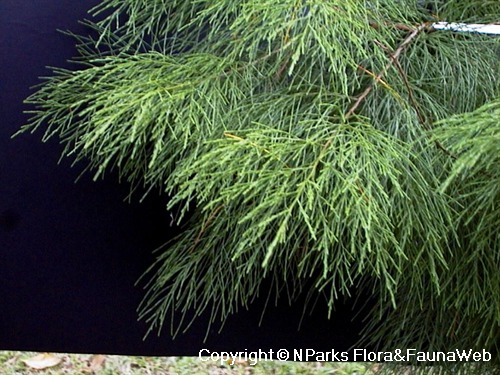
| Foliage | Twigs are needle-like with many short lateral branches, giving a soft bushy appearance. Internodes are short (0.2 – 0.3 cm long). Leaves are scale-like and wrap around the needle-like twigs. |
| Flowers | Male flowers occur at the terminal in the form spike, while female flowers occur at the terminal in the form of a compacted head (capitate) structure. |
| Fruit | Cones are elliptic (2.5 cm long and 4.5 cm wide), woody, and each comprises of 20 – 35 fruitlets. |
| Habitat | It is found on hill forest and ultramafic soil, 600 – 1800 m altitude. |
| Etymology | Gymnos, is Greek for exposed; stoma, is Greek for minute opening, which refers to the position of the stomata in the grooves of needle-twigs. Specific epithet means that this species originates from Sumatra. |
Plant Care and Propagation
| Light Preference | Full Sun |
|---|---|
| Water Preference | Moderate Water |
| Plant Growth Rate | Moderate to Slow |
Foliar
| Mature Foliage Colour(s) | Green |
|---|---|
| Leaf Area Index (LAI) for Green Plot Ratio | 3.0 (Tree - Intermediate Canopy) |
Fruit, Seed and Spore
| Mature Fruit Colour(s) | Brown |
|---|
Image Repository
Others
| Master ID | 1502 |
|---|---|
| Species ID | 2795 |
| Flora Disclaimer | The information in this website has been compiled from reliable sources, such as reference works on medicinal plants. It is not a substitute for medical advice or treatment and NParks does not purport to provide any medical advice. Readers should always consult his/her physician before using or consuming a plant for medicinal purposes. |