




Back
Xanthophyllum obscurum Benn.
| Family Name: | Polygalaceae |
| Common Name: | Buah Kapas, Lima Berok, Mengkapas |
Name
Classifications and Characteristics
| Plant Division | Angiosperms (Flowering Seed Plants) (Dicotyledon) |
|---|---|
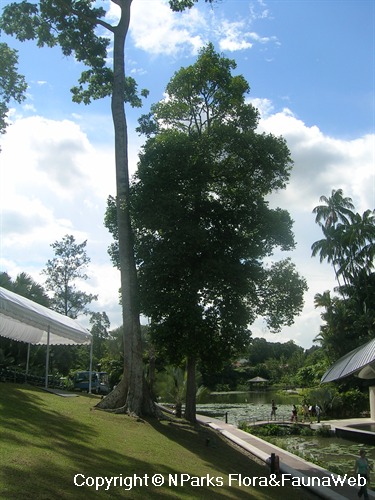
| Plant Growth Form | Tree (Big (>30m)) |
| Lifespan (in Singapore) | Perennial |
| Mode of Nutrition | Autotrophic |
| Plant Shape | Irregular |
| Maximum Height | 47 m |
Biogeography
| Native Distribution | South Thailand, Sumatra, Peninsular Malaysia, Singapore, and Borneo |
|---|---|
| Native Habitat | Terrestrial (Primary Rainforest, Mountain, Secondary Rainforest) |
| Preferred Climate Zone | Tropical |
| Local Conservation Status | Native to Singapore (Critically Endangered (CR)) |
Description and Ethnobotany
| Growth Form | It is a tree up to 47 m tall. |
|---|---|
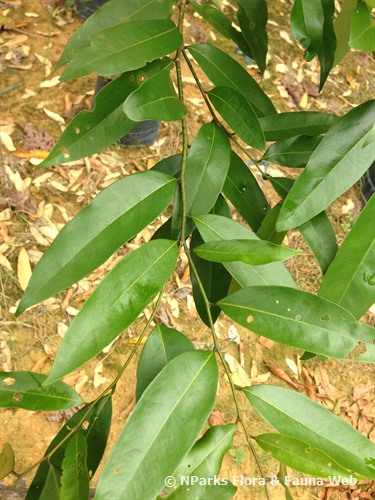
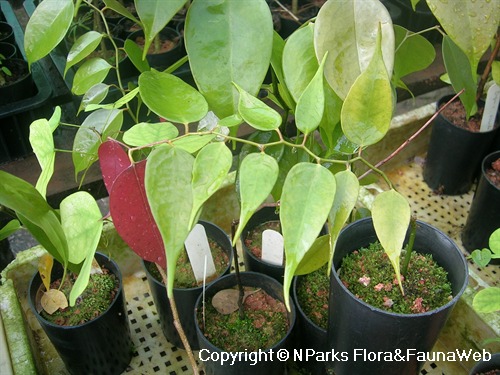
| Foliage | Its alternate, stalked leaves have leaf blades that are egg-shaped to elliptic, and 4–17 by 1.5–9 cm, without small projections below. 2–16 glands are located near or on the leaf blade margins. |
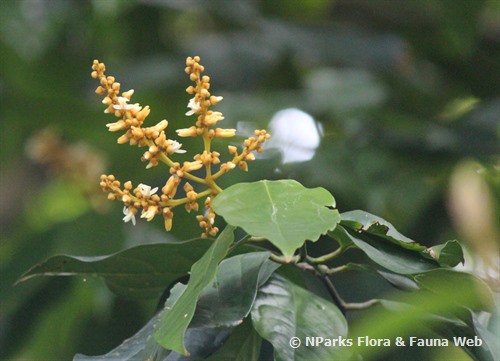
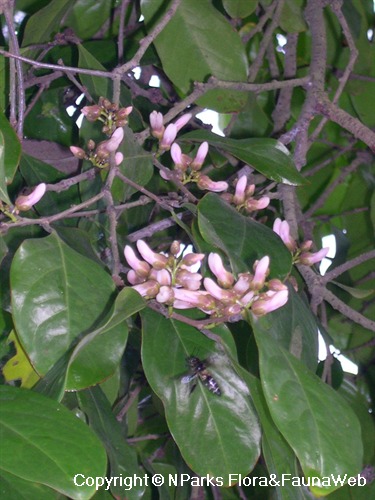
| Flowers | Its unbranched flowering shoots are shorter than the leaves and sometimes found on the older nodes. Its flowers have 5 unequal, white or purple petals, the upper ones with a yellow or green spot. The lateral petals are spatula-shaped, while the lower one is boat-shaped. |
| Fruit | Its fruits are round berries, up to 1.4 cm across, and each contains 8–16 seeds in white, fleshy fruit pulp. The seeds stick together like a ball when dry and are up to 2–6 cm across each. |
| Habitat | It grows in lowland primary forests, on hillsides, and in lower montane forests, up to 1800 m altitude. |
| Associated Fauna | Its flowers are insect-pollinated, and fruits eaten by mammals. |
| Cultivation | It can be propagated by seed. |
| Etymology | Greek xanthos, yellow; Greek phullon, leaf, referring to the leaves that are often yellow when dry; Latin obscurus, dark, referring to the colour of the dried flowers and fruits |
| Ethnobotanical Uses | Edible Plant Parts : Edible Fruits Food (Fruit or Vegetable): The fleshy fruit pulp is edible. Timber & Products: The timber is moderately hard, but not durable. |
Landscaping Features
| Landscaping | It is suitable for parks. |
|---|---|
| Landscape Uses | Parks & Gardens |
Fauna, Pollination and Dispersal
| Pollination Method(s) | Biotic (Fauna) |
|---|---|
| Seed or Spore Dispersal | Biotic (Fauna) |
Plant Care and Propagation
| Light Preference | Full Sun |
|---|---|
| Water Preference | Moderate Water |
| Plant Growth Rate | Moderate |
| Rootzone Tolerance | Moist Soils, Well-Drained Soils, Fertile Loamy Soils |
| Propagation Method | Seed |
Foliar
| Foliage Retention | Evergreen |
|---|---|
| Mature Foliage Colour(s) | Green |
| Mature Foliage Texture(s) | Leathery |
| Foliar Type | Simple / Unifoliate |
| Foliar Arrangement Along Stem | Alternate |
| Foliar Attachment to Stem | Petiolate |
| Foliar Shape(s) | Non-Palm Foliage (Ovate, Elliptical) |
| Foliar Venation | Pinnate / Net |
| Foliar Margin | Entire |
| Leaf Area Index (LAI) for Green Plot Ratio | 3.0 (Tree - Intermediate Canopy) |
Floral (Angiosperm)
| Flower & Plant Sexuality | Bisexual Flowers |
| Flower Colour(s) | Pink, Purple, White |
|---|---|
| Flower Grouping | Cluster / Inflorescence |
| Flower Location | Axillary |
| Flower Symmetry | Bilateral |
Fruit, Seed and Spore
| Fruit Classification | Simple Fruit |
|---|---|
| Fruit Type | Fleshy Fruit , Non-Accessory Fruit |
Image Repository
Others
| Master ID | 1906 |
|---|---|
| Species ID | 3199 |
| Flora Disclaimer | The information in this website has been compiled from reliable sources, such as reference works on medicinal plants. It is not a substitute for medical advice or treatment and NParks does not purport to provide any medical advice. Readers should always consult his/her physician before using or consuming a plant for medicinal purposes. |