




Back
Cenchrus purpurascens Thunb.
| Family Name: | Poaceae (Gramineae) |
| Synonyms: | Pennisetum alopecuroides (L.) Spreng. |
| Common Name: | Chinese Fountain Grass, Swamp Foxtail Grass, Swamp Foxtail, Chinese Pennisetum, 狼尾草, 狗尾草, 大狗草, 狗仔尾, 小芒草, 油包草 |
Name
Classifications and Characteristics
| Plant Division | Angiosperms (Flowering Seed Plants) (Monocotyledon) |
|---|---|
| Plant Growth Form | Grass or Grass-like Plant (Tall Grass (Poaceae)) |
| Lifespan (in Singapore) | Perennial |
| Mode of Nutrition | Autotrophic |
| Plant Shape | Grassy |
| Maximum Height | 1 m |
| Maximum Plant Spread / Crown Width | 0.5 m to 0.6 m |
Biogeography
| Native Distribution | Eastern Himalayas, China, Korea, Japan, Myanmar, Vietnam, Peninsular Malaysia, Borneo, the Philippines, Java, Andaman Islands, & northwestern & eastern Australia |
|---|---|
| Native Habitat | Terrestrial (Grassland / Savannah/ Scrubland, Agricultural Land) |
| Preferred Climate Zone | Temperate |
| Local Conservation Status | Non-native (Horticultural / Cultivated Only) |
Description and Ethnobotany
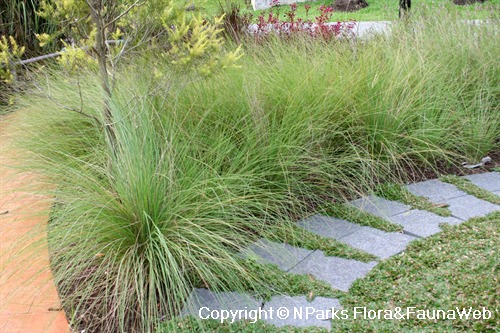
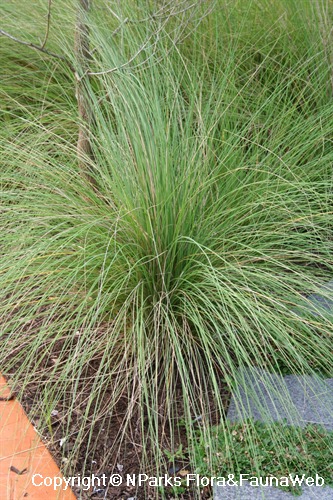
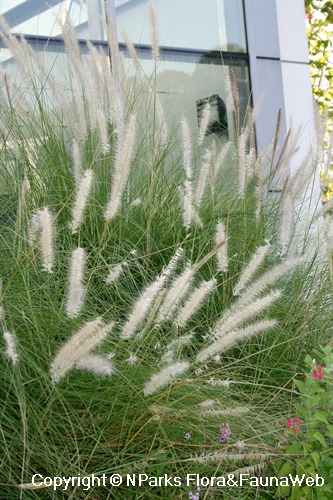
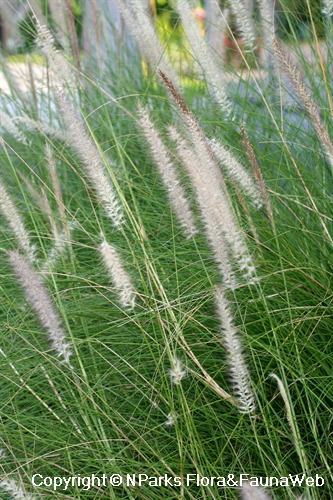
| Growth Form | It is a perennial clump-forming grass that grows up to 1 m tall (occasionally up to 1.5 m tall). |
|---|---|
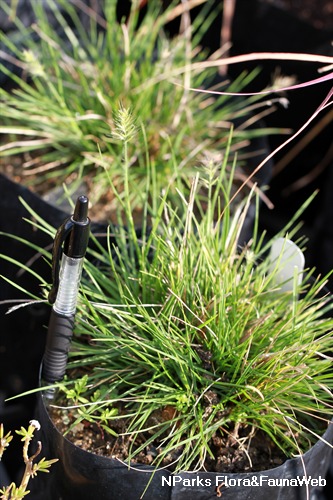
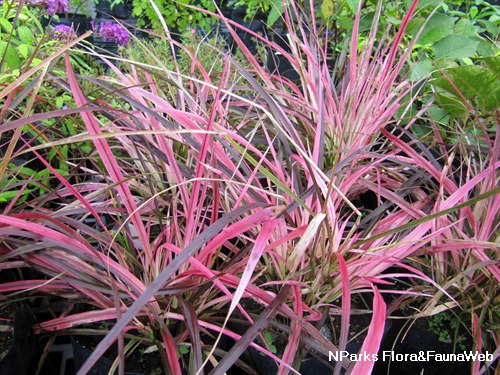
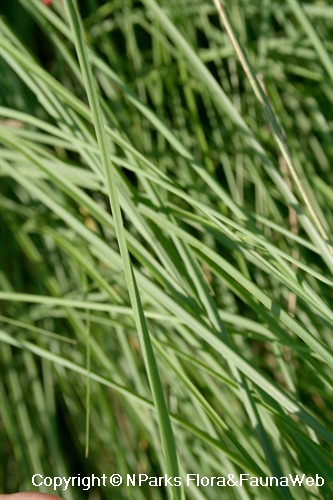
| Foliage | The leaves are green, narrow, flat, thread-like, and held erect or drooping, reaching 10–45 cm long × 3–6 mm wide. The leaf margins are smooth. The leaf sheaths are folded inwards, forming a V cross-section. The ligules (projection at the top of the leaf sheath) are present as fringes of hair, up to 0.5–0.75mm long. The leaves are arranged alternately in two ranks |
| Stems | The culms (aboveground stems of grasses and grass-like monocots) are erect, growing up to 0.2–0.8 m tall. |
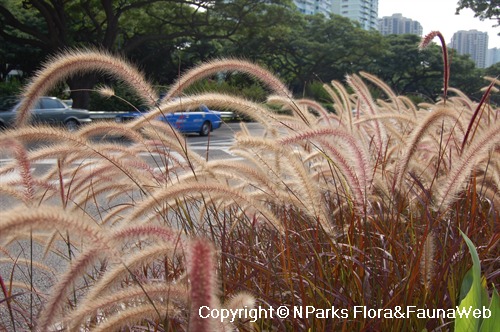
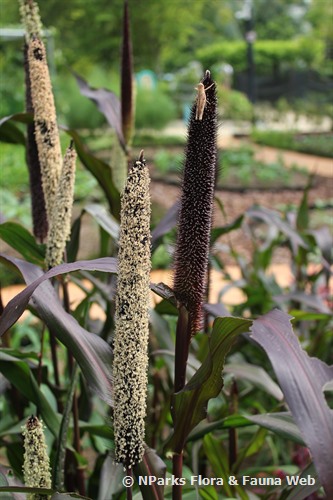
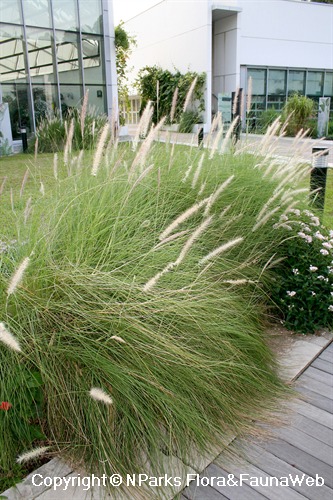
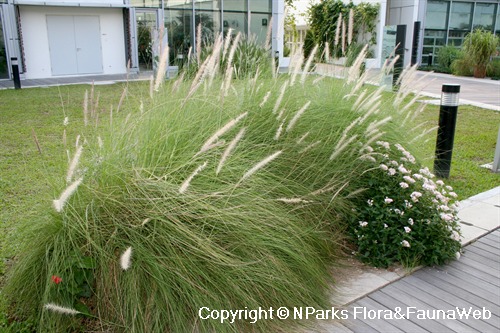
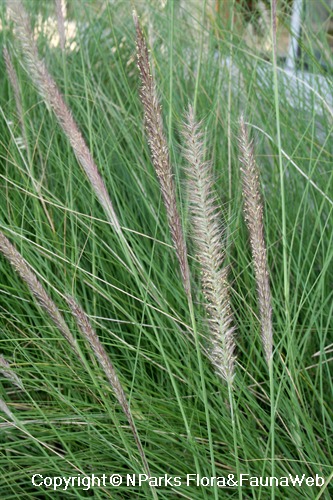
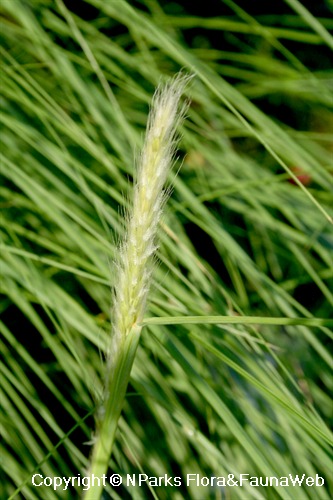
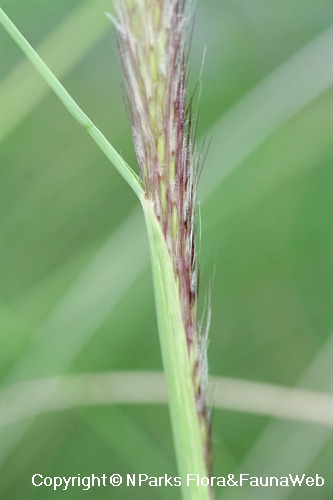
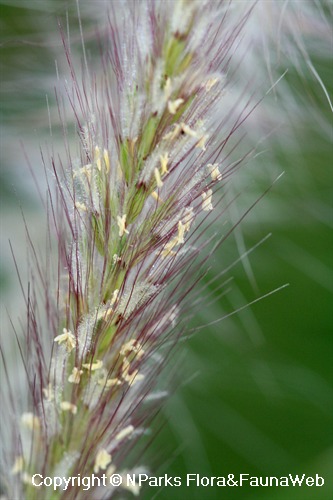
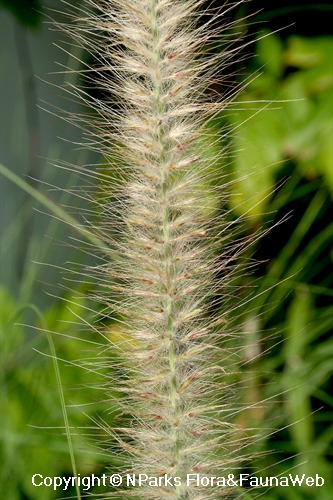
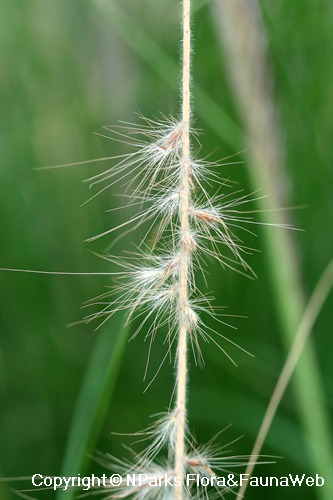
| Flowers | The inflorescence is a foxtail-like panicle with whitish, greenish and/or purple bristles and spikelets. The bristles are stiff and of unequal lengths, varying from 8–30 mm long. Each spikelet is 5–8 mm long and comprises a single fertile floret, each consisting of heavily reduced petals and sepals, anthers, and stigmas. The lower glume is reduced to a tiny, translucent scale while the upper glume reaches about a third or two-thirds of the total spikelet length. Fertile lemmas (the two bracts enclosing a grass floret) are present, being lanceolate and 6–8 mm long. Sterile lemmas (the remaining highly reduced, bracts of vestigial florets) are also present at the base of the single floret. |
| Fruit | The fruit is a caryopsis (a type of dry, indehiscent fruit, commonly known as a grain). Local cultivated plants does not seem to be successfully self-seeding under local conditions. |
| Habitat | It can be found on grassy hillsides, meadows, roadsides, and field margins, from 0 to 3200 m above sea level. |
| Cultivation | It is best grown under full sun and in moist, well-drained soils. Established plants are drought-tolerant once established. Foliage may be cut back to two-thirds of its height yearly to rejuvenate the plant and produce new growth. Plant tends to be open up in the center with age. Slow-release phosphorus-rich fertilizer may be added to soil mix during planting, but fertilisation is generally not necessary after establishment. Excess nutrients may suppress flower formation. It can be propagated by division. |
| Etymology | The genus Cenchrus is derived from the Greek cenchros, "millet", although the scientific name for the common millet is Panicum miliaceum. The specific epithet purpurascens is Latin for "becoming purple," probably referring to the bristles. |
| Ethnobotanical Uses | Edible Plant Parts : Edible Seeds Agriculture - Forestry: It is used as grazing for sheep and horses when young but too tough for cattle. <1&4> Cut - Dried Flower: The inflorescence can be used in bouquets. <2> Others: Food: Seeds can be grounded into powder and used as flour. <3> It is used as a famine food in India. <4> |
Landscaping Features
| Landscaping | Plants are best grown in large quantities in landscape for a bigger impact. |
|---|---|
| Desirable Plant Features | Ornamental Flowers, Ornamental Form |
| Landscape Uses | General, Parks & Gardens, Flowerbed / Border, Container Planting |
| Thematic Landscaping | Silver Garden, Wildflower Garden, Zen / Minimalist Garden |
Fauna, Pollination and Dispersal
| Pollination Method(s) | Abiotic (Wind) |
|---|---|
| Seed or Spore Dispersal | Abiotic (Wind) |
Plant Care and Propagation
| Light Preference | Full Sun |
|---|---|
| Water Preference | Moderate Water |
| Plant Growth Rate | Moderate |
| Rootzone Tolerance | Well-Drained Soils, Poor Infertile Soils, Disease / Pest Resistant, Moist Soils, Drought Tolerant |
| Maintenance Requirements | Moderate |
| Pruning | Cut back old foliage by two-thirds of its length once a year during active growth. |
| Fertilizing | Use low-phosphorus slow-release fertilizer in potting mix, or apply liquid fertilizer during cultivation. Once planted out, generally does not require fertilization as excessive nutrients may suppress inflorescence production. |
| Propagation Method | Division |
| Planting Distance | 0.9 m to 1.2 m |
Foliar
| Foliage Retention | Evergreen |
|---|---|
| Mature Foliage Colour(s) | Green |
| Mature Foliage Texture(s) | Smooth |
| Foliar Type | Simple / Unifoliate |
| Foliar Arrangement Along Stem | Alternate |
| Foliar Attachment to Stem | Sessile |
| Foliar Shape(s) | Non-Palm Foliage (Linear) |
| Foliar Venation | Parallel |
| Foliar Margin | Entire |
| Foliar Apex - Tip | Acuminate |
| Typical Foliar Area | Mesophyll ( 45cm2 - 182.25 cm2 ) |
| Leaf Area Index (LAI) for Green Plot Ratio | 3.5 (Shrub & Groundcover - Monocot) |
| Typical Foliar Size | 80 cm |
Non - Foliar and Storage
| Stem Type & Modification | Culm |
|---|---|
| Root Type | Underground (Fibrous Root) |
Floral (Angiosperm)
| Flower & Plant Sexuality | Bisexual Flowers |
| Flower Colour(s) | Purple, White |
|---|---|
| Flower Grouping | Cluster / Inflorescence |
| Flower Location | Terminal |
| Inflorescence Type | Spikelet / Pseudospikelet / Compound Spike, Panicle |
| Flowering Period | Free-Flowering |
| Flower Lifespan on Plant | Several Weeks |
| Flowering Habit | Polycarpic |
Fruit, Seed and Spore
| Fruit Classification | Simple Fruit |
|---|---|
| Fruit Type | Indehiscent Dry Fruit , Caryopsis / Grain |
| Seed Quantity Per Fruit | Few (1-5) |
References
| References | <1> 6. Pennisetum alopecuroides (Linnaeus) Sprengel, Syst. Veg. 1: 303. 1825. http://www.efloras.org/florataxon.aspx?flora_id=2&taxon_id=200025851 (Accessed 29 Jan 2026) <2> Darke, Rick. (2007). The Encyclopedia of Grasses for Livable Landscapes. USA: Timber Press. 487pp. <3> Tanaka, T. & Nakao, S. (1976). Tanaka's cyclopedia of edible plants of the world. Keigaku Publishing Co. <4> Veldkamp, J.F. (2014). A revision of Cenchrus incl. Pennisetum (Gramineae) in Malesia with some general nomenclatural notes. Blumea 59, pp 70. |
|---|
Image Repository
Others
| Master ID | 15637 |
|---|---|
| Species ID | 3333 |
| Flora Disclaimer | The information in this website has been compiled from reliable sources, such as reference works on medicinal plants. It is not a substitute for medical advice or treatment and NParks does not purport to provide any medical advice. Readers should always consult his/her physician before using or consuming a plant for medicinal purposes. |