




Back
Euphorbia coalcomanensis
| Family Name: | Euphorbiaceae |
| Synonyms: | Pedilanthus coalcomanensis |
| Common Name: | Little Bird Plant, Candle Cactus, Bird Flower Plant, Candelilla |
Name
Classifications and Characteristics
| Plant Division | Angiosperms (Flowering Seed Plants) (Dicotyledon) |
|---|---|
| Plant Growth Form | Herbaceous Plant |
| Lifespan (in Singapore) | Perennial |
| Mode of Nutrition | Autotrophic |
| Plant Shape | Irregular |
Biogeography
| Native Distribution | Mexico |
|---|---|
| Native Habitat | Terrestrial |
| Preferred Climate Zone | Sub-Tropical / Monsoonal |
| Local Conservation Status | Non-native (Horticultural / Cultivated Only) |
Description and Ethnobotany
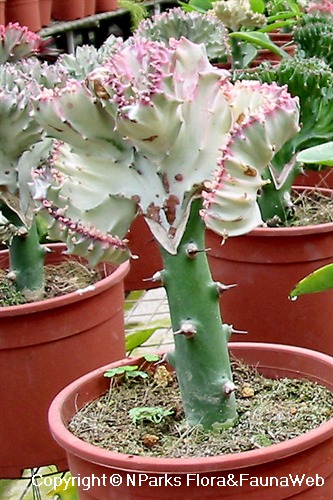
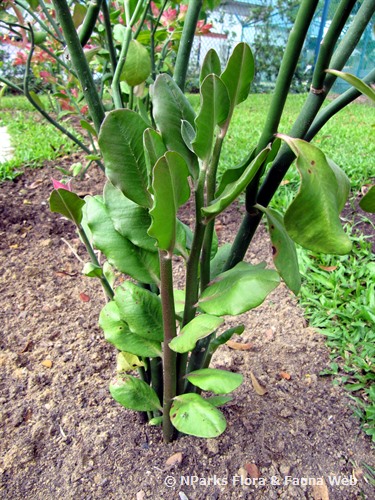
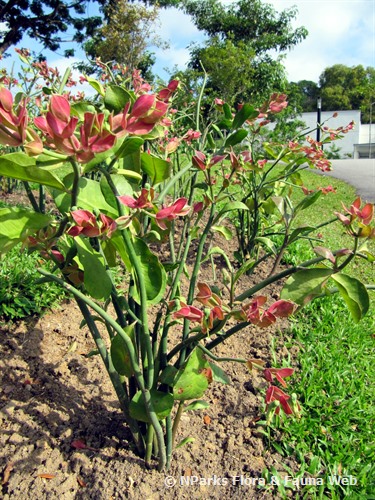
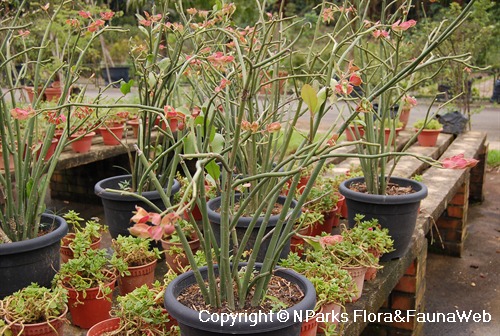
| Growth Form | Succulent shrub growing up to 2 m tall. |
|---|---|
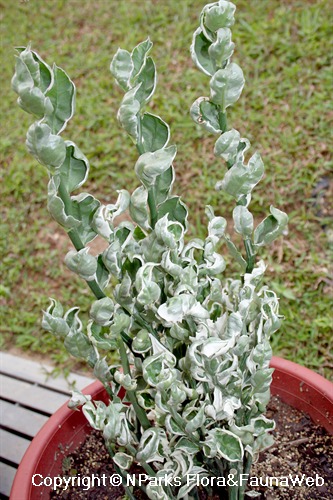
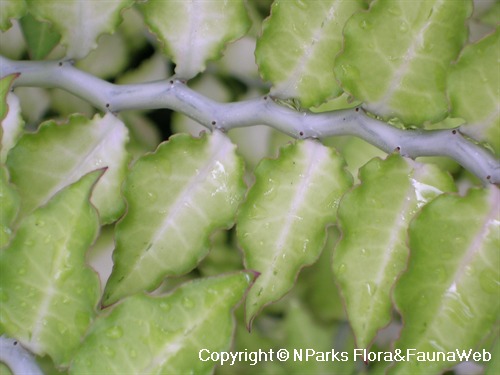
| Foliage | Green, fuzzy leaves are oval to oblong with entire leaf margin and rounded apex. |
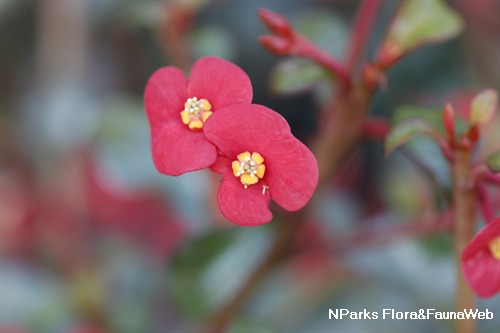
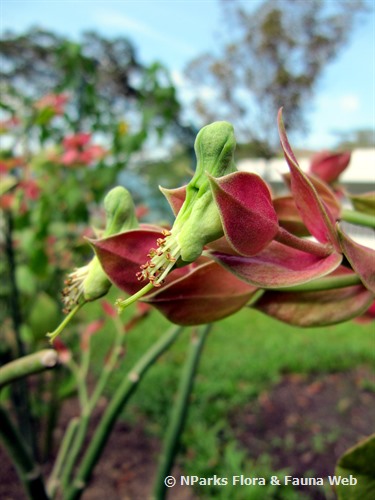
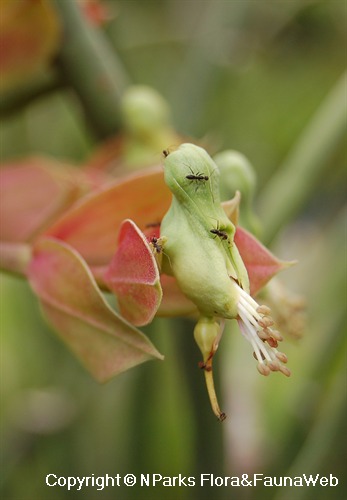
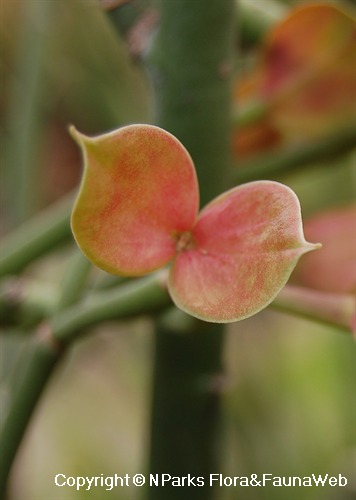
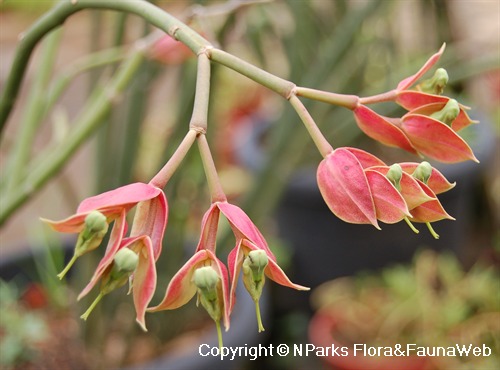
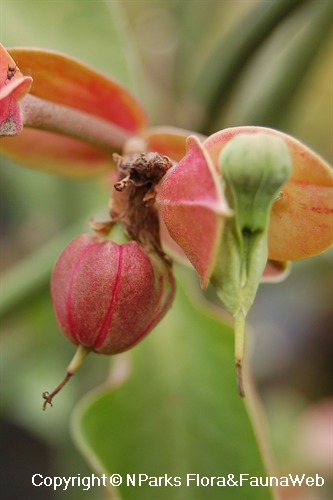
| Flowers | Flowers have pink to red bracts (modified leaves) that are oval-shaped with a sharply-pointed tip. The inflorescence (known as a cyathia) is cream to bright green and shaped like a bird. Each cyathia is partly enclosed by a pair of bracts. The numerous stamens bundled together resemble a bird's tail. |
| Habitat | Occurs in seasonal tropical dry forests. |
| Cultivation | This species grows best in well-drained soil that is kept on the dry side. |
| Etymology | The genus Euphorbia means Euphorbus, the physician to the King of Mauritiana, who used the latex of a spurge for medicinal purposes. |
| Ethnobotanical Uses | Others: The plant is said to be the source of candelila wax, which is used in the same way as carnauba wax, to make candles, polishes and varnish. |
Landscaping Features
| Landscaping | The plant is suitable as a specimen or grown in mass for screening. It also provides an excellent backdrop with lower-growing plants or ground covers in the front of the landscape. It is also suitable for xeriscaping as it is tolerant to drought after established. |
|---|---|
| Desirable Plant Features | Ornamental Flowers |
| Landscape Uses | Hedge / Screening, Flowerbed / Border, Container Planting |
| Thematic Landscaping | Rockery / Desert Garden |
| Usage Hazard - Cons | Irritant - Sap |
Plant Care and Propagation
| Light Preference | Full Sun |
|---|---|
| Water Preference | Little Water |
| Plant Growth Rate | Fast to Moderate |
| Rootzone Tolerance | Drought Tolerant, Well-Drained Soils |
| Pruning | Prune the flowering stalks after blooming stops, to induce branching and increase flowering. |
| Fertilizing | Fertilize once a month with a balanced fertilizer. |
| Potential Problems | Mealybugs |
| Propagation Method | Stem Cutting |
Foliar
| Foliage Retention | Evergreen |
|---|---|
| Mature Foliage Colour(s) | Green |
| Mature Foliage Texture(s) | Leathery |
| Prominent Young Flush Colour(s) | Green |
| Young Flush Texture(s) | Leathery |
| Foliar Modification | Flower/Fruit Bract |
| Foliar Type | Simple / Unifoliate |
| Foliar Arrangement Along Stem | Alternate |
| Foliar Attachment to Stem | Petiolate |
| Foliar Shape(s) | Non-Palm Foliage |
| Foliar Venation | Pinnate / Net |
| Foliar Margin | Entire |
| Foliar Apex - Tip | Acute |
| Foliar Base | Acute |
Floral (Angiosperm)
| Flower & Plant Sexuality | Unisexual Flowers |
| Flower Colour(s) | Cream / Off-White, Green, Pink, Red |
|---|---|
| Flower Texture(s) | Smooth |
| Flower Grouping | Cluster / Inflorescence |
| Flower Location | Axillary |
| Flower Symmetry | Bilateral |
| Inflorescence Type | Cyathium |
| Flowering Period | Free-Flowering |
| Flowering Habit | Polycarpic |
Image Repository
Others
| Master ID | 29851 |
|---|---|
| Species ID | 4160 |
| Flora Disclaimer | The information in this website has been compiled from reliable sources, such as reference works on medicinal plants. It is not a substitute for medical advice or treatment and NParks does not purport to provide any medical advice. Readers should always consult his/her physician before using or consuming a plant for medicinal purposes. |